
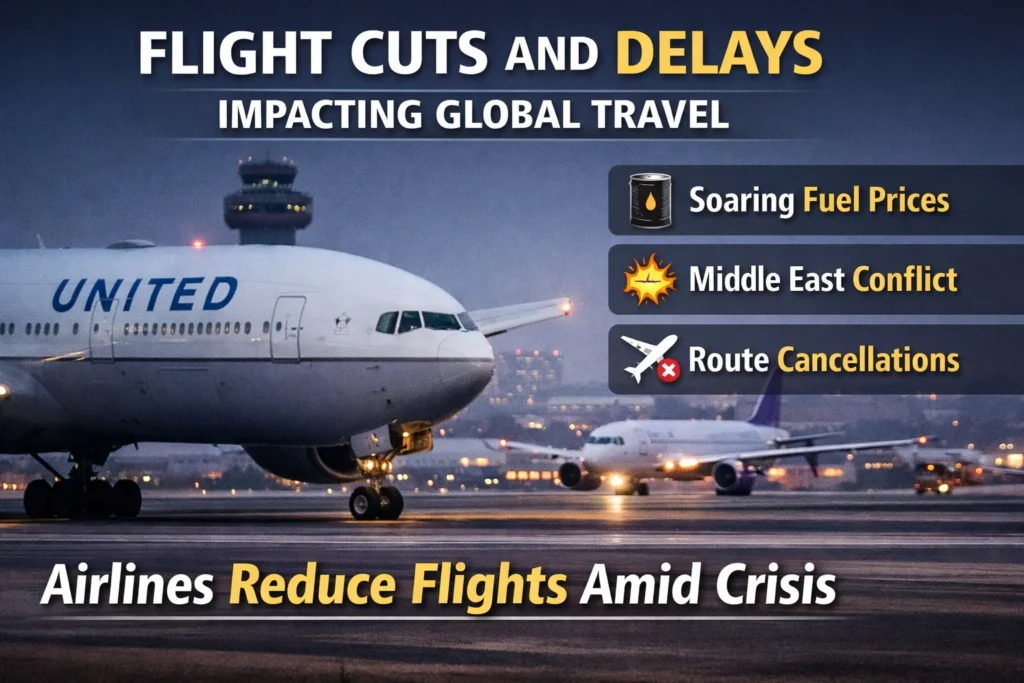
Global air travel is entering a turbulent phase as airlines respond to soaring fuel costs and escalating geopolitical tensions in the Middle East. Major carriers, including United Airlines, are cutting hundreds of flights through 2026, creating widespread disruptions for both business and leisure travellers.
The decision comes as jet fuel prices surge sharply due to instability in key energy-producing regions. Combined with restricted airspace and longer flight routes, airlines are facing mounting operational challenges that are reshaping schedules worldwide.
United Airlines Reduces Capacity Amid Rising Costs
United Airlines has announced a significant reduction in its flight schedule, cutting approximately 5 percent of its planned operations between April and September 2026. The move is aimed at offsetting the steep increase in fuel prices, which are expected to climb to record levels as supply chains face disruption.
The airline is focusing on trimming less profitable routes, particularly midweek and overnight services, while prioritizing high-demand destinations. This strategic adjustment reflects a broader industry trend, as carriers attempt to balance financial sustainability with passenger demand.
Passengers travelling across Europe, Asia, and the Middle East are among those most affected, with fewer available flights and limited options for rebooking.
Airspace Restrictions Complicate Global Routes
The ongoing conflict has led to the closure or restriction of several key air corridors, particularly in and around the Middle East. These routes are critical for long-haul travel between Europe, Asia, and beyond.
As airlines avoid affected airspace, flights are being rerouted along longer paths, increasing travel times and fuel consumption. This not only raises operational costs but also contributes to delays and scheduling disruptions across global networks.
Airports that serve as major transit hubs are experiencing congestion, as rerouted flights converge on alternative corridors. The result is a cascading effect, with delays spreading across multiple regions and impacting connecting passengers.
Broader Industry Response to the Crisis
United Airlines is not alone in scaling back operations. Other carriers, including Air New Zealand and Scandinavian Airlines, have also reduced flight schedules in response to rising fuel costs and operational challenges.
Some airlines are grounding aircraft or cutting frequencies on selected routes, particularly those with lower passenger demand. While carriers with fuel hedging strategies may be temporarily shielded from price spikes, the long-term outlook remains uncertain as global energy markets fluctuate.
The aviation sector is now navigating a delicate balance between maintaining service levels and managing escalating costs.
Impact on Business and Leisure Travel
The reduction in flights is having a noticeable impact on travellers worldwide. Business travellers are facing difficulties in securing seats on preferred routes, with reduced frequencies leading to tighter schedules and increased fares.
For leisure travellers, the situation is equally challenging. Popular destinations across Europe, the Middle East, and Asia are becoming harder to reach due to limited flight availability. Higher ticket prices, driven by increased fuel costs and reduced capacity, are also affecting travel budgets.
Holiday plans are being disrupted as passengers encounter delays, cancellations, and longer travel times. The uncertainty surrounding flight schedules is prompting many travellers to reconsider or postpone trips.
Rising Costs and Limited Availability
With fewer flights in operation, demand for available seats is intensifying. This imbalance is pushing ticket prices higher, particularly on long-haul routes where alternatives are limited.
Travellers may also face additional expenses, including extended layovers, accommodation costs due to missed connections, and higher insurance premiums. The overall cost of travel is rising, making it more important than ever for passengers to plan carefully.
Airlines are offering rebooking options and refunds in many cases, but availability can be constrained, especially during peak travel periods.
Environmental Concerns Add Pressure
The shift to longer flight paths is not only increasing costs but also raising environmental concerns. Extended routes result in higher fuel consumption and greater carbon emissions, adding pressure on the aviation industry to address sustainability challenges.
As environmental awareness grows, both airlines and travellers are being encouraged to consider more sustainable travel practices. However, the current crisis highlights the difficulty of balancing environmental goals with operational realities during periods of geopolitical instability.
What Travellers Should Do
In this rapidly changing travel environment, staying informed is essential. Passengers are advised to monitor flight updates regularly and maintain communication with airlines for the latest information.
Booking flexible tickets can provide greater security, allowing travellers to adjust plans if disruptions occur. Reviewing travel insurance policies is also important, as coverage for delays and cancellations can help mitigate financial losses.
Allowing extra time for connections and being prepared for longer journeys can reduce stress and improve the overall travel experience.
Outlook for the Aviation Industry
The combination of rising fuel costs and geopolitical tensions is creating one of the most challenging periods for global aviation in recent years. Airlines are being forced to adapt quickly, making difficult decisions about routes, capacity, and pricing.
While the situation remains fluid, the impact on travel is expected to continue throughout 2026. Recovery will depend on stabilizing energy markets, easing airspace restrictions, and restoring confidence among travellers.
For now, flexibility and preparedness are key. As airlines adjust to this new reality, passengers must navigate a travel landscape defined by uncertainty, higher costs, and evolving challenges.
For more travel news like this, keep reading Global Travel Wire