London Heathrow Airport has completed one of the most significant aviation security transformations seen in nearly two decades, marking the end of the familiar ritual of removing liquids and electronic devices at airport security. With the full installation of next-generation CT security scanners across all terminals, passengers can now keep laptops, tablets, and liquids inside their carry-on bags—eliminating a longstanding frustration that defined modern air travel for millions of people around the world.
The change signals a major upgrade in how airports balance passenger experience with aviation security. For travellers passing through the UK’s busiest international hub, the new process promises faster checkpoints, fewer bottlenecks during peak travel months, and a far more seamless beginning to the airport journey. It also introduces one of the most passenger-friendly shifts in aviation regulations since the early 2000s, when liquid restrictions were first imposed in response to global security concerns.
End of a Two-Decade Security Habit
Liquid restrictions were introduced in 2006 and quickly became a standard across airports globally. Travellers grew accustomed to decanting toiletries into 100-millilitre containers, sealing them in transparent plastic bags, and placing laptops in separate trays. Over time, what began as a temporary emergency measure evolved into a permanent and widely disliked travel norm.
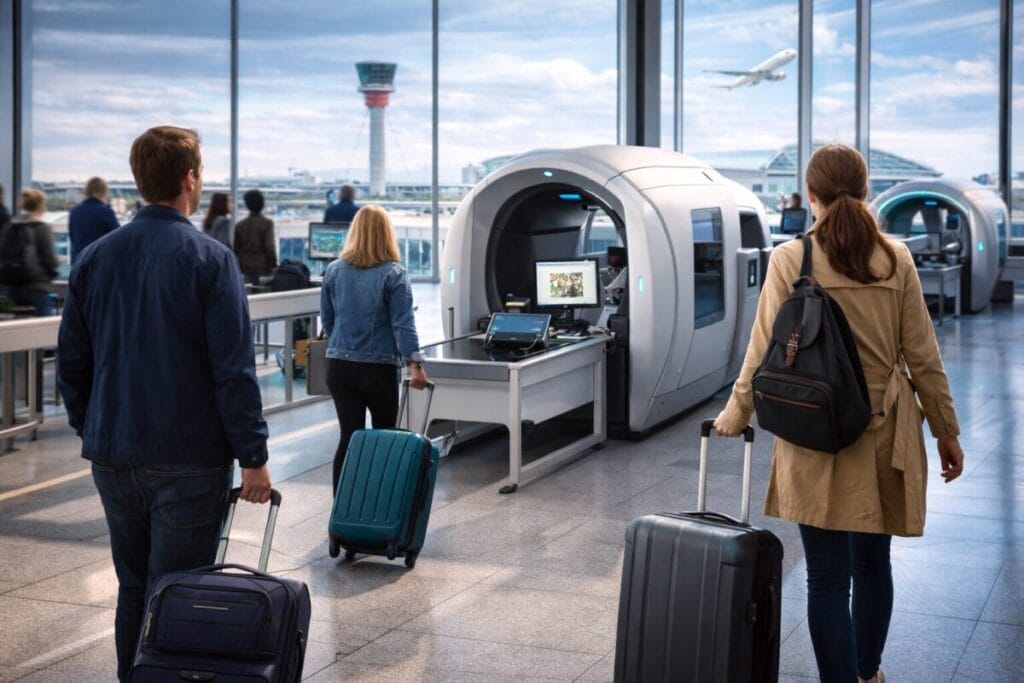
Heathrow’s new scanners eliminate the need for most of those steps. The CT systems operate in a similar way to medical computed tomography devices, producing high-resolution 3D imagery that allows security teams to inspect bag contents digitally, rotate objects virtually, and identify prohibited items without physical unpacking.
Passengers may now bring liquids up to two litres in capacity—twenty times greater than previous limits—and leave them in their hand luggage. The shift removes one of the airport’s most time-consuming choke points and signals a broader movement toward modernised airport screening across the aviation sector.
Fewer Queues, Lower Stress, Faster Throughput
For travellers, the impact extends beyond convenience. Heathrow security has historically been one of the busiest pressure points in the airport journey, especially at peak holiday periods, during business travel rush hours, and at connecting bank times. By reducing manual searches and re-tray procedures, overall throughput is expected to increase noticeably.
The benefits are particularly meaningful for:
- Families travelling with children and multiple bags
- Business travellers with laptops and devices
- Passengers connecting between international flights
- Travellers with mobility or accessibility needs
The reduction in manual intervention also means fewer belongings at risk of being misplaced at checkpoints—a common airport pain point for passengers.
Sustainability Gains Through Reduced Plastic Waste
Beyond efficiency, the elimination of the small plastic liquid bag requirement has environmental implications. Millions of single-use bags are distributed at airports each year, most of which are thrown away immediately after screening. By removing the need for separate packing, Heathrow’s upgrades support sustainability goals and align with industry-wide efforts to reduce plastic waste across the travel ecosystem.
A Major Investment in Aviation Technology
Heathrow’s upgrade ranks among the most ambitious security technology investments undertaken by an airport of its scale. The project required redesigned lanes, new equipment, extensive staff training, and regulatory validation. With more than a billion passengers having travelled through Heathrow over the past 20 years, the ability to modernise screening at such volume is seen as a benchmark for other major hubs.
The rollout also positions Heathrow at the front edge of a global transition. Several UK airports, including Birmingham, Bristol, and London Gatwick, have introduced similar scanners, although deployment timelines have varied due to supply chain and certification constraints.
A Global Transition Already Underway
Beyond the UK, airports across Europe, North America, and Asia have begun adopting CT screening, though rules remain inconsistent internationally. Some airports now allow larger liquid volumes or relaxed screening, while others continue to enforce the traditional 100-millilitre limit. This means passengers must remain attentive to guidance on return or connecting flights, particularly when travelling through multi-airport itineraries.
Despite ongoing variations, aviation authorities agree that CT technology marks the long-term direction of travel for airport security. The systems are considered more accurate, more efficient, and less disruptive to passengers.
Implications for Airlines and Airport Operations
Airlines and airport operators also stand to benefit. Faster processing at checkpoints reduces queueing, decreases missed flights related to security delays, and improves punctuality across schedules. Enhancing the security experience also carries reputational value—particularly for hub airports where competition for transfer traffic is increasing.
A Passenger-Centric Airport Experience
By eliminating liquid and laptop restrictions, Heathrow shifts closer to what travellers increasingly expect from modern air transport: simplicity, speed, and less stress. The move fits within a broader industry shift where airports are investing in digital border control, contactless processing, biometric immigration, and automation to streamline the end-to-end journey.
For travellers who have long viewed security as the most inconvenient part of flying, Heathrow’s transformation marks a long-anticipated milestone. It suggests that the era of tiny bottles and plastic bags is nearing its end—and that the next generation of flying may feel just a little more like the seamless experience travellers have been waiting for.
For more travel news like this, keep reading Global Travel Wire