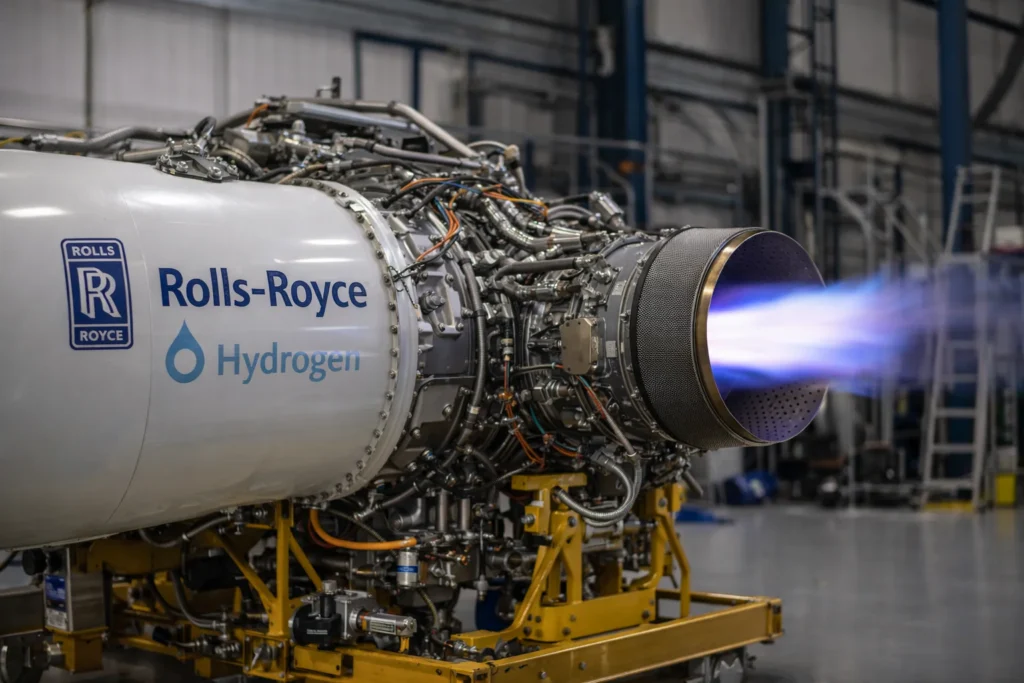
The future of global tourism and air travel is entering a transformative phase as hydrogen aviation gains momentum, driven by new technological developments from leading aerospace manufacturers. Recent official disclosures confirm that Rolls-Royce has filed a patent for an advanced hydrogen combustion system, marking a significant step toward cleaner and more sustainable aviation.
Government aviation authorities and international environmental initiatives have increasingly emphasized the need to reduce carbon emissions from air travel. With tourism continuing to grow worldwide, the pressure on airlines and manufacturers to adopt greener technologies has intensified. Hydrogen is now being explored as a promising alternative fuel that could reshape the aviation landscape in the coming decades.
The patented system developed by Rolls-Royce introduces a new approach to hydrogen-powered flight by addressing one of the most complex challenges associated with this fuel. According to official technical descriptions, the system includes a mechanism that heats hydrogen before combustion, allowing for a more stable and efficient energy release within the engine. This innovation is designed to improve safety and performance while overcoming the difficulties linked to hydrogen’s extremely low storage temperature.
Hydrogen fuel must be stored at extremely cold conditions, requiring specialized tanks and advanced insulation. Aviation authorities have noted that these requirements present major design challenges for aircraft manufacturers, particularly when compared to conventional jet fuel systems. By introducing a method to regulate fuel temperature before combustion, Rolls-Royce aims to enhance the practicality of hydrogen as a viable aviation fuel.
Tourism boards and transport ministries have highlighted that sustainable aviation technologies are essential for supporting long-term travel growth. As international tourism rebounds and expands, reducing the environmental impact of flights has become a priority for governments and industry stakeholders alike. Hydrogen aviation is viewed as one of several solutions that could help achieve global climate targets while maintaining connectivity between destinations.
The development of hydrogen-powered engines is part of a broader effort supported by international programs and government-backed initiatives. In Europe, collaborative projects focused on clean aviation are investing in research, testing, and infrastructure to accelerate the transition toward low-emission flight. Rolls-Royce is actively participating in these initiatives, working alongside engineers and scientists to refine hydrogen combustion technology.
Despite its potential, hydrogen aviation remains in the early stages of development. Official industry statements indicate that the technology is unlikely to be deployed on large commercial aircraft in the immediate future. Instead, initial applications are expected to focus on smaller and regional aircraft, where shorter flight distances and lower capacity requirements make hydrogen systems more feasible.
Projections from aviation authorities suggest that hydrogen-powered regional aircraft could begin entering service in the next decade. These aircraft are expected to carry between 30 and 40 passengers, providing a testing ground for the technology before it is scaled up for larger operations. Such developments could significantly influence regional tourism, enabling more sustainable travel options for short-haul routes.
The aviation industry is also exploring hybrid solutions that combine hydrogen with other energy sources, such as electric propulsion or sustainable aviation fuels. This approach allows manufacturers to reduce emissions while addressing the limitations of hydrogen storage and infrastructure. Government agencies have indicated that a combination of technologies may be necessary to achieve long-term sustainability goals.
Infrastructure remains one of the biggest challenges for hydrogen aviation. Current production levels of clean hydrogen are limited, and expanding supply chains will require substantial investment. Airports, energy providers, and regulatory bodies will need to collaborate to develop the necessary facilities for storage, distribution, and refueling.
Official statements from aviation authorities emphasize that building this infrastructure will take time and coordinated global efforts. In addition to technical challenges, economic factors also play a role, as the cost of producing environmentally friendly hydrogen remains higher than traditional fuels. However, forecasts suggest that prices could decrease as production scales up and renewable energy sources become more widely available.
The environmental benefits of hydrogen aviation are significant. When used in fuel cells, hydrogen produces zero carbon dioxide emissions, making it an attractive option for reducing the aviation sector’s carbon footprint. However, experts note that the overall sustainability of hydrogen depends on how it is produced. Green hydrogen, generated using renewable energy, is considered the most environmentally friendly option.
Tourism authorities have recognized that sustainable travel options are becoming increasingly important for travelers. Many destinations are promoting eco-friendly initiatives to attract environmentally conscious visitors, and advancements in aviation technology play a crucial role in supporting these efforts.
The introduction of hydrogen-powered aircraft could also influence how destinations are marketed and accessed. Regions that invest in sustainable infrastructure may gain a competitive advantage, attracting travelers who prioritize low-impact travel experiences. This shift could redefine global tourism patterns over time.
While uncertainties remain, the progress made by Rolls-Royce and other industry leaders demonstrates a clear commitment to innovation. Hydrogen aviation is not expected to replace conventional fuels immediately, but it represents a critical step toward a more sustainable future for air travel.
As research and testing continue, aviation authorities and tourism boards will closely monitor developments in hydrogen technology. The successful integration of hydrogen into commercial aviation could transform the industry, offering cleaner, more efficient travel options for millions of passengers worldwide.
For the tourism sector, these advancements signal a new era where sustainability and connectivity go hand in hand. Hydrogen aviation, supported by ongoing innovation and international collaboration, has the potential to reshape how people explore the world while minimizing environmental impact.