
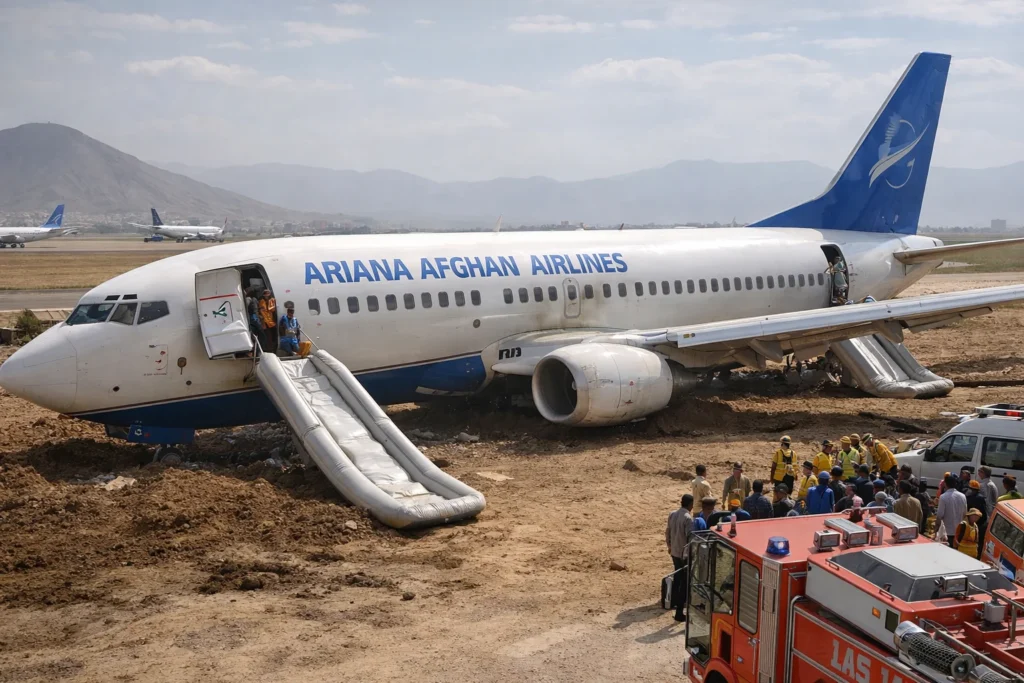
Kabul’s main aviation hub faced sudden disruption after an Ariana Afghan Airlines Boeing 737-400 veered off the runway during landing, prompting a temporary suspension of flight operations and triggering a full-scale safety investigation. While all passengers and crew were safely evacuated without injuries, the incident caused widespread travel chaos and raised important questions about aviation safety and airport preparedness.
The aircraft reportedly lost directional control during the landing phase and skidded onto soft ground beside the runway. Emergency response teams were deployed immediately, and evacuation procedures were carried out efficiently, ensuring that all onboard individuals exited the aircraft safely. Despite the absence of casualties, the situation escalated quickly due to the aircraft’s position, which rendered the runway unusable and forced airport authorities to halt operations.
Immediate Impact on Airport Operations
The incident had an immediate and visible effect on operations at Kabul International Airport. With the runway partially obstructed, authorities suspended all arrivals and departures as a precautionary measure. Incoming flights were diverted to nearby airports, while departing services faced delays or cancellations.
Airport officials prioritized safety, initiating runway inspections and coordinating efforts to remove the aircraft. These procedures are standard in aviation incidents involving runway excursions, as even minor debris or structural damage can pose serious risks to subsequent flights.
Passengers at the airport experienced long wait times, confusion, and uncertainty as airlines worked to adjust schedules. Many travellers had to rebook flights or seek alternative arrangements, highlighting the cascading impact of a single aviation incident on broader travel networks.
How the Incident Unfolded
The runway excursion occurred during what is typically a controlled stage of flight—the landing roll. After touchdown, the aircraft was expected to decelerate and maintain a straight path along the runway. However, reports indicate that the plane began drifting off course before eventually leaving the paved surface.
Once on soft ground, the aircraft’s stability was compromised. Uneven terrain and reduced friction increased the risk of further damage, and the plane came to a stop in a position that blocked safe runway use. Visual assessments suggest potential strain on the landing gear and undercarriage, though a detailed engineering evaluation is still underway.
Effective Emergency Response
Despite the dramatic nature of the incident, the response by crew members and emergency services was swift and well-coordinated. Cabin crew initiated evacuation protocols immediately, deploying emergency slides and guiding passengers out of the aircraft in an orderly manner.
Airport rescue teams, including fire and medical units, arrived within minutes to secure the area and assess the situation. The absence of injuries is being seen as a testament to the effectiveness of aviation safety training and emergency preparedness measures.
Such outcomes are not guaranteed in runway excursions, which can sometimes lead to more severe consequences. In this case, clear communication and adherence to established procedures played a crucial role in ensuring passenger safety.
Wider Impact on Travel and Connectivity
The disruption extended beyond Kabul, affecting regional air travel and airline operations. Flights scheduled to arrive in the city were rerouted, creating additional pressure on nearby airports. Airlines had to quickly reorganize logistics, including crew assignments and aircraft rotations.
Passengers traveling on connecting flights faced missed connections and extended delays, while airlines worked to accommodate affected travellers. The incident highlights how disruptions at a single airport can ripple across the broader aviation network, particularly in regions with limited alternative infrastructure.
Tourism and business travel were also impacted, as Kabul serves as a key gateway for both domestic and international movement. Even temporary closures can have economic implications, especially when they disrupt time-sensitive travel plans.
Investigation Underway
Authorities have launched a comprehensive investigation to determine the cause of the incident. Multiple factors are being examined, including potential mechanical issues, pilot handling, runway conditions, and weather at the time of landing.
Flight data recorders and cockpit voice recordings will be analyzed to reconstruct the sequence of events. Maintenance records of the aircraft will also be reviewed, particularly given that the Boeing 737-400 is an older model that requires rigorous upkeep.
Investigators are expected to take a thorough approach, as identifying the root cause is essential for preventing similar incidents in the future. The findings will likely influence operational guidelines, maintenance standards, and safety protocols across the aviation sector.
Questions Around Infrastructure and Safety
The incident has brought attention to broader concerns about aviation infrastructure and operational resilience. Runway conditions, emergency response capabilities, and aircraft maintenance practices are all under scrutiny as part of the ongoing investigation.
Airports must be equipped to handle unexpected situations without causing prolonged disruptions. The temporary shutdown at Kabul underscores the importance of having contingency plans and rapid response mechanisms in place.
At the same time, airlines must ensure that aircraft are maintained to the highest safety standards, particularly when operating older models. Regular inspections and adherence to international aviation guidelines are critical to minimizing risks.
Looking Ahead
As recovery operations continue and normal flight schedules gradually resume, the focus remains on ensuring safety and restoring passenger confidence. Authorities are expected to implement any necessary corrective measures based on the investigation’s findings.
For travellers, the incident serves as a reminder of the unpredictable nature of air travel and the importance of staying informed. While disruptions can be challenging, the effective handling of this situation demonstrates the strength of aviation safety systems when properly executed.
In the long term, lessons learned from this event will contribute to improving safety standards and operational efficiency, helping to prevent similar disruptions and ensuring smoother travel experiences in the future.