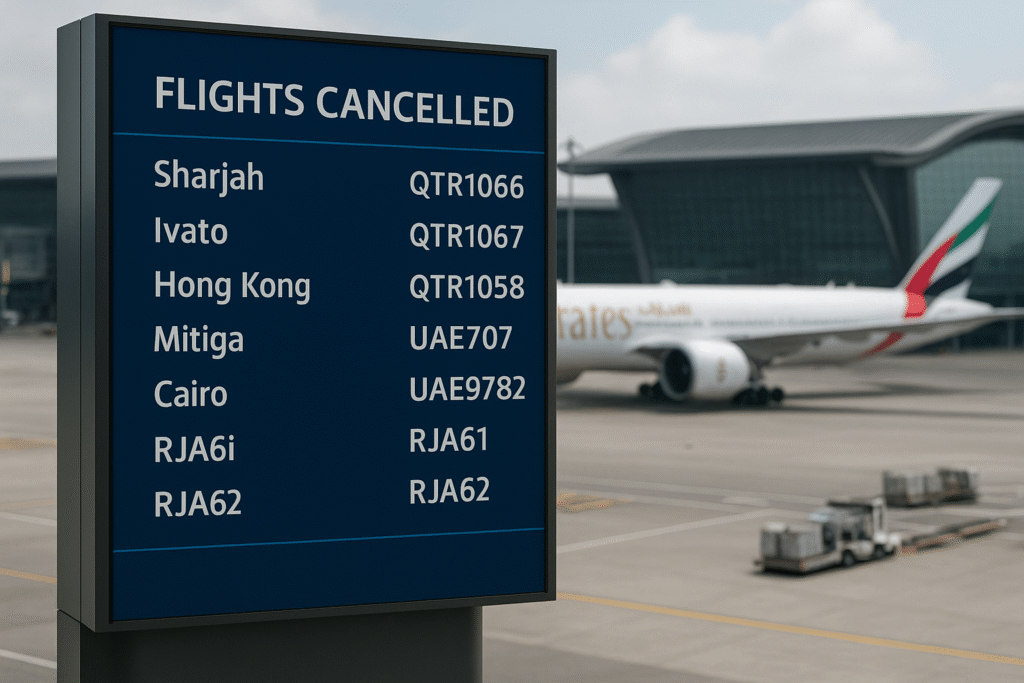
Air travel across the Middle East faced a severe setback this week as nine scheduled flights were abruptly canceled, leaving thousands of passengers stranded in airports from Doha to Dubai. The cancellations, announced by leading airlines including Emirates, Qatar Airways, and Royal Jordanian, disrupted key routes that connect the Gulf with Africa, Asia, and neighboring Middle Eastern cities.
Affected airports include Doha’s Hamad International Airport and Dubai’s Al Maktoum International Airport, two of the region’s busiest hubs. Destinations impacted range from Sharjah and Cairo to the Seychelles and Hong Kong, highlighting the wide scope of the disruption. Many travelers were left scrambling for rebookings, with long queues at airline service counters and mounting uncertainty about onward journeys.
Why the Flights Were Canceled
According to airline statements, the wave of cancellations stemmed from a mix of operational challenges. These include crew shortages, last-minute aircraft maintenance, and broader scheduling strains caused by the heavy demand for air travel in the region.
The Middle East has been one of the fastest-recovering aviation markets post-pandemic, with passenger volumes rising steadily in 2024 and 2025. However, the surge in demand has put additional strain on airlines, testing the resilience of their fleets and staffing levels. While airlines have assured customers that safety remains the top priority, passengers faced the immediate inconvenience of delayed travel plans, missed connections, and in some cases, canceled vacations.
Qatar Airways: Three Flights Canceled Between Doha and Sharjah
Qatar Airways confirmed the cancellation of three scheduled services between Doha’s Hamad International Airport and Sharjah International Airport on Friday.
- Flight QTR1066: Doha to Sharjah, originally scheduled for 3:45 PM.
- Flight QTR1067: Sharjah to Doha, scheduled for 7:30 PM.
- Flight QTR1058: Doha to Sharjah, scheduled for 9:25 PM.
All three flights were operated by Airbus A320 aircraft. Passengers were advised to seek alternative arrangements or rebook on upcoming flights. For those traveling onward to other destinations, this disruption has led to ripple effects, with connecting flights being missed and itineraries thrown into disarray.
Emirates Airlines: Disruptions Extend to Seychelles and Hong Kong
Emirates Airlines, headquartered in Dubai, also announced multiple cancellations affecting international destinations.
- Flight UAE707: Scheduled to depart Seychelles International Airport for Madagascar’s Ivato International at 3:15 PM.
- Flight UAE708: Return service from Ivato to Seychelles, scheduled for 6:45 PM.
- Flight UAE9782: Al Maktoum International Airport (Dubai) to Hong Kong International, scheduled for 2:30 AM Saturday.
The affected routes highlight how disruptions in the Gulf can stretch far beyond the Middle East, impacting tourism and business travelers heading to or returning from Africa and Asia. For Emirates passengers, the cancellations created bottlenecks at Dubai’s terminals, where the airline is working to accommodate stranded travelers.
Royal Jordanian Airlines: Flights Affected Across Amman, Mitiga, and Cairo
Royal Jordanian Airlines also joined the list of carriers facing operational setbacks, canceling three flights scheduled for Saturday.
- Flight RJA61: From Amman’s Queen Alia International Airport to Mitiga International Airport, scheduled for 8:10 AM.
- Flight RJA61 (return sector): From Mitiga to Cairo International at 12:40 PM.
- Flight RJA62: Cairo to Amman at 6:10 PM.
These cancellations disrupted not only regional business travelers but also leisure passengers planning weekend trips between Jordan, Libya, and Egypt.
Impact on Tourism and Business Travel
The timing of these cancellations is particularly significant. The autumn travel season across the Middle East is a peak period, with business conferences, cultural events, and tourism inflows contributing to high passenger numbers. Dubai and Doha, in particular, continue to serve as major stopover hubs for international tourists heading to destinations in Asia and Africa.
Stranded travelers have reported challenges with rebooking due to limited availability on alternative flights. Hotels near the airports in Doha and Dubai also saw an uptick in last-minute bookings from passengers forced to stay overnight. The tourism sector, already grappling with fluctuating travel patterns, faces renewed challenges as last-minute disruptions affect visitor experiences.
Airlines Respond and Offer Guidance
Airlines have moved quickly to provide guidance, urging passengers to check flight status updates regularly and to use official airline apps for real-time notifications. Customer service desks have been set up in affected terminals to assist with rebooking and compensation queries.
For Emirates, Qatar Airways, and Royal Jordanian, the priority remains minimizing passenger inconvenience while ensuring that fleet safety standards are met. Industry experts suggest that such cancellations may continue intermittently as airlines balance the surge in demand with operational readiness.
What Passengers Should Do
Travel experts recommend that passengers flying through Doha, Dubai, or Amman in the coming weeks take proactive steps:
- Confirm bookings 24–48 hours before departure.
- Allow extra layover time if traveling on connecting itineraries.
- Consider travel insurance that covers cancellations and disruptions.
For tourists planning regional trips, flexibility will be key as the situation evolves. While cancellations are frustrating, they also underline the importance of prioritizing safety and operational reliability in aviation.
Conclusion
The cancellation of nine flights across the Middle East by Emirates, Qatar Airways, and Royal Jordanian has underscored the ongoing challenges facing the region’s aviation sector. With routes spanning from Doha and Dubai to Cairo, Seychelles, and Hong Kong, the disruptions have affected both regional and international travel.
As airlines continue to navigate resource constraints and high passenger volumes, travelers are urged to stay informed, remain flexible, and prepare for possible last-minute changes. While the aviation industry in the Middle East remains robust, this episode highlights the delicate balance between growing demand and operational stability.
For more travel news like this, keep reading Global Travel Wire