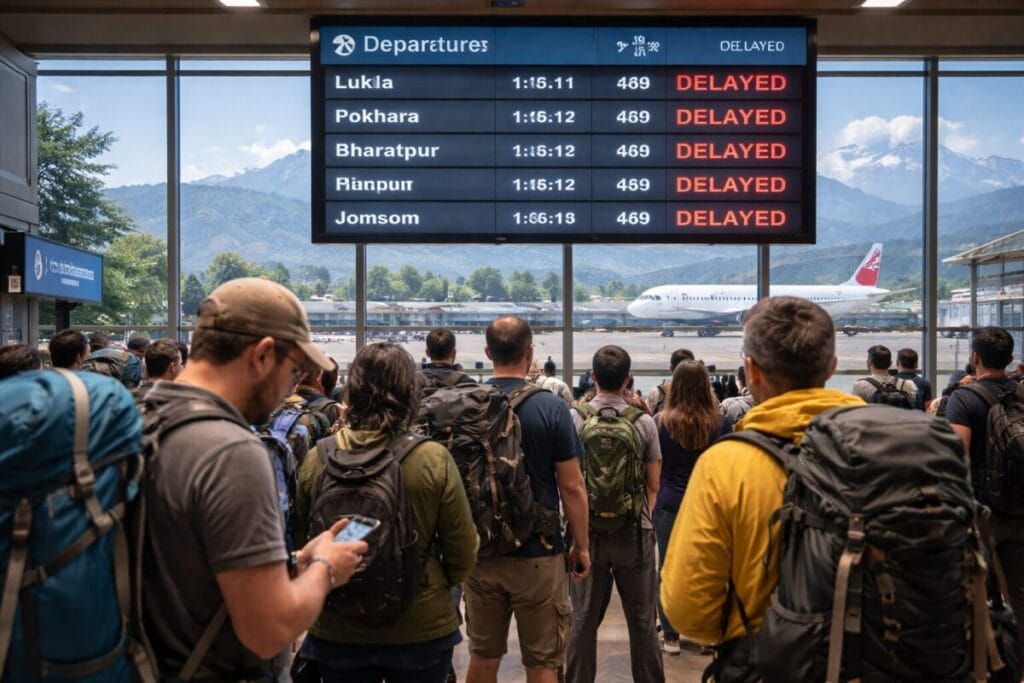
Nepal continues to attract visitors from across the world each winter and spring. Trekkers and adventure travelers arrive at Tribhuvan International Airport in Kathmandu or Ramechhap before heading toward Everest or Annapurna. Yet the travel experience often includes long hours of waiting as departure boards flash delay notices. The skies may appear clear outside, but passengers quickly learn that mountain aviation operates under rules that differ from other regions.
More than 1.1 million visitors entered Nepal during the 2025 and 2026 tourist seasons. This growth testifies to Nepal’s expanding reputation as a world-class trekking destination. However, the country’s airspace remains limited. Nepal’s mountainous geography and single-runway infrastructure drive aviation challenges that surprise many first-time visitors.
Limited Airspace Meets Surging Demand
Nepal’s terrain defines its aviation system. Aircraft must navigate narrow valleys, sharp elevation changes, and restricted approach corridors. Tribhuvan International Airport serves as the main international hub with a single runway that handles both domestic and international traffic. Additional airports in Pokhara and Bhairahawa support international operations, yet Kathmandu continues to absorb the bulk of peak-season air movements.
During tourist season, the demand for runway slots rises sharply. Controllers must separate aircraft within tight air corridors to maintain safety. When several flights request departure or arrival slots at the same time, delays accumulate quickly. To the traveler in the terminal, this may resemble inefficiency. To those in the tower, it represents safe and responsible sequencing.
Mountain Weather and the “Window” Problem
Travelers often ask why a flight that left earlier departed with no issue, while their own flight remains grounded. The answer lies in mountain microclimates. Airports such as Lukla, Phaplu, or Jomsom operate under Visual Flight Rules. Pilots must see terrain and runway to land safely. A cloud bank can move into a valley with little warning. Weather windows open and close within minutes.
When the window closes in the mountains, flights remain grounded in Kathmandu or Ramechhap. Even sunny skies in the capital cannot override low visibility in a Himalayan valley. Once conditions improve, flights resume, yet a backlog may have formed. Clearing such backlogs while maintaining safety often takes hours.
The Domino Effect That Challenges Travelers
A single domestic aircraft may operate up to ten legs in a single day during peak season. If the first departure suffers a thirty-minute delay due to fog or air traffic sequencing, each remaining leg also slips. By mid-afternoon, crew duty limitations may restrict further operations. Aircraft parking spaces may also reach capacity, forcing controllers to slow movement to avoid apron congestion. Passengers waiting in departure halls witness delays with no visible external weather cues.
ATC Priorities That Influence Flight Timing
In-season air traffic does not treat all flights equally. Controllers must assign priorities based on safety and operational necessity. Helicopter evacuations for altitude sickness receive first priority during trekking season. Medical transports often divert resources as they cannot wait for scheduled traffic. International overflights cross Nepal’s skies en route between major world cities and require steady sequencing. International arrivals also receive priority due to fuel and schedule constraints.
These priority rules shape domestic aviation during peak trekking months and often extend waiting times for short-haul flights that connect to mountain towns.
Winter Haze Adds a New Layer of Delay Pressure
Air quality challenges have increased during winter seasons in the Kathmandu Valley. Stagnant air traps fine particles and dust, creating thick haze that reduces visibility at ground level. Controllers may hold both arrivals and departures until visual requirements are met. Even clear skies above the haze layer cannot override the need for safe operations during takeoff and landing.
Patience Becomes Part of the Himalayan Travel Culture
Travelers often assume that delay equals mismanagement. In Nepal’s aviation system, delay often equals caution. Controllers choose safety over speed because mountain aviation allows no margin for error. The scenic appeal that draws trekkers to Nepal also creates a complex air traffic environment. Pilots, controllers, and ground staff rely on coordination and patience to move thousands of passengers through rugged terrain.
Tips for Travelers Planning Himalayan Itineraries
Travel experts recommend several strategies to avoid itinerary disruptions:
• Add buffer days when planning departures from the mountains.
• Book morning flights for mountain sectors when weather proves more stable.
• Use travel insurance that covers cancellations or helicopter transfers.
• Avoid same-day connections between domestic returns and international departures.
These steps reduce stress and allow more flexibility if weather delays stretch past expected windows.
Aviation Growth Continues as Tourism Expands
Nepal’s tourism sector continues to grow. New airports, expanded domestic fleets, and improved navigation systems signal long-term progress. However, geography and safety will always shape Nepal’s aviation rhythm. Travelers who understand these dynamics approach flight delays with more patience and preparation.
As the trekking season continues to attract international visitors, Nepal’s aviation ecosystem must balance rising demand with the realities of mountain airspace. For travelers, the wait in the terminal becomes part of the Himalayan journey, where adventure begins long before the trail.
For more travel news like this, keep reading Global Travel Wire