



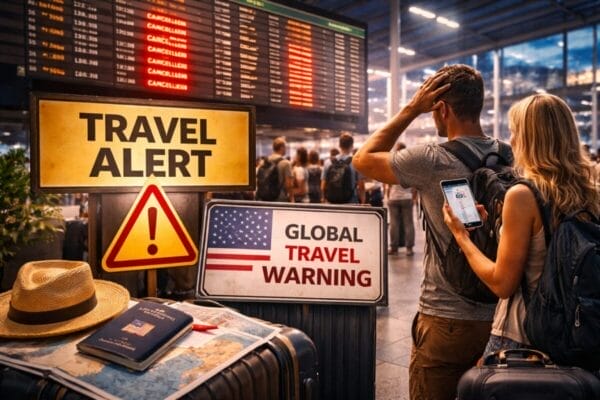



Aviation chaos has gripped Tel Aviv after approximately 180 flight cancellations at Ben Gurion Airport left thousands of passengers stranded amid escalating regional tensions. The sudden suspension of departures and arrivals has disrupted major international routes to North America, Europe and Asia, turning Israel’s primary gateway into the center of a rapidly evolving travel emergency.
Airlines including United Airlines, Delta Air Lines, El Al Israel Airlines and Swiss International Air Lines halted or postponed services following heightened security concerns linked to missile activity in the region. The operational freeze has affected long-haul routes to New York, Newark, Boston, Los Angeles, Toronto, London, Paris and Bangkok, along with key European connections to Zurich, Budapest, Munich and Rome.
For travelers across multiple time zones, the cancellations triggered a chain reaction of missed connections, delayed returns and urgent rebooking attempts.
Ben Gurion Airport Under Severe Operational Pressure
Ben Gurion Airport serves as Israel’s busiest and most strategically important aviation hub. In peak travel periods, tens of thousands of passengers pass through its terminals daily, connecting Israel to major global cities.
The recent spike in cancellations included both outbound and inbound services. Departures to major hubs such as New York’s JFK, Newark Liberty, London Heathrow and Paris Charles de Gaulle were among the most affected. Incoming flights from Chicago, Toronto, Zurich and Amsterdam were also halted.
Airport authorities emphasized that safety remains the top priority. When regional airspace risks intensify, airlines are required to reassess operations immediately. In this case, precautionary decisions led to the grounding of widebody aircraft and suspension of long-haul services.
Major Global Airlines Suspend Key Routes
Several high-profile international routes were impacted during the disruption window:
- United Airlines suspended services to Newark and Chicago
- Delta Air Lines halted JFK–Tel Aviv operations
- El Al grounded multiple Boeing 787 and 777 long-haul flights
- Swiss International Air Lines paused Zurich connections
- European routes to Paris, Berlin, Madrid, Rome and Vienna were canceled
These cancellations affect not only point-to-point passengers but also transit travelers connecting onward through Tel Aviv. Tourists returning home, business travelers, students and visiting families all faced uncertainty.
For North American passengers in particular, the suspension of overnight departures created significant backlogs due to limited alternative routing options.
Thousands of Travelers Stranded Across Continents
The scale of disruption extends far beyond Israel. Passengers scheduled to depart from cities including London, Paris, Munich, Budapest and Bangkok toward Tel Aviv were forced to remain at origin airports or seek refunds.
In North America, travelers arriving for connecting flights discovered onward segments canceled mid-journey. Some aircraft turned back to departure airports, while others diverted.
Hotels near Ben Gurion Airport quickly filled with stranded passengers waiting for rebooking confirmation. Travel agencies and embassy hotlines reported high call volumes as international visitors sought guidance.
For many travelers, uncertainty around reopening timelines has been the most challenging factor.
Tourism Impact on Tel Aviv and Israel
Tourism plays a significant role in Israel’s economy. Tel Aviv’s Mediterranean coastline, Jerusalem’s historic landmarks and religious pilgrimage sites attract millions of visitors annually.
Aviation stability is critical to maintaining inbound tourism flows. Prolonged air travel disruptions could impact:
- Hotel occupancy rates in Tel Aviv and Jerusalem
- Conference and business travel schedules
- Religious pilgrimage itineraries
- Cruise and regional tour connections
In the immediate term, hotels are experiencing a mixed effect. Some properties are seeing extended stays from stranded visitors, while others face future booking cancellations due to uncertainty.
Tour operators are advising clients to monitor airline communications closely before making new travel arrangements.
Why Aviation Disruptions Escalated Quickly
The rapid pace of cancellations reflects modern aviation’s safety protocols. When missile activity or regional security threats intensify, civil aviation authorities coordinate with airlines to evaluate airspace risk levels.
Widebody aircraft operating long-haul routes require stable corridors for extended overflight. If those corridors are deemed unsafe, flights are postponed or rerouted.
Because Ben Gurion Airport serves as Israel’s primary international gateway, even limited airspace concerns can trigger a significant percentage of cancellations.
Passenger Guidance and Rebooking Options
Travelers affected by cancellations should follow several key steps:
- Check airline flight status before heading to the airport
- Avoid relying on third-party booking platforms for updates
- Request written confirmation of cancellation for insurance claims
- Retain receipts for accommodation and meals if reimbursement applies
- Contact embassies if passport or visa validity becomes an issue
Most airlines have activated flexible rebooking policies during the disruption period. Refunds are available for canceled segments, and change fees are typically waived under force majeure conditions.
However, limited seat availability on alternative routes means rebooking may take several days depending on demand.
Ripple Effects Across Europe and North America
The disruption has created a wider scheduling imbalance. Aircraft that normally rotate between Tel Aviv and global hubs are temporarily grounded or reassigned.
This can lead to:
- Equipment shortages on certain routes
- Delays in aircraft maintenance rotations
- Crew scheduling complications
- Higher short-term fares on unaffected regional routes
Airlines are working to restore normal frequency once airspace conditions permit.
Economic and Travel Outlook
Israel’s aviation sector has faced disruptions in the past and demonstrated resilience in restoring operations once security conditions stabilize. The speed of recovery will depend largely on the duration of regional tensions.
If cancellations remain limited to a short window, long-term tourism damage may be minimal. However, prolonged instability could influence traveler confidence, particularly for long-haul leisure markets in North America and Western Europe.
For now, authorities continue to prioritize safety while coordinating closely with airlines to evaluate when normal operations can resume.
A Travel Crisis Still Unfolding
The cancellation of roughly 180 flights at Ben Gurion Airport represents one of the most significant aviation interruptions in recent years for Tel Aviv. Thousands of passengers across Israel, Europe, North America and Asia are navigating rebooking lines, hotel extensions and altered itineraries.
Yet the airport remains operational, and contingency systems are in place. Airlines are assessing routes daily. Security conditions are being monitored continuously.
For travelers, flexibility and verified information are essential. The situation remains fluid, but aviation networks are designed to adapt.
Tel Aviv’s travel gateway has weathered disruptions before. The coming days will determine how quickly this unprecedented wave of cancellations transitions from crisis to recovery.
For more travel news like this, keep reading Global Travel Wire