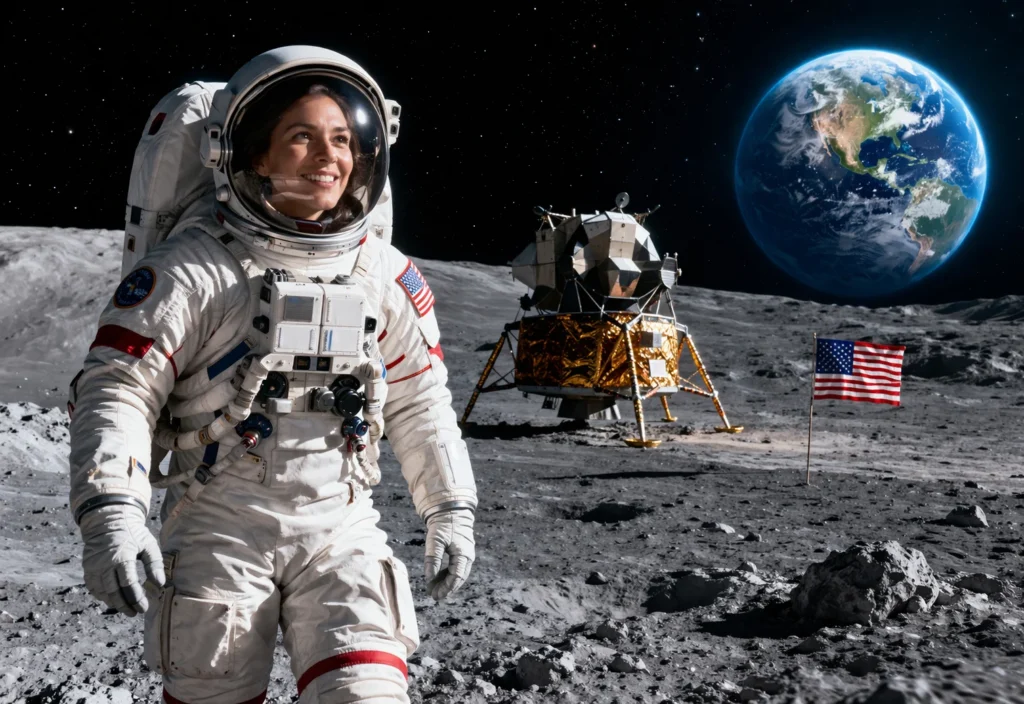
Christina Koch has entered the history books after becoming the first woman to travel around the Moon, marking a major milestone for space exploration and the future of tourism beyond Earth. Her journey aboard NASA’s Artemis II mission has captured worldwide attention, not only as a scientific achievement but also as a symbol of the next era of human travel.
The successful mission represents a new chapter in lunar exploration and growing public fascination with space tourism. While commercial moon travel remains a future goal, missions like Artemis II are helping build the technology, confidence, and global excitement that could one day transform how people think about travel itself.
For the tourism industry, the achievement highlights how exploration and travel have always been closely connected. What begins as science today may become tomorrow’s visitor experience.
Historic Journey Around the Moon
Christina Koch completed the landmark journey as part of the Artemis II crew, traveling around the Moon and safely returning to Earth after a mission lasting nearly ten days. The voyage marked humanity’s return to the Moon’s vicinity for the first time in more than fifty years.
The mission crew included astronauts from the United States and Canada, reflecting the international cooperation that defines modern space programs.
The successful splashdown off the coast of California demonstrated another important step in preparing for future lunar missions and eventual deeper space travel.
For many observers, the mission was more than a technical success. It was a powerful reminder that human exploration continues to evolve.
Why This Matters for Tourism
At first glance, a lunar mission may seem far removed from traditional tourism. However, many of today’s travel experiences once began as ambitious exploration projects.
Commercial aviation, ocean cruising, polar expeditions, and high-altitude adventure travel all developed over time from early breakthroughs in technology and navigation.
Space travel is now following a similar path.
The growing interest in space tourism includes:
- Suborbital flights
- Orbital experiences
- Luxury space travel concepts
- Lunar tourism ideas
- Educational space journeys
- Science-based travel experiences
Each successful mission brings future possibilities closer.
Christina Koch Inspires a New Generation
Christina Koch’s achievement carries significance beyond space technology. It also represents progress in inclusion, opportunity, and inspiration for future generations.
Her milestone demonstrates that exploration belongs to everyone. Around the world, girls and young women interested in science, engineering, aviation, and travel can now see another barrier broken.
Tourism often thrives on stories that inspire curiosity. Koch’s journey is exactly that kind of story—one that encourages people to dream bigger and travel farther.
A Strong Legacy Before the Moon Mission
Even before this mission, Christina Koch was already known for breaking records in spaceflight. She previously completed one of the longest continuous missions by a woman aboard the International Space Station.
Her career has also included work in some of Earth’s most extreme environments, including polar regions and remote scientific stations.
This background reflects qualities essential to future exploration:
- Resilience
- Technical expertise
- Adaptability
- Leadership
- Curiosity
- Global collaboration
These same qualities are increasingly celebrated in adventure and experiential tourism.
How Space Tourism Could Evolve
While moon holidays are not available yet, the foundations of future space tourism are being built now. As technology advances and costs gradually improve, more travelers may gain access to experiences once limited to astronauts.
Possible future tourism models include:
- Space station stays
- Lunar orbit viewing trips
- Moon surface visitor centers
- Zero-gravity experiences
- Space museums with live mission integration
- Training-based astronaut adventures
These ideas may sound futuristic today, but global demand for unique experiences continues to grow.
The Power of Destination Storytelling
Tourism is driven by imagination. Destinations become popular when they offer stories people want to be part of. The Moon is perhaps the ultimate destination story.
It offers:
- Global emotional appeal
- Scientific wonder
- Historic legacy
- Stunning views of Earth
- A sense of achievement
- Once-in-a-lifetime prestige
As public interest grows, space agencies and tourism companies may increasingly collaborate on educational programs, exhibitions, simulators, and visitor attractions inspired by lunar missions.
Benefits for Earth-Based Tourism Too
Even before commercial lunar travel arrives, space exploration already supports traditional tourism on Earth.
Examples include:
- Space museums and visitor centers
- Rocket launch tourism
- Science festivals
- Educational travel programs
- Planetariums and observatories
- STEM family attractions
Major missions often increase visitor numbers at science-focused attractions and create new travel demand around launch sites and aerospace destinations.
What Travelers Can Learn from This Moment
The Artemis II mission reminds travelers that exploration remains one of humanity’s strongest motivations. Whether someone hikes a mountain, visits a new country, or dreams of orbiting the Moon, the desire to discover is universal.
Travelers can take inspiration by:
Choosing Meaningful Journeys
Travel is richest when it expands perspective.
Supporting Science Tourism
Museums, observatories, and heritage centers connect travel with learning.
Encouraging Future Generations
Children inspired by exploration today may shape tomorrow’s travel world.
Staying Curious
The spirit of discovery is at the heart of every great trip.
A Positive Future for Space and Tourism
The success of Artemis II strengthens confidence in future lunar missions and long-term plans for deeper space exploration. It also keeps public attention focused on a future where travel may extend far beyond Earth.
While traditional tourism will remain centered on beaches, cities, culture, and nature, a new premium frontier could gradually emerge in parallel.
The combination of technology, storytelling, and human ambition makes space tourism one of the most fascinating long-term opportunities in global travel.
Final Word
Christina Koch’s journey around the Moon is a historic achievement in exploration and an inspiring moment for the future of travel. It shows that boundaries continue to move and that destinations once thought unreachable can become real.
For tourism, the message is powerful: the future traveler may go farther than anyone imagined.
As the world celebrates this milestone, one thing is clear—the next great travel era may already have begun.