












Tennessee has officially joined a growing list of US states enforcing REAL ID requirements for domestic air travel. This move places Tennessee alongside Texas, Washington, California, Pennsylvania, Michigan, New Jersey, and dozens of others. The change marks a major turning point for travelers across the country.
As of February 1, 2026, airport security rules now require stricter identification standards. Travelers who arrive without compliant identification face delays and extra costs. The new enforcement directly affects millions of passengers who still use standard driver’s licenses.
This shift represents the most significant change to US domestic air travel rules in years.
REAL ID Enforcement Reshapes the Airport Experience
The REAL ID Act sets federal standards for state-issued identification. Congress passed the law in 2005 to strengthen national security. Years of delays followed as states upgraded systems and documents.
Full enforcement now applies nationwide. Passengers must present a REAL ID-compliant license or another approved document. Without proper identification, travelers must complete identity verification at the airport.
This process adds time, stress, and expense to travel.
$45 Identity Verification Fee Impacts Unprepared Travelers
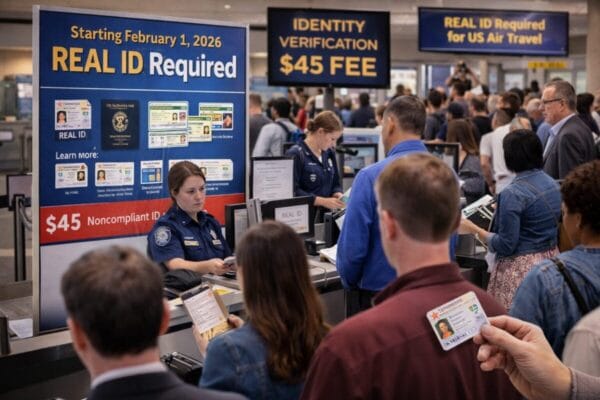
Travelers without compliant identification now face a $45 identity verification fee. The fee applies at airport security checkpoints. It covers biometric and biographic identity checks.
Verification can take between ten and thirty minutes. Travelers who prepay online reduce waiting time. Those who pay at the checkpoint risk missing flights.
The fee applies for ten days, allowing multiple flights within that window. Still, frequent travelers face repeated inconvenience without proper ID.
Tennessee Among States With Lower Compliance Rates
Tennessee began issuing REAL ID-compliant licenses in 2019. Despite this effort, millions of residents still lack compliant identification. The state now ranks among those most affected by enforcement.
Other large states face similar challenges. California, New Jersey, Pennsylvania, Michigan, Washington, and Texas continue to report uneven adoption. Large populations increase the number of unprepared travelers.
Airports in these states now experience longer security lines and more frequent delays.
Why REAL ID Matters for Domestic Travel
REAL ID compliance now determines access to domestic flights. Standard licenses without the star marking no longer meet federal requirements. This change standardizes security procedures nationwide.
Airports rely on consistent ID standards to manage passenger volume safely. Stronger verification reduces identity fraud risks. Authorities believe these measures improve aviation security.
For travelers, compliance now represents a basic travel requirement.
Accepted IDs That Avoid the $45 Fee
Travelers can avoid the fee by presenting approved identification. REAL ID-compliant licenses include a star marking. Passports and passport cards remain valid alternatives.
Trusted traveler cards also qualify. These include Global Entry, NEXUS, SENTRI, and FAST. Enhanced driver’s licenses work in certain states.
Military IDs and veteran health cards also meet requirements. Children under eighteen remain exempt when traveling with adults.
TSA Introduces Fee to Support Verification Operations
The Transportation Security Administration introduced the $45 fee to offset verification costs. Biometric systems and staffing require ongoing investment. The agency initially proposed a lower fee.
Higher operational expenses led to the final amount. Officials also hope the fee encourages travelers to obtain proper identification. Compliance reduces airport congestion and staffing strain.
The policy balances security needs with operational realities.
Delays Increase Risk of Missed Flights
Identity verification takes time, especially during peak travel periods. Airports already handle high passenger volumes. Added verification creates bottlenecks at checkpoints.
Travelers who arrive without compliant ID face longer waits. Missed flights become more likely during holidays and weekends. Airlines may not accommodate late arrivals caused by verification delays.
Preparation now plays a critical role in travel planning.
What Tennessee Travelers Should Do Now
Tennessee residents should act quickly to avoid disruption. Check your driver’s license for the REAL ID star. If missing, apply at a local DMV.
Gather required documents before visiting the DMV. These include proof of identity, residency, and legal presence. Appointment slots fill quickly as enforcement begins.
Frequent travelers should consider a passport for flexibility.
States With Ongoing Compliance Challenges
Several states continue to report low REAL ID adoption. New Jersey and Pennsylvania rank among the lowest. California and New York also face challenges due to population size.
Michigan and Minnesota show mixed adoption levels. Texas reports higher compliance but still faces large numbers of unprepared travelers.
Residents in these states should prioritize upgrades.
REAL ID Changes the Future of US Air Travel
The enforcement of REAL ID rules standardizes domestic travel across the country. Travelers must now treat identification as a core travel requirement. Planning ahead becomes essential.
Airports expect smoother operations once adoption increases. Security processes gain consistency. Passenger confidence improves with clearer rules.
The transition period brings inconvenience, but long-term stability remains the goal.
Preparing Now Ensures Stress-Free Travel in 2026
Tennessee’s enforcement signals a nationwide shift that affects all travelers. The $45 fee and added delays serve as strong incentives for compliance. Preparation saves time, money, and frustration.
Travelers who upgrade early avoid airport stress. They move through security smoothly and protect travel plans. REAL ID compliance now defines responsible travel planning.
The message remains clear. Check your ID, upgrade if needed, and travel with confidence in 2026.
For more travel news like this, keep reading Global Travel Wire