
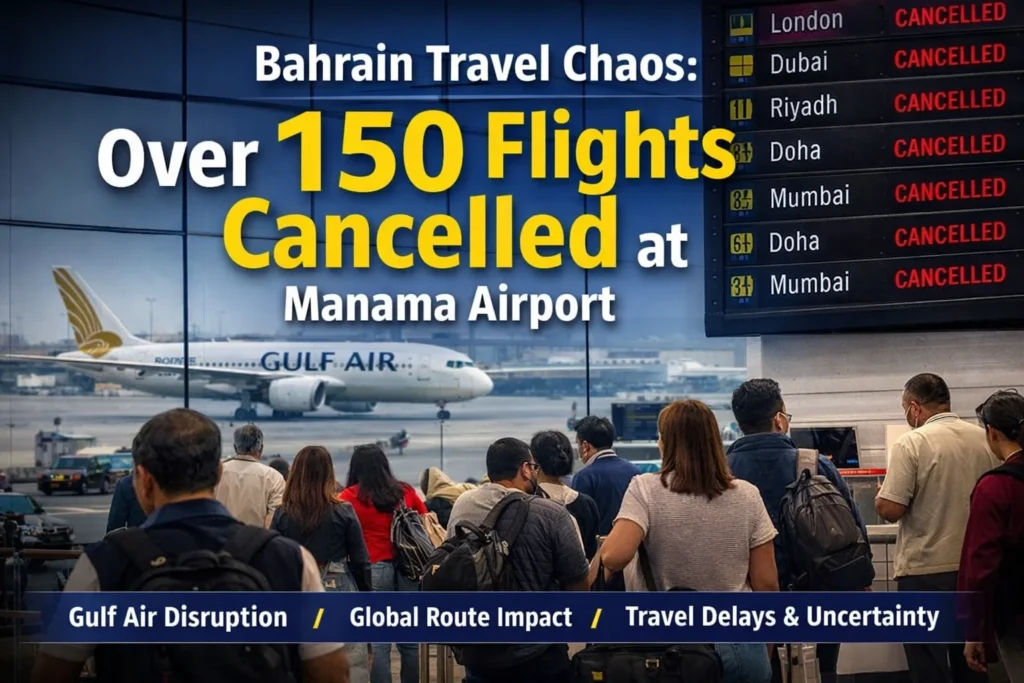
Bahrain’s aviation sector is experiencing a major disruption as more than 150 flights have been cancelled at Bahrain International Airport in Manama, significantly impacting regional and international travel. The widespread cancellations, largely involving Gulf Air operations, have affected routes across the Gulf, the Middle East, South Asia, and key long-haul destinations, leaving thousands of passengers facing uncertainty.
The scale of the disruption highlights the challenges faced by airlines operating in high-density travel corridors, where even localized operational issues can ripple across global networks. With Bahrain serving as a key transit hub, the impact has extended far beyond the country’s borders.
Extensive Impact Across Global Routes
The cancellations have affected a wide range of destinations, including major cities such as Jeddah, Riyadh, Dubai, Abu Dhabi, Doha, Kuwait, and Amman. In addition, international routes to London, Singapore, Bangkok, Guangzhou, and Shanghai have also been disrupted, along with numerous cities across India including Mumbai, Bengaluru, Chennai, Delhi, and Hyderabad.
These routes represent some of the busiest travel corridors connecting the Gulf region with Asia and Europe. Their disruption has created a cascade effect, with passengers missing onward connections and airlines struggling to accommodate demand on alternative flights.
Domestic and regional routes within Saudi Arabia have been particularly affected, with repeated cancellations to cities such as Jeddah, Riyadh, Dammam, and Medina. These routes are essential for both business and religious travel, making their interruption especially significant.
Patterns Reveal Ongoing Operational Challenges
One of the most notable aspects of the disruption is the repeated cancellation of the same flight routes over consecutive days. Flights to key destinations have been suspended multiple times, indicating persistent operational challenges rather than isolated incidents.
Cancellations have occurred throughout the day, from early morning departures to late-night services, suggesting that the disruption is affecting the entire schedule rather than specific time slots. Additionally, a wide range of aircraft types have been involved, indicating that the issue is not limited to a single fleet or technical problem.
Industry observers suggest that such patterns may be linked to factors such as aircraft availability, crew scheduling constraints, and logistical pressures. While official explanations remain limited, the consistency of the cancellations points to broader systemic challenges within airline operations.
Passenger Experience and Airport Conditions
At Bahrain International Airport, the impact of the cancellations is clearly visible. Terminals are crowded with passengers seeking information, while airline service counters are managing a surge in rebooking requests.
Travellers are facing extended waiting times, limited availability on alternative flights, and uncertainty regarding their travel plans. For those with connecting flights, the disruption has been particularly challenging, as missed connections can affect entire itineraries.
Business travellers have experienced delays that disrupt meetings and schedules, while leisure travellers have faced changes to vacation plans. Families and tourists have had to adjust bookings, often at short notice, adding to the overall stress of travel.
Ripple Effect Across Regional Aviation
The disruption in Bahrain has had a significant ripple effect across the broader aviation network. Airports in neighbouring countries, including the United Arab Emirates, Saudi Arabia, and Qatar, have experienced increased passenger volumes as airlines redirect travellers.
Flights arriving from Bahrain have also been affected, creating additional delays and congestion at destination airports. This interconnected nature of modern air travel means that disruptions in one hub can quickly spread across multiple regions.
For airlines, managing these ripple effects requires careful coordination and resource allocation. Adjusting flight schedules, reallocating aircraft, and accommodating passengers on alternative routes are all part of the recovery process.
Challenges for Airlines and Operations
Gulf Air has been at the center of the disruption, with a large proportion of cancellations attributed to its network. The airline’s extensive route map, covering both regional and long-haul destinations, means that any operational issue can have widespread consequences.
Airlines are working to stabilize operations by adjusting schedules and prioritizing key routes. However, the scale of the disruption has made it difficult to fully restore normal service in the short term.
Operational resilience is becoming increasingly important in the aviation industry, particularly in regions with high traffic volumes and complex route networks. The current situation highlights the need for improved contingency planning and resource management.
What Travellers Should Expect
Passengers planning to travel through Bahrain are advised to remain cautious and prepared for potential disruptions. Checking flight status regularly is essential, as schedules may change with little notice.
Maintaining communication with airlines can help travellers secure alternative arrangements more quickly. Flexibility in travel plans, including considering different routes or travel times, can also reduce inconvenience.
Arriving at the airport earlier than usual is recommended, as additional time may be needed to handle rebooking and security procedures.
Looking Ahead
Airlines and airport authorities are actively working to restore normal operations and minimize further disruption. Efforts include improving coordination, reallocating resources, and enhancing communication with passengers.
While the current situation presents challenges, it also underscores the resilience of the aviation system. With coordinated efforts, operations are expected to gradually stabilize, allowing travellers to resume their journeys with greater confidence.
The recent wave of cancellations at Bahrain International Airport serves as a reminder of the complexities of modern air travel. As demand continues to grow, maintaining reliable operations will remain a key priority for airlines and aviation authorities worldwide.