
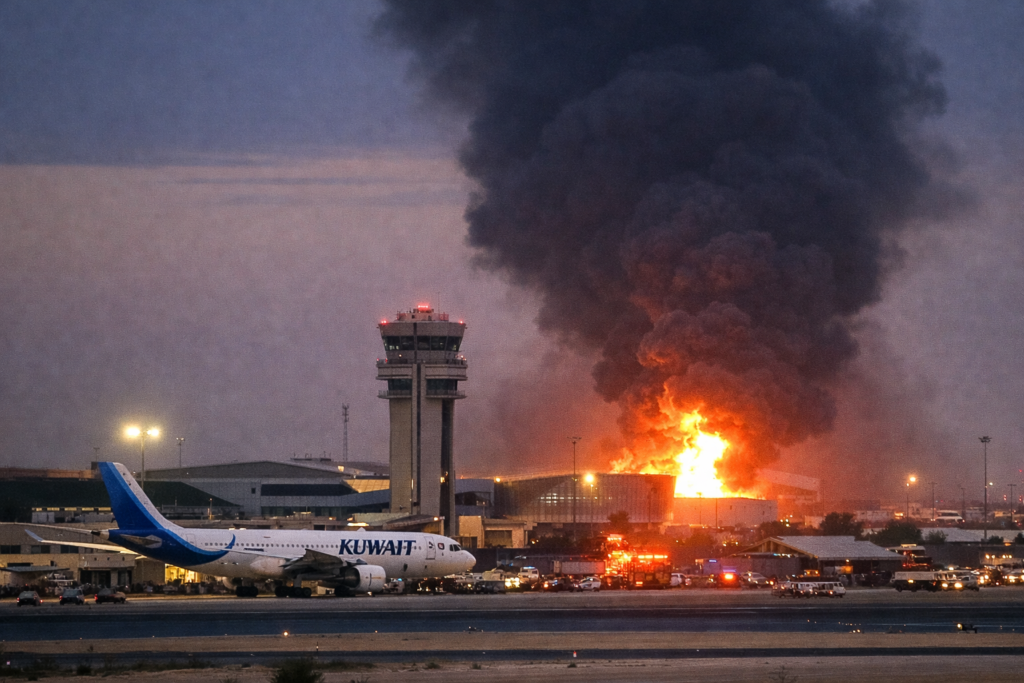
In a dramatic and deeply concerning development, a fire broke out at Kuwait International Airport after drone s reportedly struck a fuel storage tank. The incident has raised urgent questions about regional security, aviation safety, and the growing threat posed by unmanned aerial attacks in the Middle East.
Kuwait, long considered one of the more stable nations in the Gulf, now finds itself confronting a crisis that underscores how rapidly the security landscape is evolving. The airport, a critical gateway connecting Kuwait to the rest of the world, became the centre of emergency response operations as flames and thick smoke engulfed part of its infrastructure.
What Happened: Timeline of the Drone Strike
Initial reports indicate that multiple drones targeted a fuel tank within the airport’s perimeter. Shortly after impact, a fire erupted, triggering alarms and immediate deployment of firefighting units. Emergency crews worked swiftly to contain the blaze and prevent it from spreading to nearby facilities, including passenger terminals and aircraft zones.
While authorities have not yet confirmed the full extent of the damage, early indications suggest that the fire was localised and brought under control before causing catastrophic disruption. However, the psychological and operational impact of such an attack cannot be underestimated.
Aviation Disruption and Passenger Concerns
Although airport authorities acted quickly, the incident inevitably caused disruptions. Flights were delayed, and some operations were temporarily halted as safety protocols were activated. Travellers at the airport reported confusion and concern, with many witnessing the plume of smoke rising from the affected area.
For a major regional hub like Kuwait International Airport, even short-term disruptions can ripple across international flight networks. Airlines are now reassessing schedules, and passengers are advised to check updates before travelling.
Rising Threat of Drone Warfare in the Gulf
This incident highlights a broader and increasingly alarming trend: the use of drones as tools of modern conflict. Across the Middle East, drone attacks have become more frequent, targeting critical infrastructure such as oil facilities, airports, and military bases.
The relatively low cost and high precision of drones make them an attractive option for hostile actors. For countries like Kuwait, which rely heavily on oil and aviation infrastructure, the stakes are particularly high.
Security experts warn that traditional defence systems are often not fully equipped to handle small, agile unmanned aerial vehicles. As a result, nations are now investing heavily in advanced detection and interception technologies.
Emergency Response and Containment Efforts
Authorities in Kuwait responded with notable efficiency. Firefighting teams were dispatched immediately, working under high-risk conditions to control the blaze. Emergency protocols ensured that nearby fuel reserves were secured, preventing a potentially devastating chain reaction.
Medical teams were also placed on standby, though there have been no confirmed reports of casualties at the time of writing. Officials have praised the rapid coordination between airport staff, emergency responders, and security forces.
Security Implications for Travellers
For travellers planning to visit or transit through Kuwait, the incident serves as a reminder of the importance of staying informed. While the situation has been stabilised, heightened security measures are likely to remain in place.
Passengers should expect:
- Increased screening procedures
- Possible flight delays
- Enhanced surveillance at airport facilities
Despite the incident, authorities have reassured the public that safety remains a top priority and that operations are gradually returning to normal.
A Wake-Up Call for Global Aviation Security
The attack on Kuwait International Airport is not just a local issue—it is a global warning. Airports worldwide must now consider the vulnerabilities posed by drone technology and adapt accordingly.
From Europe to Asia, aviation authorities are reviewing their security frameworks to address this emerging threat. The incident in Kuwait could accelerate the adoption of anti-drone systems, including radar detection, signal jamming, and interception technologies.
Looking Ahead: Stability Amid Uncertainty
While the immediate crisis appears to be under control, investigations are ongoing to determine who was behind the attack and how such a breach occurred. The answers will be crucial in shaping future security policies not only in Kuwait but across the region.
For now, Kuwait remains resilient, demonstrating its ability to respond swiftly to unexpected challenges. Yet, the incident leaves behind an undeniable message: in today’s interconnected world, even the most secure locations are not immune to evolving threats.
Source: Reuters and BBC News Middle East, Image generated by AI.