





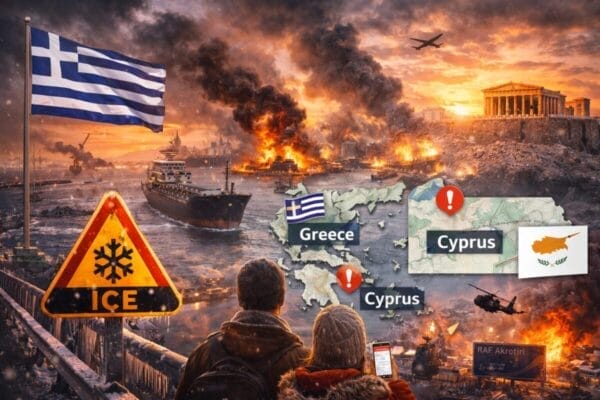
The escalating conflict involving the United States, Israel, and Iran has reshaped the Eastern Mediterranean security landscape. Greece and Cyprus now face direct strategic and economic pressures.
Both countries have moved from observer status to frontline proximity. Military installations, shipping routes, and tourism flows now sit under intense scrutiny.
Government officials in Athens and Nicosia have activated high-level security coordination. National defense agencies continue reviewing contingency plans.
Crete and Cyprus Under Heightened Military Alert
Crete holds major strategic importance due to the Souda Bay naval base. NATO and allied forces rely heavily on this installation.
Security experts warn that retaliatory strikes could target key regional facilities. A recent drone strike near a British base in Cyprus heightened concerns across the region.
Cyprus hosts RAF Akrotiri, a critical military site. Authorities increased surveillance and air defense readiness following recent incidents.
Greek defense officials placed sensitive installations on elevated alert. Civil aviation authorities also continue monitoring regional airspace risks.
Shipping Disruptions Threaten Greek Maritime Power
Greece operates the world’s largest merchant fleet by tonnage. Escalation in the Strait of Hormuz has placed Greek shipping companies under pressure.
War-risk insurance premiums have surged sharply. Shipping operators must choose between costly rerouting and operating in high-risk corridors.
Rerouting vessels around the Cape of Good Hope adds weeks to transit schedules. This detour increases fuel costs and delays deliveries.
The Strait of Hormuz remains vital for global oil shipments. Any instability in this corridor influences global trade and energy supply chains.
Greek shipowners now face rising operational expenses. These costs may ripple through global logistics and commodity pricing.
Energy Price Volatility Hits Domestic Markets
Greece depends heavily on imported oil and liquefied natural gas. Disruptions in Gulf supply routes have triggered price volatility.
Energy analysts warn that fuel prices may climb further. Higher transport costs often translate into broader inflation pressures.
Greece also relies on maritime transit through the Suez Canal. Continued security challenges in the Red Sea add further uncertainty.
If shipping traffic declines, supply bottlenecks could intensify. Energy security has therefore become a top government priority.
Tourism Industry Faces Image Challenges
Tourism remains a cornerstone of the Greek and Cypriot economies. Both countries attract millions of visitors each summer.
However, proximity to expanding conflict zones may affect traveler confidence. Safety perception strongly influences booking decisions.
Recent drone incidents in Cyprus triggered flight cancellations at Larnaca and Paphos airports. Airlines adjusted schedules due to precautionary measures.
Greek tourism authorities emphasize that major islands remain safe and operational. Crete, Santorini, Mykonos, and Rhodes continue welcoming visitors.
Nevertheless, negative headlines can impact short-term demand. Travel agencies across Europe report increased customer inquiries regarding safety.
Port of Piraeus Faces Trade Pressure
The Port of Piraeus serves as one of Europe’s most significant shipping hubs. Disruptions in Suez Canal traffic have altered vessel arrival patterns.
Shipping lines now operate under shifting global routes. Congestion and scheduling adjustments have increased pressure on port operations.
Delays of several days affect cargo turnover. Importers and exporters face higher costs due to extended transit times.
Retailers may also feel the impact through delayed product deliveries. Supply chain volatility continues across multiple sectors.
Migration Pressures and Border Security
Conflict in the broader Middle East may influence migration flows toward Europe. Greece often serves as an entry point into the European Union.
Authorities remain vigilant along maritime and land borders. Border security agencies coordinate closely with European partners.
At the same time, Greece must balance humanitarian obligations with national security. Government councils continue reviewing contingency responses.
Cyprus also monitors potential migration shifts. The island sits geographically close to several conflict-affected regions.
Economic and Geopolitical Implications
The Eastern Mediterranean has become a strategic focal point in global geopolitics. Greece and Cyprus now operate within a more volatile security environment.
Economic planners in Athens continue assessing inflation risks. Energy costs, tourism revenue, and shipping expenses all influence growth forecasts.
Despite challenges, both governments emphasize resilience. Greece has diversified tourism markets and expanded energy partnerships in recent years.
Cyprus continues promoting itself as a secure financial and tourism hub. Authorities highlight strong law enforcement and stable governance.
Outlook for Travelers and Investors
Travel experts advise visitors to monitor official government advisories. Airlines and tour operators continue updating policies as conditions evolve.
Most tourist regions in Greece remain geographically distant from active conflict zones. However, travelers should remain informed.
Investors and businesses closely track shipping and energy developments. The coming months will determine the scale of long-term impact.
For now, Greece and Cyprus face a period of heightened caution. Strong infrastructure and international alliances may help stabilize conditions.
As the Eastern Mediterranean adapts to shifting geopolitics, tourism, shipping, and energy sectors will play a decisive role in shaping regional recovery.
For more travel news like this, keep reading Global Travel Wire