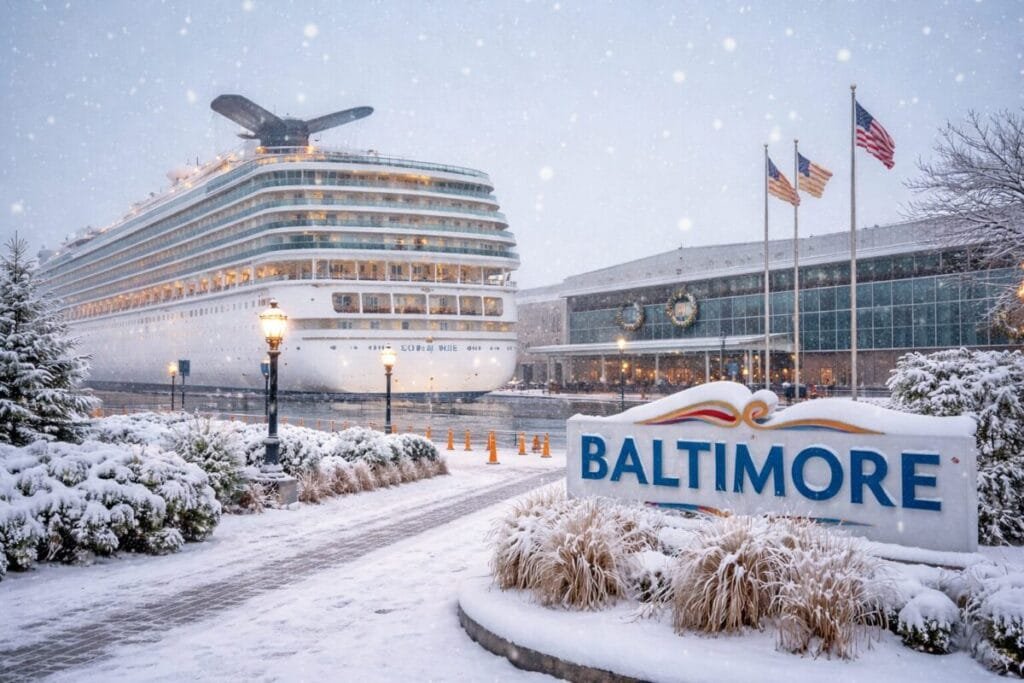
Winter in the Mid-Atlantic has always carried the possibility of surprise, but few travelers boarding the Carnival Pride this January expected a snowstorm to reshape their journey. The 14-night sailing through the Southern Caribbean was scheduled to glide into the Port of Baltimore on January 25, 2026, marking the finale of a voyage filled with sunshine, island rhythms, and turquoise waters. Instead, heavy snow and high winds drifting toward Maryland forced a one-day delay, pushing arrival to midday on January 26.
The change rippled through two groups of passengers at once: those onboard preparing to disembark and those waiting patiently on shore for their turn to sail. For the latter, the delay means a compressed turnaround before embarking on a week-long Bahamas itinerary. While it is far from ideal for those juggling onward travel plans, the moment revealed something larger about the state of modern cruising—its scale, its growth, and its remarkable resilience in the face of logistical interruptions.
Weather Meets a Booming Cruise Market
Weather disruptions are not new to the maritime world. Cruise lines navigate hurricanes, fog, tropical storms, and shifting port conditions every year. Yet the current moment in global cruising makes these interruptions more visible. Demand has climbed sharply since 2023, and the industry now serves more travelers than at any time in its history. As more ships sail from more homeports, the logistical choreography required to operate major fleet deployments has become more intricate.
Baltimore has emerged as one of the beneficiaries of this growth. Once a niche departure point, the city now stands as an increasingly important homeport for travelers along the U.S. East Coast who prefer drive-to cruising over flight-to gateways in Florida. The Carnival Pride has been central to that momentum, offering regular Bahamas and Caribbean voyages that appeal to families, first-time cruisers, and repeat passengers.
The Winter Storm’s Ripple Effect
For those onboard the Carnival Pride, the snowstorm simply added another chapter to their adventure. The delay offered bonus hours at sea, and many leaned into the amenities available on the ship. Specialty dining venues remained lively, the spa extended appointments, and passengers found themselves socializing more freely—something that rarely happens on disembarkation day, which is often rushed and transactional.
For travelers waiting ashore, the announcement sparked a different set of decisions. Hotels near the port saw an uptick in last-minute bookings as passengers adjusted travel plans and extended their stays. Travel advisors, who have witnessed a strong resurgence in cruise bookings, helped clients rework flights and transfers. For Baltimore’s tourism economy, even weather-forced delays come with a subtle benefit: passengers spend more time and money locally, further demonstrating the economic pull of cruise tourism.
A Journey Through the Bahamas Still Awaits
Despite the setback, the upcoming itinerary remained intact—only shorter by a day. When passengers finally board, they will sail toward a blend of private island beaches, Bahamian culture, and warm winter waters, calling on Bimini, Celebration Key, and Princess Cays. These destinations represent the direction the industry is moving: curated environments where relaxation, entertainment, and cultural access coexist smoothly. Cruise lines have invested heavily in such ports of call, recognizing that travelers increasingly seek unique shore experiences rather than merely checking destinations off a list.
Cruise Tourism’s Expanding Footprint
Delays aside, the Baltimore-Caribbean route highlights the broader growth of cruise tourism in 2026. The Cruise Lines International Association projects continued expansion over the next several years, fueled by new ship deliveries, longer itineraries, and surging interest from younger demographics who value experiential and multi-modal travel. The Caribbean remains the world’s most popular cruise region, but secondary routes—Alaska, the Mediterranean, and emerging Asian river corridors—show increasing momentum.
The recent rise in homeport diversification is especially noteworthy. Ports such as Baltimore, Charleston, and Galveston have helped broaden the geographic accessibility of cruising. For regions like Maryland, cruise tourism contributes to local revenue through hotel stays, restaurants, transportation, and port services, strengthening the economic case for maritime investment.
Adaptability Becomes Part of the Experience
For travelers, the Carnival Pride snow delay is a reminder that cruising, unlike flying, is shaped by natural rhythms. Wind, tide, and weather still hold veto power. Yet, paradoxically, this unpredictability contributes to cruising’s enduring charm. Passengers learn to adapt, to linger, to savor an extra sunset at sea. Conversation replaces schedule obsession. The ship becomes not merely transportation, but a temporary home on the water.
As the Carnival Pride finally glides into Baltimore after its unplanned pause offshore, the episode becomes a small chapter in a larger story—one about a sector that has grown beyond entertainment into a major pillar of global tourism. The snow may have slowed disembarkation by a day, but it did little to chill enthusiasm. If anything, the appetite for cruising in 2026 appears stronger than the winter storm that briefly altered its course.
For more travel news like this, keep reading Global Travel Wire