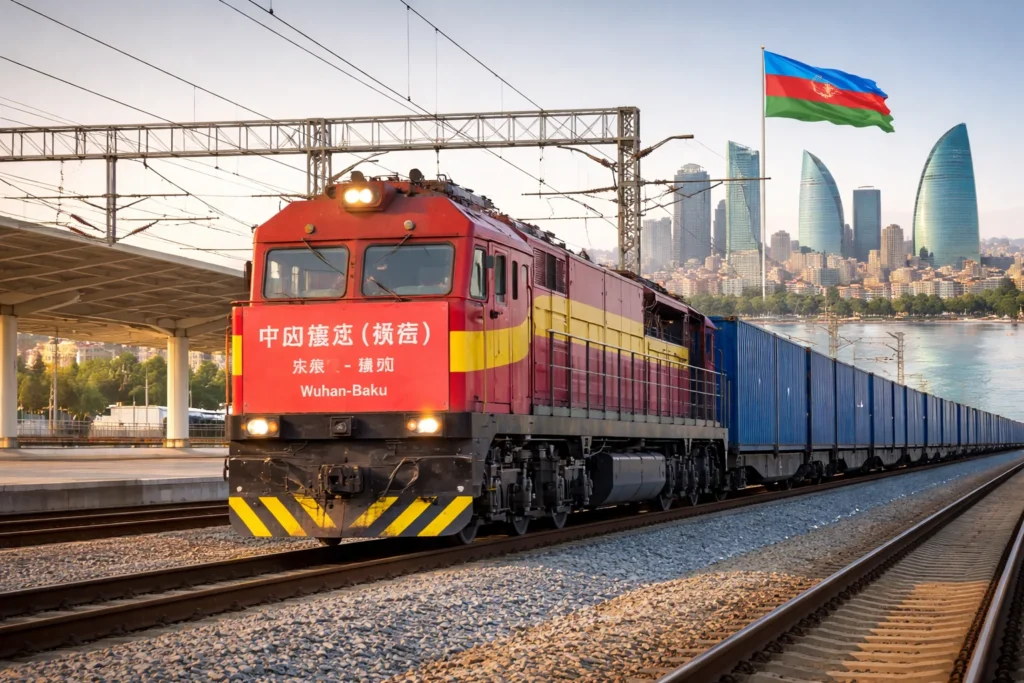
China has launched a new international freight rail service linking Wuhan with Azerbaijan, marking a major development in Eurasian connectivity. The new route strengthens the China Europe rail corridor and supports faster movement of goods across continents.
Officials confirmed that the first train departed from Wuhan, the capital of Hubei province, carrying electronics, household appliances, and consumer goods. The service connects directly to Baku, Azerbaijan, via the Trans-Caspian International Transport Route, widely known as the Middle Corridor.
This development reflects ongoing efforts by transport and railway authorities to improve logistics efficiency and strengthen cross-border infrastructure. It also signals growing integration between Asia and Europe through modern rail networks.
New Route Enhances Travel and Trade Infrastructure
The new rail service follows a multimodal route that combines rail and maritime transport. The train travels through China’s Xinjiang region, enters Kazakhstan, and crosses the Caspian Sea before reaching Azerbaijan.
From Baku, Azerbaijan Railways manages cargo transfers to European-bound trains. This integrated system allows goods to move efficiently toward key European markets.
The full journey takes approximately 18 days, which is faster than traditional routes that can take up to 22 days. This time-saving advantage improves supply chain efficiency and supports business expansion across Eurasia.
For the tourism industry, improved logistics networks often lead to better infrastructure, enhanced connectivity, and increased accessibility across regions.
Wuhan Strengthens Position as Eurasian Logistics Hub
Wuhan has become a major hub for China-Europe freight services. The city now connects to more than 100 cities across over 40 countries through an expanding rail network.
Rail services operate from key logistics centers such as Wujiashan and Xianglushan stations. These hubs support the movement of a wide range of goods, including automotive parts and electronics.
Authorities have also introduced integrated customs clearance systems at Xianglushan station. This reduces processing times and improves operational efficiency.
The expansion of routes in 2025 and 2026 further strengthens Wuhan’s role in global logistics. New connections to Northern Europe and Central Asia are helping diversify transport options.
Middle Corridor Gains Strategic Importance
The Middle Corridor has emerged as a key alternative to traditional shipping routes. It offers lower geopolitical risks and more stable transport conditions.
The corridor spans approximately 4,250 kilometers of rail and 500 kilometers of sea routes. It connects China with Europe through Kazakhstan, the Caspian Sea, Azerbaijan, Georgia, and Türkiye.
This route also provides access to the Middle East, North Africa, and the Mediterranean through integrated port systems.
Favorable weather conditions along the corridor reduce delays and improve reliability. Compared to traditional sea routes, transit times can be significantly shorter.
Rising Cargo Volumes Reflect Growing Demand
Official railway data shows strong growth in cargo movement along the Middle Corridor. Since 2022, freight traffic through Azerbaijan has increased by nearly 90 percent.
In 2025, Azerbaijan Railways handled more than 380 block trains from China. This represents a 35 percent increase compared to the previous year.
During the same period, cargo volumes reached 137,000 TEUs, marking a steady annual growth rate of around 20 percent.
These figures highlight the increasing importance of Eurasian rail corridors in global trade and logistics.
Impact on Tourism and Regional Development
Improved transport corridors often support tourism development. Enhanced connectivity encourages infrastructure investment and regional accessibility.
As rail networks expand, cities along these routes may see increased economic activity. This includes growth in hospitality, local transport, and tourism services.
The Middle Corridor connects diverse cultural regions across Asia and Europe. This creates opportunities for future tourism initiatives linked to rail travel and heritage routes.
Destinations along the corridor, including Central Asia and the Caucasus, may benefit from increased visibility and visitor interest.
Future Outlook for Eurasian Connectivity
The launch of the Wuhan to Azerbaijan freight route highlights a broader shift in global transport strategies. Governments and railway authorities continue to invest in efficient and resilient logistics systems.
The China Europe rail corridor plays a central role in this transformation. It supports faster trade, strengthens supply chains, and enhances regional cooperation.
As infrastructure improves, the corridor may also influence future passenger travel and tourism development. Rail connectivity could become a key driver of cross-border tourism in Eurasia.
For now, the focus remains on freight efficiency and network expansion. However, the long-term impact extends beyond logistics, shaping how regions connect, trade, and potentially travel in the years ahead.