Buyuk Han, one of Nicosia’s most impressive historic structures, has emerged as a flagship example of living cultural tourism in Cyprus. Once constructed as an Ottoman caravanserai to shelter merchants and travelers, the building now stands at the heart of Nicosia Old Town as a flourishing creative center filled with artisan studios, cafés, boutique shops, and cultural events. Its evolution from utilitarian lodging house to a celebrated heritage site highlights not only the history of Cyprus, but also how historic spaces can be successfully reintegrated into modern city life.
From Caravanserai to Cultural Icon
Buyuk Han was built during the late 16th century, when Cyprus was under Ottoman rule. At the time, caravanserais functioned as fortified inns on major trade routes. They provided secure accommodation for traders, animals, and valuable goods, and often served as important economic hubs for nearby marketplaces. Within a few decades of its construction, Buyuk Han became one of the most distinguished stops for travelers entering Nicosia.
Over the centuries, the building weathered neglect, administrative changes, and periods of alternative use. Yet its basic form and purpose remained recognizable. Extensive restoration efforts during the late 20th century enabled the structure to reclaim its original function as a communal gathering place—though now oriented toward culture rather than commerce. This transformation ultimately secured Buyuk Han’s position as one of the most vibrant heritage attractions in the capital.
A Landmark in the Heart of Nicosia Old Town
Geographically, Buyuk Han occupies a prime location inside the historic Venetian Walls of Nicosia. The Old Town is characterized by winding streets, traditional shops, small museums, and layers of architecture reflecting Venetian, Byzantine, British, and Ottoman influence. For first-time visitors, Buyuk Han is often encountered naturally during a walking exploration of the Old Town, making it one of the most accessible heritage sites in the city. Its proximity to Ledra Street and other cultural landmarks ensures consistent foot traffic throughout the year.
Architectural Character and Spatial Layout
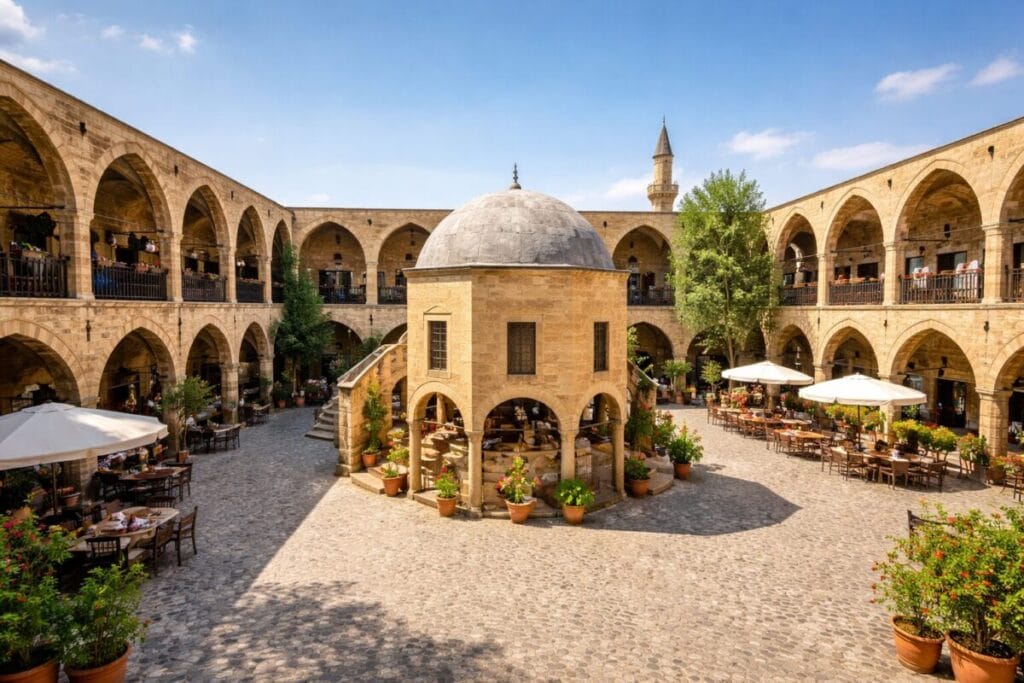
The building exemplifies classic Ottoman caravanserai architecture. It consists of a two-story rectangular layout built around a central open courtyard. Historically, this courtyard served as a vital logistical space for animals and merchant goods. Today, the same courtyard has been reimagined as a tranquil meeting point shaded by arcades, ideal for enjoying coffee, browsing artisan stalls, or simply observing the atmosphere.
The outer perimeter of the courtyard is lined with stone arcades and small vaulted rooms that originally functioned as sleeping chambers and storerooms for traveling merchants. In the present day, these rooms have been converted into workshops, jewelry boutiques, pottery studios, galleries, and specialty retail spaces, providing opportunities for visitors to engage directly with local craftsmanship.
Perhaps the most striking feature of the courtyard is the small octagonal mosque—known as a mescit—located at its center. The presence of a mosque within caravanserais underscored both the communal nature of these buildings and the importance of religious life within Ottoman society. Today the mescit, combined with the arcades and stone detailing, provides exceptional photographic opportunities for architecture enthusiasts.
A Revival Through Culture and Creativity
Buyuk Han’s modern success lies in its adaptive reuse. Rather than turning the structure into a static museum, planners and preservationists positioned it as a space where contemporary Cypriot culture could unfold naturally. Craft demonstrations, art exhibitions, design studios, and regular cultural events animate the site throughout the year. This living-heritage approach resonates especially well with travelers seeking immersive and experiential tourism rather than passive sightseeing.
Families, photographers, history lovers, and casual tourists all find reasons to linger. The building encourages exploration across both levels, and the courtyard café allows visitors to absorb the ambience at a relaxed pace. The flat layout, shaded walkways, and open circulation make the complex accessible to a wide variety of visitors.
A Pillar of Cypriot Heritage and Global Tourism Appeal
Buyuk Han plays a significant role in interpreting Cyprus’s layered historical identity. Within a small geographic radius, visitors encounter Venetian fortifications, Byzantine churches, British colonial structures, and Ottoman public buildings. This architectural mix reflects the island’s longstanding position at the crossroads of Mediterranean and Near Eastern trade networks.
Internationally, Buyuk Han is considered one of the most complete and authentically preserved caravanserais in the Eastern Mediterranean. Its ongoing use as a cultural venue distinguishes it from many comparable buildings that remain empty or conserved solely as museum artifacts. As global tourism trends increasingly favor authenticity, handicrafts, and interactive cultural encounters, Buyuk Han elevates Nicosia’s reputation as a destination where history continues to function in everyday life.
Practical Visiting Information
Buyuk Han can be reached easily on foot within Nicosia Old Town. Public buses operate nearby, and those arriving by car may park outside the Old Town walls and enter through pedestrian gates. Seasonal conditions influence the experience: spring and autumn offer the most pleasant weather, while summer benefits from arcaded shade and winter provides a quieter, less crowded atmosphere.
A Living Monument
More than a preserved relic, Buyuk Han embodies continuity. It connects Cyprus’s Ottoman past with its creative present, making it one of the capital’s defining cultural assets. For travelers who wish to understand Nicosia not just through its monuments but through its daily rhythms, Buyuk Han offers something truly rare: history in use, history alive, and history shared.
For more travel news like this, keep reading Global Travel Wire