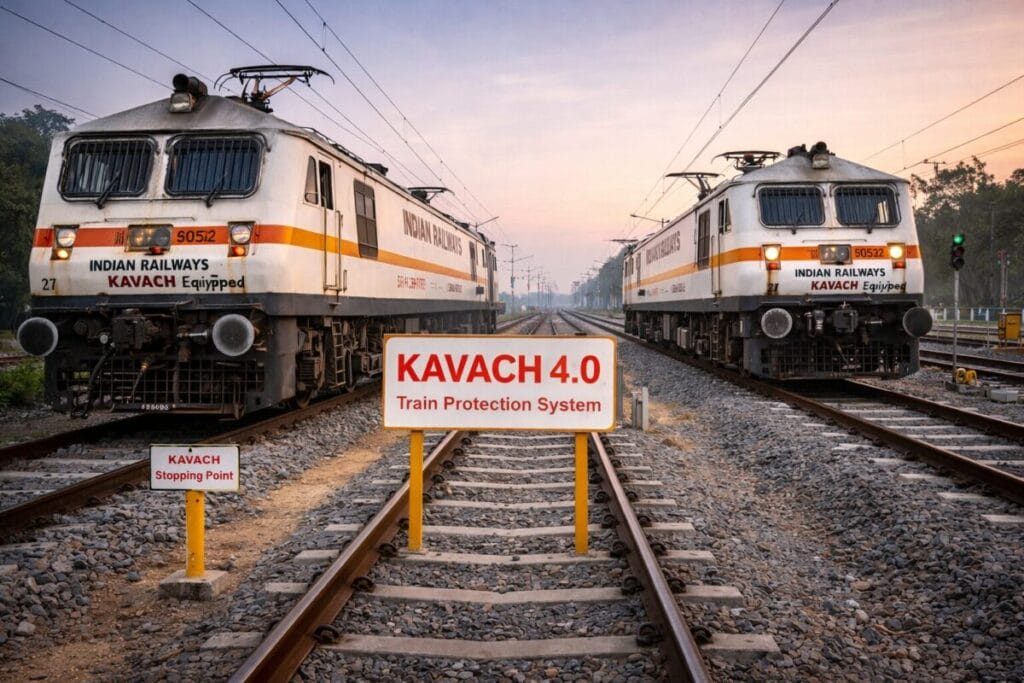
India has taken a major leap forward in rail safety with the large-scale commissioning of its advanced Kavach 4.0 automatic train protection system, marking a landmark achievement for one of the world’s largest rail networks. Rolled out over 472.3 route kilometres in a single phase across three critical corridors, this development represents the biggest one-day expansion of the indigenous safety technology and reinforces India’s commitment to safer, smarter, and more reliable train travel.
Indian Railways serves millions of passengers daily, making safety innovation a national priority. The introduction of Kavach 4.0 on some of the busiest and most complex routes strengthens passenger confidence while laying the groundwork for future operational upgrades, including higher speeds and improved punctuality.
Understanding Kavach 4.0 and its role in rail safety
Kavach 4.0 is the latest evolution of India’s homegrown Automatic Train Protection system. Designed to reduce dependence on manual intervention, the technology continuously monitors train speed, location, and signal status. If a train approaches a red signal, enters a restricted zone, or exceeds its permitted speed, the system automatically applies brakes to prevent potential accidents.
The upgraded version brings enhanced communication reliability, better system redundancy, and compatibility with higher operational speeds. It integrates onboard equipment, trackside devices, and signalling infrastructure into a unified safety framework that functions even in poor visibility conditions such as fog, heavy rain, or night operations. By minimizing human error, Kavach 4.0 significantly raises the safety threshold across equipped sections.
Strategic corridors now protected
The latest commissioning covers three high-density sections of the Indian Railways network: the Vadodara–Virar corridor on Western Railway, the Tuglakabad–Palwal section on Northern Railway, and the Manpur–Sarmatanr stretch within East Central Railway. These routes handle a heavy mix of long-distance passenger trains, suburban services, and freight traffic, making them particularly vulnerable to operational risks.
With this rollout, total Kavach coverage has crossed 1,300 kilometres across multiple railway zones. The selection of these corridors reflects a targeted approach, prioritizing routes where safety interventions can deliver the greatest immediate impact.
Why Kavach 4.0 matters for passengers
For travellers, the most direct benefit of Kavach 4.0 is enhanced safety and peace of mind. Automated protection against signal violations and overspeeding reduces the likelihood of collisions, one of the most serious risks in rail operations. Passengers on these routes can expect more dependable journeys supported by advanced technology working continuously in the background.
Beyond safety, Kavach also improves operational reliability. Automated braking and precise train monitoring help prevent near-miss incidents that often cause cascading delays. Over time, this contributes to smoother schedules and better on-time performance, particularly on congested corridors connecting major cities and industrial hubs.
Enabling future speed and capacity upgrades
Kavach 4.0 is not just a safety system; it is also a foundation for modernization. Sections equipped with advanced train protection can safely support higher speeds, subject to infrastructure readiness. This opens the door to reduced travel times and more competitive rail services, making trains an increasingly attractive option for long-distance and intercity travel.
For tourism, faster and safer rail links enhance accessibility to destinations across the country. Domestic and international visitors benefit from improved connectivity, especially on routes that link cultural, commercial, and heritage centres.
Raising national rail safety standards
One of the strongest advantages of Kavach 4.0 is its ability to significantly reduce accidents caused by human error. On busy mixed-traffic routes, where high-speed passenger trains share tracks with slower freight services, automated intervention becomes critical. The system ensures that even momentary lapses in attention do not escalate into major incidents.
The deployment of an indigenous technology also strengthens self-reliance in critical infrastructure. By developing and scaling its own safety systems, India reduces dependence on imported technologies while building domestic expertise and industrial capacity.
Challenges in nationwide implementation
Despite its success, Kavach deployment still faces challenges. India’s railway network spans tens of thousands of kilometres, and coverage remains limited to selected corridors. Until the system is rolled out more widely, many routes will continue to rely on conventional signalling and safety mechanisms.
Installation is also complex and resource-intensive. Integrating Kavach requires coordination across signalling upgrades, rolling stock modifications, staff training, and system testing. Expanding coverage to remote or less busy routes may take longer due to cost and logistical constraints.
Implications for long-distance and tourist travel
For long-distance passengers traveling on Kavach-enabled routes, the experience is expected to be safer and more reliable, especially during peak seasons or adverse weather conditions. As more corridors are equipped, rail travel will become increasingly appealing for tourists exploring multiple regions within tight schedules.
However, travellers on routes without Kavach should be aware that traditional safeguards remain in place, offering standard but less automated protection. As expansion continues, the benefits of advanced train protection are expected to reach a wider section of the network.
A milestone in India’s rail modernization journey
The commissioning of 472.3 kilometres of Kavach 4.0 in a single rollout stands as a record-breaking achievement for Indian Railways. It signals a decisive move toward technology-driven safety and positions India among global leaders in large-scale rail protection systems.
While nationwide implementation will take time, this milestone highlights a clear direction: safer operations, smarter infrastructure, and stronger passenger confidence. As Kavach coverage expands, it will play a central role in shaping the future of rail travel in India—making journeys not only faster and more efficient, but fundamentally safer for millions of travellers every day.
For more travel news like this, keep reading Global Travel Wire