








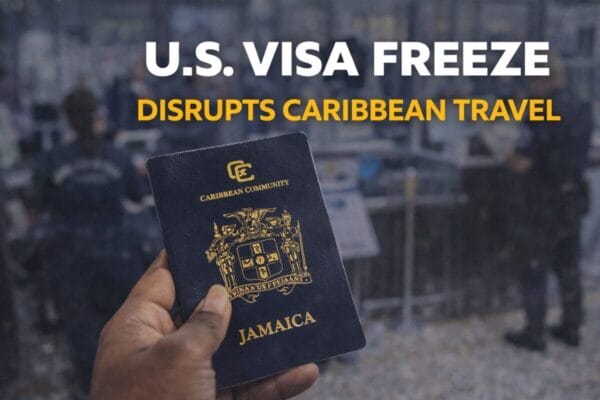
Jamaica has joined a growing list of Caribbean and Central American nations facing serious travel and migration challenges following a sweeping decision by the United States to pause immigrant visa issuance. The move, which took effect in January 2026, has sent shockwaves across the region, affecting families, businesses, and long-established migration pathways that have shaped Caribbean–U.S. relations for decades.
Alongside Jamaica, countries such as the Bahamas, Guatemala, Saint Lucia, Barbados, Dominica, Antigua and Barbuda, Belize, and Haiti are now navigating an uncertain landscape as immigrant visa processing remains on hold. While the decision does not affect tourist or short-term non-immigrant visas, its impact on permanent migration, family reunification, and employment-based travel is already being widely felt.
The pause is part of a broader U.S. review of immigration screening standards, with a focus on financial self-sufficiency and public charge concerns. U.S. authorities are reassessing whether applicants can support themselves without relying on government assistance. Until this review is completed, immigrant visa categories—including family-sponsored visas, employment-based visas, and diversity lottery visas—remain frozen for nationals of dozens of countries.
For Jamaica, a nation with one of the largest Caribbean diasporas in the United States, the consequences are particularly significant. Thousands of Jamaican families have long depended on family-based immigration routes to reunite with relatives, pursue better economic opportunities, and maintain close cross-border ties. The sudden halt has left many applicants in limbo, including those who had already completed interviews or received preliminary approvals.
The Bahamas faces similar challenges, especially for families and professionals with strong links to Florida and other U.S. states. Immigration pathways to the United States have historically supported education, healthcare, and workforce mobility for Bahamian citizens. The visa freeze now introduces uncertainty into long-term planning for individuals and institutions alike.
In Barbados and Saint Lucia, where migration to the U.S. often supports professional development and family stability, the pause is being viewed as more than an administrative delay. Many applicants had aligned career decisions, housing plans, and education choices around anticipated migration timelines. The freeze disrupts those plans and creates financial strain for households that have already invested heavily in the immigration process.
Smaller nations such as Dominica and Antigua and Barbuda are also feeling the effects, particularly in sectors tied to hospitality, healthcare, and skilled labor. Citizens from these countries often migrate to the U.S. for long-term employment opportunities, contributing to remittances that play a vital role in local economies. Any prolonged disruption to these flows could have broader economic implications beyond individual travelers.
Guatemala and Haiti face even more complex challenges. Both countries have significant populations with close family connections in the United States, and migration has long been a critical coping mechanism for economic hardship and instability. The suspension of immigrant visas deepens uncertainty for families hoping to reunite or secure long-term stability abroad.
While tourist visas, student visas, and certain temporary work visas remain available, the freeze on immigrant visas draws a sharp line between short-term travel and permanent relocation. For many Caribbean nationals, permanent migration represents not just opportunity, but family unity, access to healthcare, and long-term security. The inability to move forward with these plans has emotional as well as economic consequences.
The business community is also reassessing its strategies. Companies operating across the Caribbean and the United States rely on predictable immigration systems to transfer skilled employees, support regional offices, and maintain cross-border operations. With immigrant pathways paused, employers are exploring alternatives such as remote work arrangements, temporary visa options, or relocation to other destinations with more predictable immigration policies.
Tourism authorities across the Caribbean are monitoring the situation closely. Although leisure travel remains unaffected for now, immigration uncertainty can influence traveler sentiment, diaspora visits, and long-term tourism investment. Many Caribbean destinations depend on strong ties with their overseas communities, who frequently travel back and forth, invest in property, and support local businesses.
Governments in the region are engaging diplomatically while urging citizens to remain informed and cautious. Officials have emphasized that the visa freeze is under review and may change, but no clear timeline has been provided. In the meantime, travelers and applicants are being encouraged to explore alternative legal pathways, seek professional advice, and prepare for extended delays.
Advocacy groups and legal experts have raised concerns about the broad scope of the suspension, arguing that it disproportionately affects certain regions and undermines long-standing migration relationships. Legal challenges are expected to continue, adding another layer of uncertainty to an already complex situation.
For individuals affected by the freeze, adaptability has become essential. Some are postponing relocation plans, others are pursuing temporary study or work options, while many are simply waiting for clarity. The emotional toll of prolonged separation and uncertainty is emerging as a major concern across the Caribbean diaspora.
As Jamaica and its regional neighbors confront these new travel hurdles, the situation underscores how deeply interconnected the Caribbean and the United States remain. Migration, tourism, education, and business mobility have long formed the backbone of these relationships. While the current visa freeze presents serious challenges, Caribbean nations are expected to continue seeking solutions that preserve mobility, protect families, and sustain economic cooperation.
The coming months will be critical in determining how long the suspension lasts and what form future U.S. immigration policy will take. Until then, Jamaica and other affected countries must navigate a period of uncertainty that is reshaping travel, migration, and regional planning across the Caribbean.
For more travel news like this, keep reading Global Travel Wire