











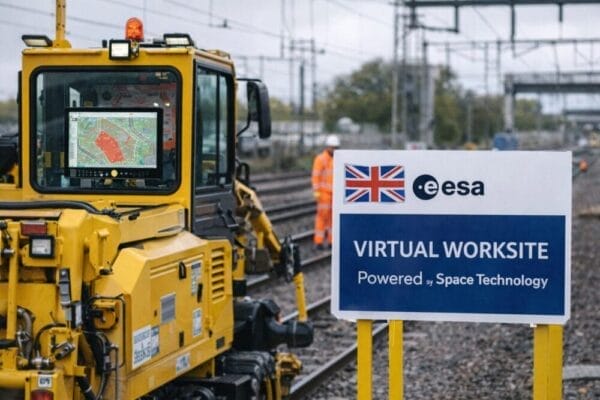
A new partnership between British technology firm Tended and the European Space Agency is introducing an advanced digital solution that could transform the way railway construction sites operate. By integrating satellite positioning technology with innovative worksite management tools, the collaboration aims to make railway infrastructure projects safer, faster and more efficient.
The project focuses on improving the Virtual Worksite Marker Board system, a digital platform designed to replace traditional physical markers used to define construction boundaries along railway lines. The integration of space-based navigation signals and geospatial data is expected to deliver highly accurate positioning for worksite machinery and personnel.
With rail networks across Europe and other regions undergoing modernization, the technology represents a significant step toward smarter infrastructure development and safer working environments for construction crews.
A Digital Alternative to Traditional Worksite Boundaries
Railway construction projects often require teams to operate within clearly defined safety zones. Traditionally, these boundaries are marked using physical panels or signs placed around the worksite. Workers must install and remove these markers before and after maintenance operations, a process that can take valuable time and expose staff to potential hazards.
The Virtual Worksite Marker Board system eliminates the need for physical boundary markers by creating digital worksite limits using geospatial mapping. Instead of relying on manual placement of signs, the system generates virtual safety zones that can be monitored in real time.
Construction machinery equipped with the technology can detect these boundaries automatically. If equipment approaches the limits of the authorized work area, the system alerts operators instantly, helping prevent accidents or unauthorized movement.
This digital approach not only improves safety but also simplifies the preparation process for railway maintenance and construction tasks.
Space-Based Positioning Improves Accuracy
A key element of the project is the use of satellite positioning technology to enhance the precision of the virtual worksite system. By connecting construction equipment to global navigation satellite signals, the system can determine exact positioning within the work zone.
This technology enables accurate monitoring even in complex environments such as railway tunnels, bridges or remote sections of track where traditional positioning methods can struggle.
Satellite-supported positioning provides continuous location updates, ensuring that operators remain aware of their equipment’s exact position relative to the virtual boundaries. This allows construction teams to operate with greater confidence and accuracy during maintenance operations.
By integrating space technology with digital mapping, the system delivers a level of precision that is difficult to achieve using conventional worksite management methods.
Early Trials Show Promising Results
The Virtual Worksite Marker Board technology has already been tested in several pilot projects within the United Kingdom’s rail network. These trials have demonstrated how digital worksite management can improve operational efficiency while reducing safety risks.
In one early deployment conducted with a major railway technology partner, the system helped streamline construction tasks by reducing worksite preparation time and minimizing delays. The results showed measurable cost savings and improved productivity for infrastructure teams.
Additional trials on a major rail corridor showed that digital boundary management could extend available work windows. By removing the need to install and dismantle physical markers, crews were able to start work earlier and complete tasks more quickly.
These early results suggest that the technology could have widespread benefits for rail networks facing increasing demand for maintenance and expansion.
Real-World Deployment in Scotland
The technology has also been introduced in railway operations in Scotland through collaboration with infrastructure and engineering teams responsible for maintaining key rail lines.
Initial deployments showed significant time savings during maintenance shifts. Crews were able to reduce the amount of time spent traveling along tracks to install boundary panels, allowing them to focus more directly on construction and repair tasks.
The reduction in manual worksite setup also lowered the amount of time workers spent in potentially hazardous areas along active rail corridors. By minimizing physical exposure to the track environment, the system contributed to a safer workplace.
These practical benefits demonstrate how digital technologies can support safer working conditions while maintaining high levels of operational efficiency.
Enhancing Worker Safety in Railway Construction
Safety remains one of the most critical challenges in railway construction and maintenance. Workers frequently operate in environments where heavy machinery, active rail lines and complex infrastructure create potential risks.
The introduction of digital boundary management helps reduce these risks by removing the need for manual installation of safety markers. Workers no longer need to enter hazardous areas simply to place or retrieve boundary signs.
Automated alerts and monitoring also help prevent equipment from moving beyond approved zones, further reducing the likelihood of accidents.
By combining real-time positioning data with automated safety alerts, the system provides an additional layer of protection for construction teams working on rail infrastructure projects.
Supporting Modern Rail Infrastructure Development
As rail networks continue to expand and modernize, infrastructure operators are increasingly adopting digital technologies to manage large-scale projects more effectively. Innovations such as satellite positioning, digital mapping and automated monitoring are becoming essential tools for improving construction efficiency.
The collaboration between Tended and the European Space Agency highlights how space technology can support the development of modern transportation infrastructure. By applying satellite-based solutions to railway construction, the project demonstrates how advanced technology can solve real-world engineering challenges.
Industry experts believe that digital worksite systems could become standard practice for rail maintenance in the future.
Potential Applications Beyond Railways
While the technology is currently focused on railway construction, the principles behind the system have potential applications across other sectors.
Industries such as large-scale construction, logistics operations and public infrastructure projects could benefit from virtual boundary management and satellite positioning systems.
Digital worksites could help improve safety standards, streamline project coordination and provide better oversight for complex operations involving multiple teams and equipment.
As digital infrastructure technologies continue to evolve, similar solutions may eventually support a wide range of industries requiring precise location tracking and safety monitoring.
A Step Toward Smarter Infrastructure
The partnership between Tended and the European Space Agency represents a significant milestone in the development of digital infrastructure solutions. By merging space technology with construction management tools, the project demonstrates how innovation can reshape traditional industries.
As railway operators seek ways to improve safety, reduce costs and increase efficiency, technologies like the Virtual Worksite Marker Board offer a glimpse into the future of infrastructure development.
With further testing and refinement, space-powered digital worksites could soon become a central part of railway construction projects worldwide, helping create safer and more efficient transportation networks for the years ahead.
For more travel news like this, keep reading Global Travel Wire