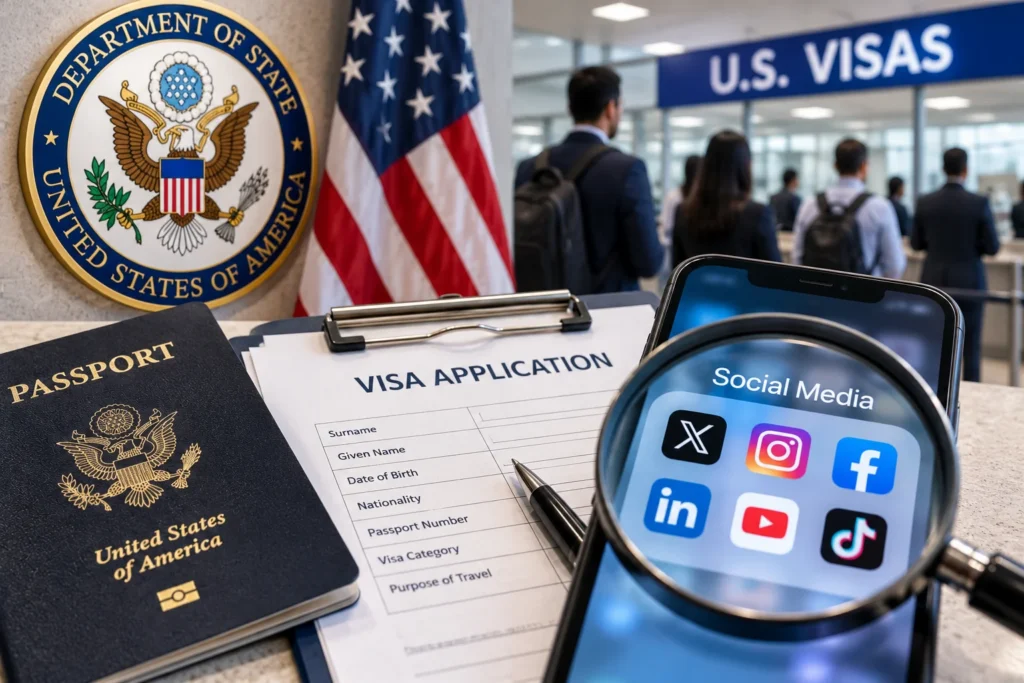
The United States Department of State has expanded its mandatory online presence review process for foreign visa applicants, bringing three additional nonimmigrant visa classifications under heightened screening protocols. Effective immediately, international applicants applying for foreign media credentials, qualifying regional trade professional status, and associated family dependency designations must comply with updated digital background checks before entry credentials can be approved.
Under the updated guidelines, affected foreign nationals must configure the privacy settings on all active social media accounts to public or open status. Official diplomatic statements emphasize that these digital reviews enable consular officers to evaluate applicant eligibility, verify employment credentials, and conduct continuous security vetting before granting temporary entry into the United States.
Foreign Media and Regional Trade Professionals Subject to Digital Vetting
The recent policy expansion introduces mandatory social media reviews to three specific visa classifications:
I Visas: Issued to accredited representatives of foreign media organizations, including journalists, broadcast crews, and editors traveling to the United States in an official professional capacity.
TN Visas: Granted to eligible Canadian and Mexican citizens performing specialized professional activities under the terms of the United States-Mexico-Canada Agreement.
TD Visas: Designed for dependent spouses and children accompanying qualifying trade professionals under the United States-Mexico-Canada Agreement framework.
Federal authorities have instructed applicants across these classifications to ensure that public digital records, online profiles, and professional listings remain fully accessible throughout the application adjudication period. Consular officials evaluate this information to verify that intended activities align strictly with nonimmigrant status regulations.
Continuous Screening Framework Builds on Established Consular Guidelines
The addition of these new categories represents a continuation of established federal screening policies rather than a novel legal framework. The Department of State began requesting social media identifiers from the majority of immigrant and nonimmigrant visa applicants in 2019 to enhance national security assessments and establish identity verification.
Prior to this expansion, online presence reviews were already mandatory for numerous visa classifications, including:
Student and Exchange Visitors: F, M, and J academic and vocational training categories.
Temporary Workers and Cultural Exchange: H-1B specialty occupation workers, H-3 trainees, Q cultural exchange participants, and R religious workers.
Family and Specialized Categories: K fiancé visas, alongside S, T, and U specialized protective nonimmigrant categories.
Federal officials maintain that every visa adjudication constitutes an official national security decision. Foreign applicants bear the legal burden of demonstrating full eligibility for their requested status, verifying their financial resources, and proving their intent to abide by all immigration laws during their stay.
Federal Security Goals Balance International Business and Travel Confidence
By reviewing public digital footprints, consular officers aim to identify potential grounds for inadmissibility, including fraud, misrepresentation of travel intent, or potential threats to public safety. The Department of State emphasizes that thorough pre-issuance background checks protect domestic infrastructure and maintain the integrity of international exchange programs.
Simultaneously, international trade organizations and travel industry bodies continue to monitor how administrative screening requirements impact international visitor sentiment and cross-border commerce. Ensuring clear, predictable consular procedures remains vital for sustaining business travel, professional journalism, and corporate mobility under existing international trade agreements.
As digital background checks become a standard component of global immigration procedures, foreign nationals planning professional or temporary travel to the United States are encouraged to review consular instructions carefully. Ensuring accurate documentation and transparent public profile settings remains essential for seamless visa processing and timely travel authorization.
For more travel news like this, keep reading Global Travel Wire