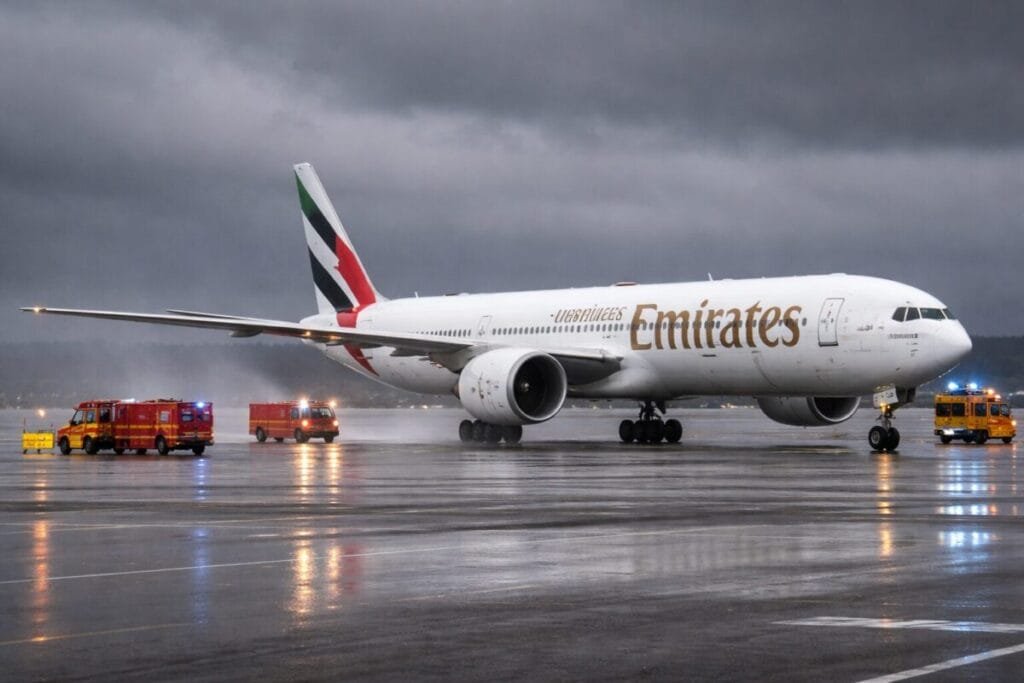
An Emirates flight operating between Dubai and Newcastle faced significant operational disruption on January 27, 2026, after severe winter weather prevented the aircraft from landing at its intended destination. The service, operating as Emirates Flight EK35 onboard a Boeing 777-300ER, attempted two approaches at Newcastle International Airport before diverting to Edinburgh following deteriorating meteorological conditions. The diversion extended the overall journey time by more than three hours and prompted an emergency alert to ensure air traffic control prioritization during the rerouting.
The aircraft was scheduled to arrive in Newcastle shortly after 11:20 a.m. local time. However, weather patterns across northeast England brought strong winds, reduced visibility, and unstable approach conditions, creating an unsafe landing environment. After holding over the Newcastle and Sunderland area, the flight crew elected to discontinue the approach sequence and divert to an alternative airport where conditions would permit a safe landing.
Emergency Alert Issued as Weather Conditions Deteriorated
During the diversion decision, the aircraft broadcast emergency code 7700, a standard transponder signal used within aviation to indicate an urgent situation that requires immediate attention from air traffic control. Although emergency codes can relate to a variety of issues—including mechanical, medical, or meteorological—the broadcast ensures that controllers and emergency personnel are aware of the aircraft’s status and can prioritize its movement through controlled airspace.
Despite the heightened alert status, the aircraft did not encounter a technical failure and was able to land safely in Edinburgh around midday. Emergency declarations during diversions are not uncommon in adverse weather situations, as they allow air traffic services to expedite rerouting and secure required runway slots without delay.
Extended Ground Delay Before Continuing to Newcastle
Once on the ground in Edinburgh, the aircraft remained parked for approximately two hours due to both airport operational constraints and ongoing adverse weather in northeast England. Passengers remained onboard during this period while flight crew and airline operations assessed the conditions for onward travel and coordinated with airport authorities.
Eventually, with weather stabilizing at Newcastle, the Boeing 777-300ER departed Edinburgh for the final leg of the journey, arriving later that afternoon more than three hours behind schedule. Passengers expressed relief at the completion of the journey but also reported understandable frustration at the prolonged disruption.
Airline Emphasizes Safety Protocols Amid Unpredictable Weather
Emirates issued a statement following the event noting that passenger safety remains its highest priority and acknowledging the inconvenience caused by the diversion and subsequent delay. Safety procedures, the carrier noted, are designed to account for scenarios in which adverse conditions make landing attempts impractical or unsafe.
Winter weather disruptions are frequent in northern Europe, particularly during December through February when strong winds, snow, icy surfaces, and poor visibility can affect aviation operations. Although UK airports maintain well-established winter resilience plans, conditions can still exceed operational thresholds for safe landing—especially for larger wide-body aircraft, which require longer runways, increased braking distances, and more stable approach paths.
Impact of Weather on Regional Aviation Operations
The disruption highlights how weather conditions can create cascading effects across air transport networks. Diversions often result in aircraft repositioning, crew duty time adjustments, and schedule changes, while passengers may face onward travel challenges or missed connections. Newcastle International Airport, despite being an important gateway for northeast England, is subject to the same meteorological variability that affects airports across the UK during winter seasons.
Edinburgh’s role as the diversion point reflects existing contingency procedures within UK aviation, where major airports maintain capacity to support unscheduled arrivals. Weather-related diversions are not unusual during winter months, and flight tracking platforms routinely record emergency code transmissions associated with weather, routing decisions, or precautionary measures.
Passenger Experience and Communication Challenges
Passengers aboard the flight described mixed feelings about the diversion. Many praised the professionalism of the flight crew, while others voiced concern about the duration of the delay and limited information during the interim period in Edinburgh. Passenger communication during irregular operations remains a consistent point of scrutiny within the air travel industry, and airlines continue to refine messaging protocols to improve clarity during unforeseen disruptions.
Social media posts following the event indicated that travelers appreciated the safety-first approach, though frustration regarding delay management and lack of firm timelines was common.
A Reminder of the Unpredictable Nature of Winter Air Travel
The incident underscores the unpredictable nature of air travel during winter months and serves as a reminder for both travelers and airlines of the importance of contingency planning. Aviation regulators generally recommend that travelers check flight status prior to departure and allow for schedule flexibility during seasons with increased weather volatility.
For Emirates, the diversion represents a rare operational setback for a carrier known for long-haul stability and high on-time performance ratings. Even so, the event illustrates that disruptive weather remains one of the few variables within aviation largely outside operational control.
As air travel demand continues to expand across Europe, particularly during winter holiday and business periods, airlines and airports are expected to maintain robust contingency strategies to manage irregular operations. Safety, however, remains the non-negotiable priority across all stakeholders, and the precautionary diversion of Emirates Flight EK35 reflects that principle in practice.
For more travel news like this, keep reading Global Travel Wire