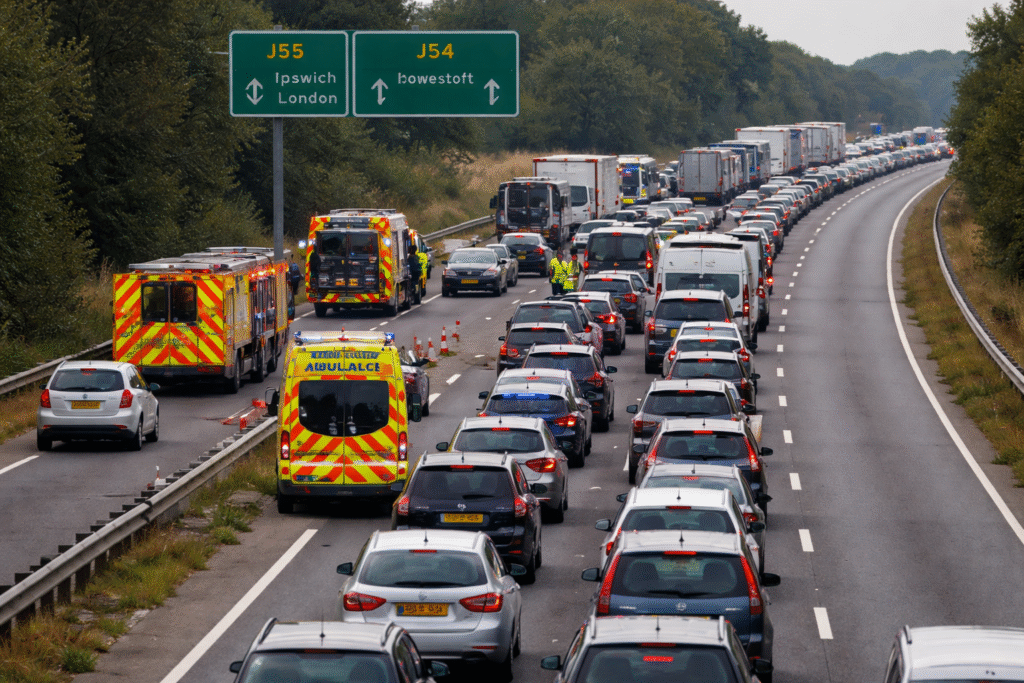
A major traffic incident on the A14 eastbound near Ipswich has caused widespread disruption, creating travel chaos across Suffolk. A two-car collision during the busy morning period led to long queues, heavy congestion, and delays exceeding thirty minutes. The incident has affected not only daily commuters but also visitors heading into Ipswich and nearby destinations.
The crash occurred between junctions 54 and 55, a key stretch of the A14 that connects ports, towns, and tourist hubs across East Anglia. As a result, traffic has slowed to a crawl, with congestion stretching for nearly five miles.
Emergency Services Respond Swiftly
Emergency services arrived quickly at the scene to manage the situation. Police teams secured the area and began directing traffic, while paramedics and fire crews assessed the vehicles involved. Their immediate focus remained on public safety and ensuring injured parties received support.
One lane of the eastbound carriageway was closed to allow emergency operations to continue safely. Although a second lane stayed open, traffic flow remained severely restricted, leading to long queues and mounting frustration for drivers.
Five Miles of Congestion During Peak Hours
The lane closure created a major bottleneck at one of Suffolk’s busiest transport corridors. With morning traffic already at high levels, vehicles backed up rapidly. Drivers reported slow-moving traffic and frequent stops as they approached the crash site.
This stretch of the A14 plays a critical role for regional travel, including access to Ipswich waterfront attractions, coastal towns, and business parks. Even a partial closure can cause ripple effects across surrounding roads, impacting local tourism activity and delivery schedules.
Impact on Commuters and Visitors
The disruption has hit commuters particularly hard, with many facing delays well beyond their normal travel times. Local workers heading into Ipswich, Felixstowe, and surrounding areas have been forced to wait in long queues or reroute through already busy secondary roads.
Visitors travelling for leisure or short breaks have also felt the impact. Suffolk attracts tourists year-round for its countryside, historic towns, and coastline. Travel delays on a main route like the A14 can disrupt hotel check-ins, scheduled tours, and planned activities.
Alternative Routes Under Pressure
Drivers have been advised to consider alternative routes where possible. However, options remain limited. The A12 and surrounding local roads have seen increased traffic as motorists attempt to bypass the affected section of the A14.
These diversion routes are not designed to handle such high volumes, leading to slower speeds and congestion elsewhere. Travel authorities continue to urge patience and caution, especially as unfamiliar roads increase the risk of further incidents.
Ongoing Traffic Management and Updates
Traffic officers remain on site to manage vehicle flow and support recovery efforts. Clearing damaged vehicles and debris takes time, especially when safety checks and investigations are required. As a result, delays are expected to continue for much of the morning.
Drivers are encouraged to allow extra travel time, avoid the area if possible, and monitor official traffic updates before setting out. Businesses and tourism operators in the region may also experience knock-on effects as staff and visitors arrive later than planned.
Expected Clearance and Recovery Timeline
Recovery work is ongoing, but authorities have warned that the affected lane may remain closed for an extended period. Once vehicles are removed and the road surface is checked, traffic should gradually return to normal.
Even after full reopening, congestion may persist as queued traffic clears. Road users should expect uneven flow and remain alert while passing through the area.
What This Means for Suffolk Travel Today
The A14 crash near Ipswich highlights how quickly travel plans can unravel on major routes. With five miles of congestion and delays of over thirty minutes, today’s disruption affects commuters, freight operators, and tourists alike.
Anyone travelling through Suffolk today should plan carefully, allow extra time, and consider rescheduling non-essential journeys. The A14 remains a vital link for the region, and incidents like this underline the importance of flexibility when travelling during peak periods.
For more travel news like this, keep reading Global Travel Wire