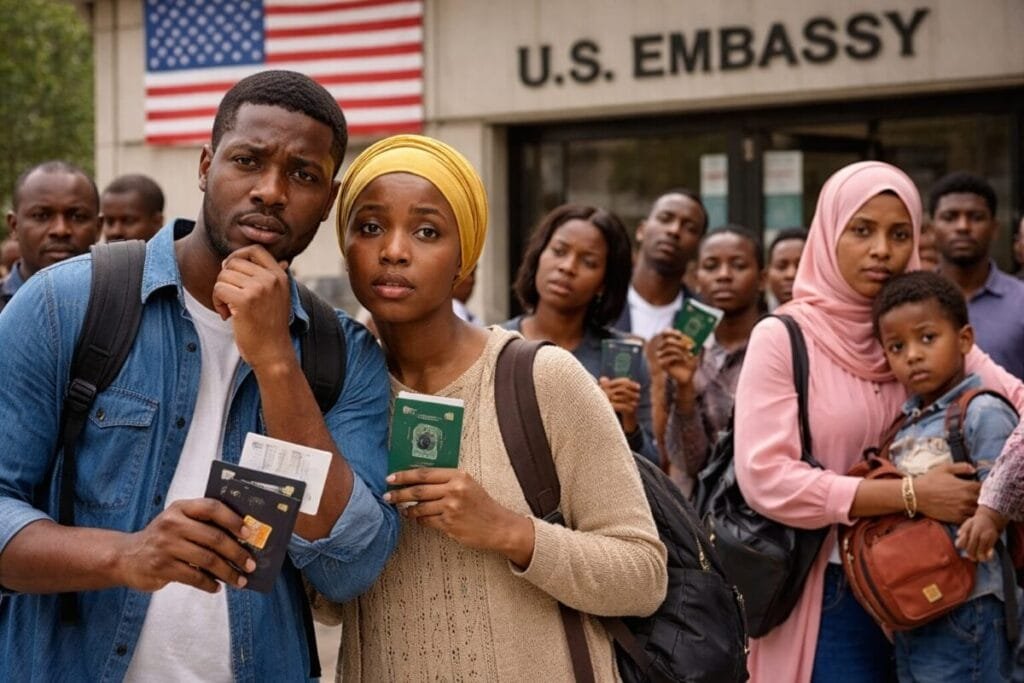
Africa has been thrust into a moment of travel uncertainty after the United States paused immigrant visa processing for citizens from dozens of countries, many located across the continent. The decision has disrupted long-term mobility, stalled education and work plans, and cast a shadow over tourism and aviation networks that rely on predictable international movement.
Egypt, Ghana, Rwanda, Tanzania, Uganda, Zimbabwe and several other African countries now find themselves navigating a landscape in which immigrant pathways to the U.S. have closed, while short-stay visas remain technically open. The mixed signal has created confusion and forced travelers to question whether future plans remain viable.
Families, Students, and Professionals Stuck in Limbo
The freeze arrived at a sensitive moment. Across Africa, study abroad programs, family reunifications, medical travel, and skilled migration have become essential mobility lifelines. The United States has been one of the top destinations for African students and professionals, with many countries building long-term academic and workforce pipelines that now face disruption.
Families are postponing weddings and reunions. Students are delaying admissions. Medical patients are reconsidering treatments abroad. Even professionals with job offers are pausing relocation timelines. The emotional toll is heavy, and the uncertainty is especially painful for diaspora communities that connect their futures across continents.
A New Visa Standard Raises Harder Barriers
The freeze is tied to stricter enforcement of the U.S. public-charge rule. Under this measure, consular officers can deny immigrant visas to applicants considered likely to depend on public assistance. The evaluation includes income levels, age, family size, health status, and financial resilience.
Human rights groups and migrant advocates argue the rule disproportionately harms applicants from emerging economies, where income measurements differ significantly from U.S. standards. Supporters frame the policy as a taxpayer safeguard. For many African applicants, the result is clear: the bar is higher, and the process more adversarial.
Impact on Tourism and Travel Planning
Even though tourist and business visas remain technically available, fear spreads faster than official guidelines. Many travelers simply do not want to risk humiliation, rejection, or wasted expenses during uncertain times. Tourism behavior is highly responsive to policy signals, and the perception of hostility can redirect travel flows even when legal channels remain open.
Hotels and tourism operators in cities with strong diaspora travel — Cairo, Accra, Addis Ababa, Dakar, Casablanca, Lagos, and Johannesburg — are reporting hesitation. Extended stays, academic visits, and family trips make up a significant share of inbound and outbound activity. A drop in confidence can suppress bookings well before data captures it.
Aviation Feels the First Shockwaves
Airlines are confronting a more immediate problem: weakened long-stay passenger demand. Africa–U.S. routes depend heavily on students, immigrants, diaspora families, and business passengers rather than pure leisure segments.
Carriers such as Ethiopian Airlines, EgyptAir, Royal Air Maroc, Kenya Airways, and South African Airways rely on U.S. connectivity to fill long-haul aircraft. Gulf and European hub carriers — including those routing through Doha, Dubai, Istanbul, Paris, and Frankfurt — are also preparing for reduced volumes.
Lower bookings can trigger route cuts, reduced frequencies, higher fares, and reduced seat capacity. For African tourism recovery, this scenario is worrying. Aviation infrastructure takes years to repair once demand collapses.
Quiet Diplomatic Anxiety as Governments Seek Clarity
African governments are monitoring the situation with caution. Mobility is tied to government revenue, university partnerships, skilled workforce development, tourism performance, and remittance flows. Disruptions in U.S. migration circuits could push students and professionals toward Europe, Asia, and the Middle East, shifting global pipelines and reshaping tourism markets.
Officials worry that long-term closures could change settlement patterns. For example, students diverted to European or Gulf institutions often build careers there instead of returning home. Remittances and trade networks evolve around these long-term patterns.
Human Stories Behind the Numbers
While policy debates often revolve around economics and national security, the lived reality is intensely personal. Dreams are paused. Opportunities expire. Children grow older while paperwork sits untouched. Couples wait for reunification. Businesses hold back on expansion. These disruptions ripple across communities, from African capitals to diaspora neighborhoods in U.S. cities.
A Stress Test for Africa’s Travel Future
African tourism entered 2026 in a rebuilding phase after years of pandemic-era challenges. Air links were expanding. Universities were restoring student pipelines. Tour operators were courting African middle-class travelers. The visa freeze now threatens that fragile momentum.
Whether temporary or prolonged, the message to African travelers is unambiguous: mobility can shift overnight, and access depends on politics as much as policy. For Africa, the moment is a reminder that global travel is not merely an industry — it is a lifeline that connects families, knowledge, and opportunity.
For more travel news like this, keep reading Global Travel Wire