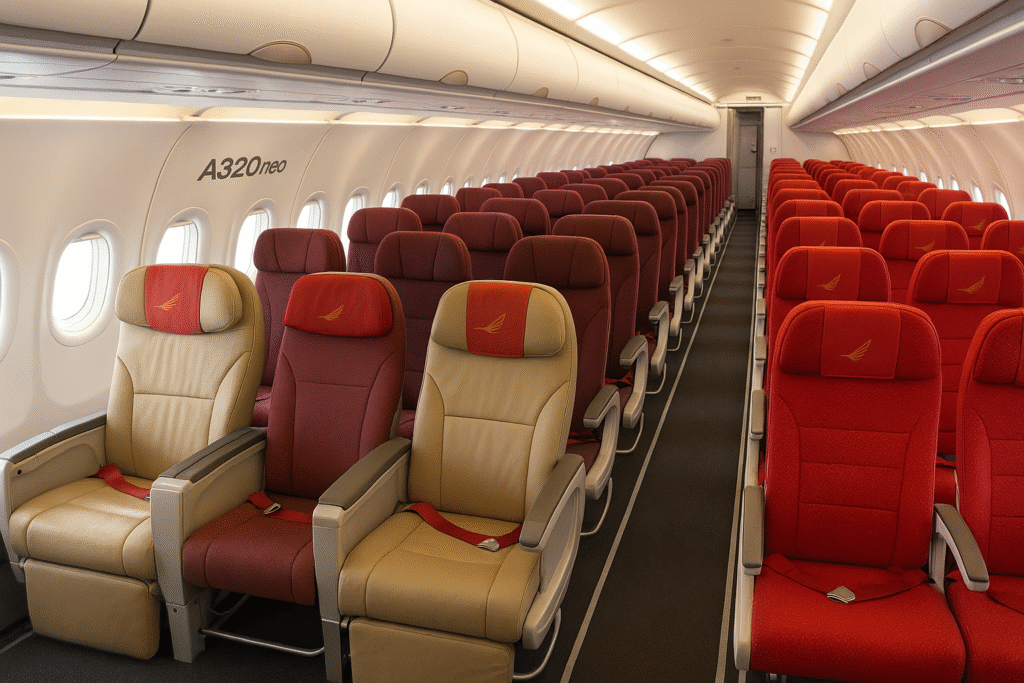
Air India has wrapped up the first major phase of its fleet modernization program by retrofitting 27 of its legacy Airbus A320neo aircraft. The overhaul is part of a wider investment of about $400 million aimed at bringing its cabin interiors and service offering in line with global standards. The project began in September 2024 and completed in October 2025 — within roughly a year.
This marks a significant step for Air India. By delivering uniform, modern three-class cabins on its narrow-body fleet, the carrier is upgrading its passenger experience across busy domestic and regional routes.
What’s New Inside the Aircraft
The makeover introduces a consistent three-class cabin configuration across all the retrofitted A320neos: Business, Premium Economy and Economy. Interiors received substantial upgrades in materials and finishes: more than 450 metres of premium leather, about 15,000 metres of fabric and over 5,000 square metres of new carpeting were installed. Seats now feature USB-A and USB-C ports, enabling passengers to charge devices and access the airline’s on-board streaming entertainment.
Capacity has been boosted as well: over 3,500 new Economy seats, nearly 650 Premium Economy and more than 200 Business seats were added across the 27 aircraft. The aircraft were also repainted in Air India’s refreshed livery, reinforcing the visual transformation.
Network Impact & Passenger Reach
With the upgrades complete, Air India now operates 104 aircraft in its A320 family (including newly delivered jets and those from merged operations) with new or upgraded interiors. These aircraft serve around 3,024 weekly flights on 82 domestic and short-haul international routes.
On domestic schedules, major routes such as Delhi–Mumbai, Delhi–Bengaluru, Mumbai–Chennai and others now feature the retrofitted aircraft. Internationally, short-haul destinations like Bangkok, Phuket, Kuala Lumpur, Malé, Riyadh and Singapore deploy the upgraded jets. The move ensures that high-demand corridors get the enhanced cabin experience.
Why This Matters for Passengers & Aviation in India
For flyers, the upgrade means greater cabin comfort, more class options and better connectivity via device ports and streaming options. For Air India, the investment signals a clear shift – moving away from legacy interiors and inconsistent product offerings to a uniform, branded experience aligned with global carriers.
The retrofit also reflects broader trends in India’s aviation maintenance, repair and overhaul (MRO) sector. With Air India performing such upgrades at scale, it underscores the growing capability of Indian aviation service infrastructure and rising standards of airline product and service.
What Comes Next: Wider Fleet Plans
While the A320neo phase is done, Air India has already set its sights on the next batch of upgrades. In 2026 the airline plans to refurbish 13 legacy A321 aircraft, aligning them with the three-class cabin standard. Parallelly, the widebody fleet — including 26 Boeing 787-8 Dreamliners and later 13 Boeing 777-300ERs — will undergo major cabin upgrades, with completion expected through 2027 to 2028.
These future phases will carry forward the same intent: consistent, premium cabin experience across the network, helping the airline compete strongly in both domestic and international markets.
Challenge & Opportunity
Large-scale retrofit projects carry risks: supply-chain delays, engineering challenges, downtime of aircraft and scheduling for retrofit slots. Air India’s ability to complete 27 narrow-body aircraft in a year is notable. Yet, the wide-body upgrade programme timeline has already shifted due to external constraints.
On the opportunity side, a refreshed fleet supports brand repositioning, customer loyalty, ancillary revenue potential and stronger international competitiveness. For travellers, this means more choice and a better flying experience.
Conclusion
Air India’s completion of the A320neo retrofit phase marks a decisive leap in its transformation journey. Upgraded cabins, added capacity, enhanced comfort and improved connectivity all contribute to a better travel experience. As the airline moves into the next stages of its fleet overhaul, passengers can expect the same investment-led focus on modernisation. For India’s aviation market, the move signals rising product standards and growing domestic capability in aircraft refurbishment.
For more travel news like this, keep reading Global Travel Wire