
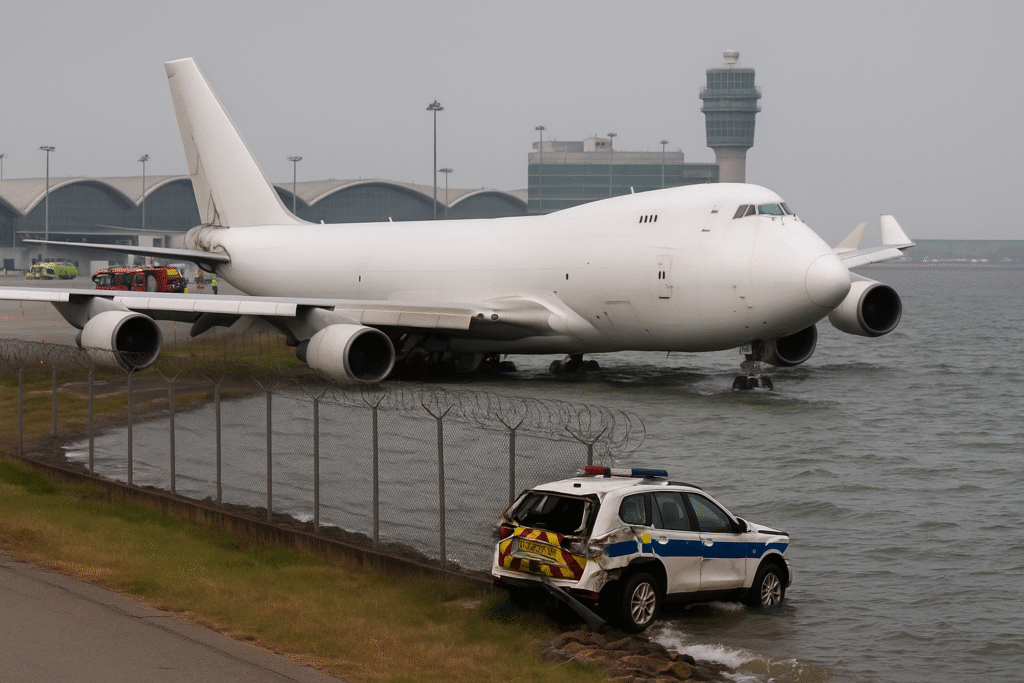
In the early hours of Monday, a devastating accident occurred at Hong Kong International Airport (HKG). A cargo aircraft landing on the north runway veered off course, broke through the perimeter fence and plunged into the sea. Two airport security officers on patrol in a vehicle were struck by the aircraft and lost their lives. Meanwhile all four crew members on the plane escaped unharmed.
What Happened
The flight, identified as EK 9788 arriving from Dubai, touched down around 3:50 a.m. local time. On landing it drifted left of the runway, crossed the safety barrier and hit a security patrol car on the perimeter road. Both the car and the aircraft ended up partially submerged in the waters adjacent to the runway. The two officers — aged 30 and 41 — were retrieved by divers but one died at the scene and the other died shortly after at hospital. The cargo plane, a Boeing 747 freighter, was empty of cargo at the time.
Impact on Airport Operations
In response to the crash, authorities closed the north runway for inspection. The remaining runways (centre and south) remained open, allowing passenger operations to continue largely unaffected. The incident did not trigger a major disruption to holiday or business travel but drew immediate focus onto the airport’s emergency response readiness and ground-safety protocols.
The Human Cost: Security Officers on Duty
The two officers who died were conducting routine perimeter patrol duties in a vehicle outside the airside fence, in accordance with standard operating protocols. Their deaths underscore the dangers faced by ground personnel at major airports. While aircrew and passenger safety often attract the bulk of public attention, this incident reminds us that support and security personnel also operate in high-risk environments.
Investigation Underway
The Airport Authority Hong Kong confirmed full cooperation with investigative bodies including the Air Accident Investigation Authority and the Civil Aviation Department. With weather and runway conditions reported as nominal at the time of the incident, attention now turns to possible mechanical failures, human factors or unexpected system malfunctions. Officials confirmed that the patrol vehicle was outside the runway fence and was operating in a standard area when the aircraft veered into it.
Reviewing Safety Standards and Training
The incident has sparked renewed debate about airport safety standards. Despite Hong Kong International Airport being one of the world’s busiest and most advanced hubs, the accident highlights that even mature airports must continually evaluate risks. Key areas under review include: ground-vehicle routing and protection, perimeter-fence integrity, emergency‐response deployment and aircraft-excursion mitigation. The tragedy underlines the need for regular drills and training that incorporate ground-staff safety as well as flight‐crew procedures.
Wider Implications for Aviation Safety
Globally, this incident serves as a warning call. A cargo plane leaving its designated path and colliding with ground equipment outside the runway fence is an extreme scenario but illustrates the interplay of air-side operations and ground-side risk. Major airports worldwide will likely review their own patrol-vehicle placement, runway safety margins and rapid-response frameworks. As cargo traffic continues to grow, especially at hubs like Hong Kong, ensuring seamless coordination between landing aircraft and ground operations becomes ever more critical.
Support for Families and Staff
The Airport Authority announced it will support the families of the deceased officers, offering both financial assistance and counselling services. Meanwhile it has noted the emotional toll on the airport’s security and rescue community. Officers and staff involved in the rescue and investigation efforts themselves now face the impact of a traumatic event. Airport management has pledged renewed focus on personnel welfare, including trauma-response programmes, following the crash.
Conclusion: A Moment of Reflection and Action
The crash at Hong Kong International Airport is both tragic and sobering. Two officers died performing their duties while the aircraft’s crew escaped serious harm. The fact that the patrol car was outside the runway fence underscores how unpredictable aviation incidents can be and how essential robust safety systems are. Beyond mourning, this event demands action. Review of procedures, reinforcement of ground-staff safety, and stronger integration of emergency protocols are all necessary steps. As investigations advance, the hope is that lessons learned will prevent future tragedies and honour the memory of those lost.
For more travel news like this, keep reading Global Travel Wire