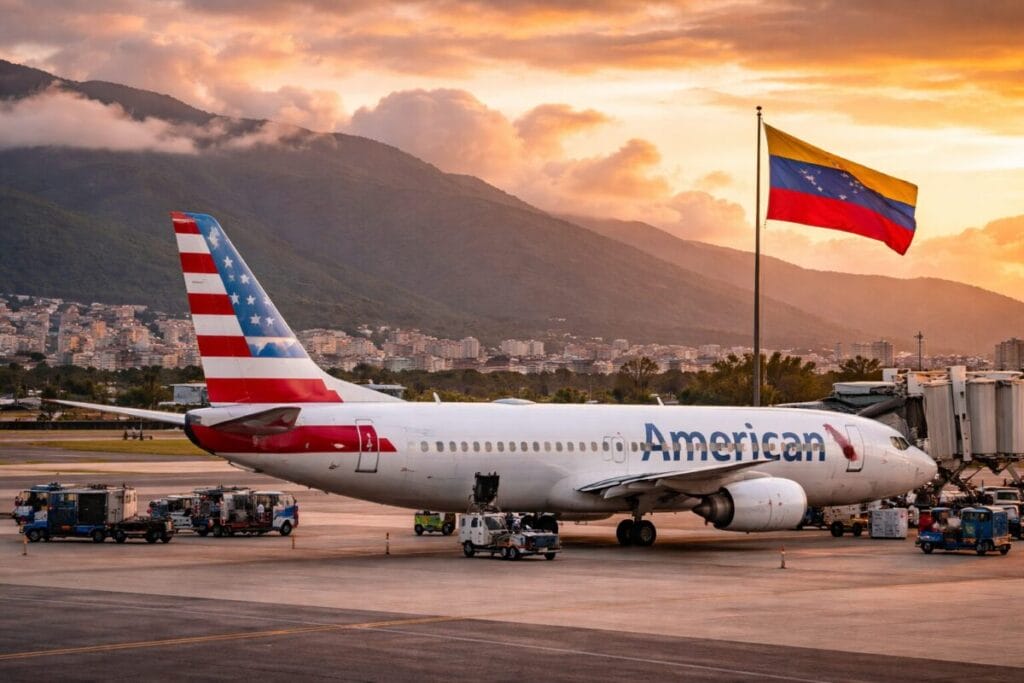
American Airlines is preparing to restart daily passenger flights to Venezuela. If approved, the move would make it the first U.S. carrier to publicly signal a return after nearly seven years of suspension.
Commercial air travel between the United States and Venezuela has remained frozen since 2019. Political tensions, security risks, and diplomatic breakdowns forced authorities to halt all scheduled flights. The new proposal suggests that a limited reopening may now be under consideration.
Government Approval and Security Reviews Still Pending
The airline confirmed it is working closely with U.S. government agencies and aviation authorities. Final approval remains mandatory before any flights can begin.
Security assessments are central to the process. U.S. regulators continue to review safety conditions, airport security standards, and operational risks. American Airlines has stated it is ready to resume service once all requirements are met.
No official launch date has been announced. The plan remains conditional and subject to policy decisions in Washington.
Aviation Emerges as a Signal of Shifting Relations
The possible return of flights comes during renewed debate over U.S.–Venezuela relations. Recent political developments have pushed policymakers to reassess sanctions, enforcement strategies, and diplomatic engagement.
While U.S. authorities have increased enforcement in key economic sectors, they have also reviewed selective engagement options. Aviation has become one of the clearest indicators of whether relations may cautiously evolve or remain restricted.
Air connectivity often reflects broader diplomatic signals. Even limited routes can suggest openness to controlled engagement.
Airlines on Both Sides Position for Change
Interest in reopening air links is growing beyond U.S. carriers. A Venezuelan airline recently renewed its request to operate flights to the United States. The application had remained inactive for more than a decade.
The carrier cited internal political changes and shifting international dynamics as reasons for its renewed push. Together, these moves show airlines preparing for a possible reopening, even as uncertainty remains high.
Regulators have not approved any new routes so far. Still, industry watchers see coordinated positioning on both sides.
American Airlines’ Long History in Venezuela
Before the suspension, American Airlines played a dominant role in U.S.–Venezuela aviation. The carrier entered the market in the late 1980s and expanded steadily over decades.
By early 2019, it was the only U.S. airline still operating scheduled flights to Venezuela. Other major carriers had already withdrawn due to financial losses and operational risks.
The airline maintained strong connectivity from its Miami hub to key Venezuelan cities. These routes served business travelers, families, and diaspora communities.
Strong Demand Before the 2019 Suspension
Passenger demand remained significant before flights stopped. In 2018, American Airlines offered more than 360,000 round-trip seats between the two countries.
That capacity represented over half of the total U.S.–Venezuela market. Overall passenger traffic approached 600,000 round-trip travelers that year.
Despite political strain, demand stayed resilient. Travel supported trade ties, family connections, and essential movement.
Sudden Halt Created a Prolonged Aviation Blackout
In May 2019, U.S. transportation authorities suspended all scheduled and charter flights. Safety concerns and the absence of a U.S. diplomatic presence drove the decision.
The suspension created an unprecedented aviation blackout. No commercial passenger flights have operated between the two countries since then.
Travelers have relied on indirect routes through third countries. These detours added cost, time, and complexity.
Overflights Continued Despite Passenger Ban
Even during the suspension, Venezuelan airspace remained technically accessible. Several U.S. airlines continue to overfly the country on routes to South America.
This shows that airspace access never fully closed. However, commercial passenger operations remained prohibited.
The lack of direct flights has strained families, businesses, and humanitarian travel.
More Than Just a Route Restart
If approved, American Airlines’ return would carry symbolic weight. It would represent cautious re-engagement in one of the region’s most sensitive aviation markets.
For the airline industry, it could unlock years of pent-up demand. For policymakers, it would test whether limited travel links can resume without compromising security goals.
Uncertain Timeline but Renewed Momentum
Approval is not guaranteed, and the timeline remains unclear. Still, the announcement signals growing attention to political and regulatory signals.
After nearly seven years without direct flights, U.S.–Venezuela aviation is no longer dormant. The possibility of planes returning to the skies is once again under active discussion.
For more travel news like this, keep reading Global Travel Wire