The iconic East Wing of the White House, which stood for over a century as a cradle of American cultural and political history, has been demolished—leaving a void in the nation’s architectural memory. In response to that loss, the technology company ARtGlass is stepping in with a ground-breaking solution: an immersive augmented reality (AR) tour that resurrects the East Wing’s spirit and invites the public to explore its storied spaces as never before.
A Historic Structure Lost, But Not Forgotten
The East Wing was built in the early 1900s and later expanded to accommodate the First Lady’s offices and social functions. Over generations, dozens of important cultural and diplomatic events took place within its walls—making it a quiet but significant part of the White House complex. Its demolition triggered emotional responses from heritage-lovers, historians and citizens who regarded the building as the “heart” of the residence’s social life.
Yet the physical structure is now gone. As a response to that loss, ARtGlass has moved fast to fill the gap—not with bricks and mortar, but with digital technology that brings back the past in vivid form. Their new AR tour invites visitors to don smart glasses and walk through what once was: exploring corridors, offices, meeting rooms, and ceremonial spaces of the East Wing, rendered in three-dimensional detail.
Preserving Heritage Through Immersive Technology
The ARtGlass initiative is more than a novelty. It represents a shift in how cultural sites are preserved and shared. Instead of simply photographing or archiving spaces, ARtGlass creates interactive experiences. Through its no-code “TourBuilder” platform, the company can recreate rooms, overlay historical images and videos, and blend past and present so that visitors feel as if they are walking through the original East Wing—despite it having been demolished.
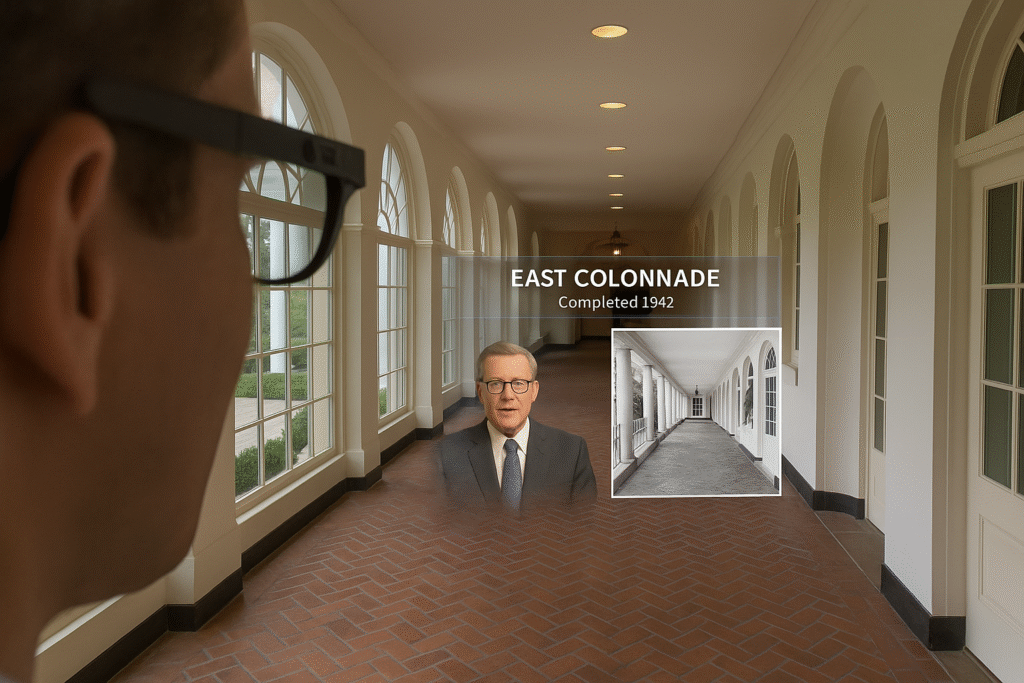
Inside the tour, visitors can explore key spaces such as the First Lady’s office suite, the historic East Colonnade and the former White House Family Theater. These were places where stateside and international guests gathered, where cultural programs were staged and where many personal stories of American history unfolded. Using AR glasses, users can walk these spaces virtually, witness reconstructions of decor, hear voices of those who worked there, and engage with artefacts rendered in high-fidelity digital form.
A New Model for Cultural and Tourism Engagement
While the demolition sparked controversy, ARtGlass is seizing the opportunity to reshape how visitors engage with presidential heritage. This AR tour is designed for public access and could be seen from adjacent outdoor spaces near the White House grounds, making the former East Wing accessible again—albeit in a different form. As the physical entrance has been closed, the AR overlay offers a way to maintain the site’s relevance for tourism and education.
From a tourism perspective, this kind of project has multiple benefits. It brings an additional attraction to Washington, D.C., it aligns with digital-savvy traveller expectations, and it offers accessible heritage interpretation without requiring full reconstruction of the original building. It also aligns with the growing trend of “experience-based” tourism—where history is not just seen but felt, explored and interacted with.
What the Tour Offers Visitors
The AR experience offers a layered insight into the building’s evolution. Users begin with the original construction of the East Wing in 1902, follow its 1942 expansion during wartime, and observe how it functioned as a social and administrative hub for decades thereafter. Along the way they will encounter virtual recreations of major rooms, archival imagery, holograms of historical figures and personal anecdotes from those who worked or visited there.
One of the features is an augmented view of the East Colonnade’s herringbone brick floor and the dramatic entrance spaces of the East Wing, now demolished. Visitors using the AR glasses will be able to move through these spaces virtually, walk the lines of former corridors and observe the architectural detailing no longer accessible in physical form. The narrative overlays help contextualise the décor, furniture, and culture of the time.
Impacts on Heritage, Education and Tourism
By converting loss into opportunity, ARtGlass’s project highlights how technology can play a major role in heritage preservation and tourism promotion. Rather than allowing the memory of the East Wing to fade, the AR tour ensures that its story lives on—accessible to students, tourists and history-enthusiasts worldwide. It also positions the site as a model for how destroyed or endangered cultural assets can be re-imagined digitally.
For tourism authorities and heritage agencies, this kind of project offers a means to engage younger travellers, support inclusive access (including remote access possibilities) and reduce physical burdens on historic sites. The AR overlay can be updated, expanded and adapted, making it a flexible tool for ongoing interpretation and engagement.
A Vision for the Future of Digital Heritage Tourism
With this AR initiative, the East Wing’s legacy is being preserved not just in memory but as an interactive experience. Visitors to the White House precinct can now experience a vanished building in virtual form—and the model heralds a shift in how tourism will evolve in heritage settings. It suggests that demolished or inaccessible historic sites can still be alive in the digital realm, contributing to tourism, education and cultural memory.
The broader implications are clear: in an age of technological advancement, heritage sites no longer need to depend solely on brick and stone. Augmented reality, mixed-reality and immersive digital platforms are turning old buildings into living, evolving experiences—accessible, shareable and engaging. For the tourism sector, this means new kinds of attractions, new audiences and new ways to tell stories.
Conclusion
The demolition of the White House East Wing marked the end of a physical structure—but thanks to ARtGlass’s pioneering augmented reality tour, the wing’s cultural, historical and emotional significance will not vanish. This digital resurrection provides a unique platform for visitors to explore, engage and reflect upon a cornerstone of American heritage. At the same time, it signals a future for tourism where preservation and innovation go hand in hand, ensuring that even lost buildings can continue to inspire, educate and draw travellers for years to come.
For more travel news like this, keep reading Global Travel Wire