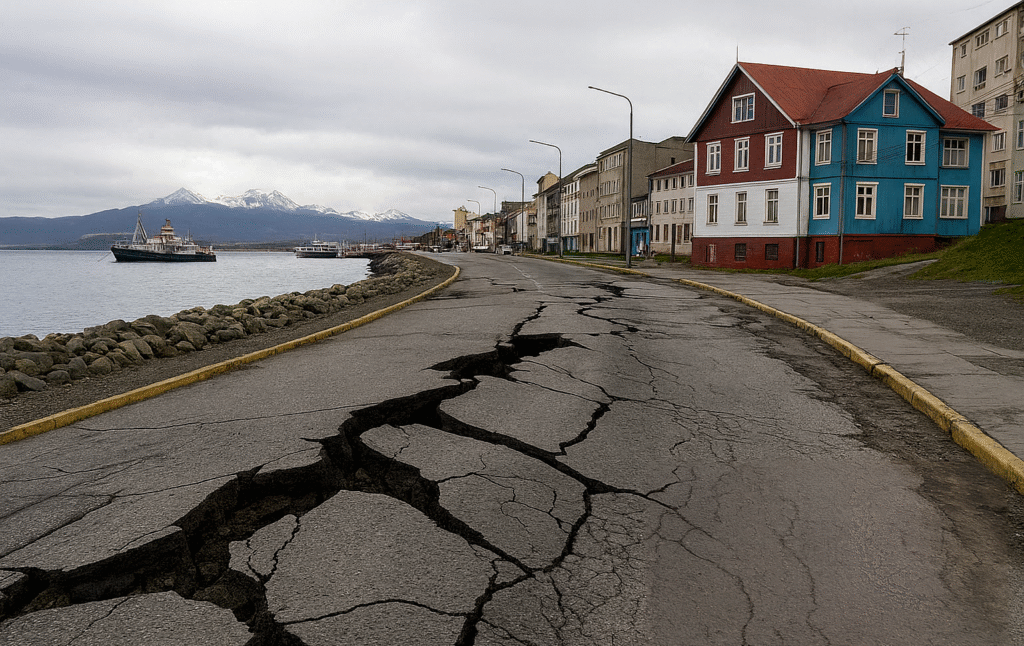
Chile was rocked by a powerful 7.8 magnitude earthquake near the Drake Passage, just one day after a tremor hit Davao in the Philippines. The major quake struck southern Chile’s coastal zone, triggering a tsunami threat for the region. Authorities moved swiftly to assess risks and alert coastal communities.
The Earthquake’s Origin
The quake’s epicenter was in the Drake Passage, the turbulent stretch of ocean between the southern tip of South America and Antarctica. It struck at a shallow depth of around 10 km, making the shaking more intense despite the remote location. The epicenter was estimated to lie about 135–150 miles south of Puerto Williams, in Chile’s Magallanes region.
Rapid Tsunami Alert — And Withdrawal
In response to the quake, Chilean marine authorities and the Pacific Tsunami Warning Center issued a tsunami alert minutes after the event. Coastal regions, especially along Chile’s southern coastline, were placed on high alert. However, after monitoring wave data and sea behavior, authorities canceled the alert roughly an hour following the quake. The intense waves expected failed to materialize, and the threat level dropped back to normal.
Why Tsunami Didn’t Materialize
Deep ocean waters and rough seas in the Drake Passage may have prevented tsunami waves from building or intensifying before reaching land. The distance from densely populated coasts also reduced likely impact. Consequently, no tsunami warnings were extended to distant Pacific regions like the U.S. or Canada.
Impact on Chile’s Southern Regions
Chile’s southern Ñ region, including remote coastal areas, holds a low permanent population, which likely mitigated potential casualties. However, communities such as Puerto Williams and other coastal towns remained on guard. Emergency services in Chile promptly relayed evacuation plans and alerts to residents in vulnerable zones.
Seismic Risk in the Drake Passage
The Drake Passage sits over complex tectonic junctions, making it prone to seismic activity. While moderate quakes occur regularly, a magnitude of 7.8 is exceptional for this region. Historically, quakes here rarely cause significant damage owing to the sparsity of coastal development and the distance from large population centers.
Aftershocks and Ongoing Monitoring
After major earthquakes, smaller quakes often follow. Authorities continue to monitor aftershocks and wave data closely to detect new threats. Residents and visitors along potentially affected routes are urged to stay alert to official advisories. Tourists near Chile’s southern coastline or Antarctic gateways should heed local guidance and remain prepared.
No Threat to Distant Pacific Nations
Due to the quake’s location and wave projections, no tsunami warnings were extended beyond Chile’s region. The seismic event posed minimal risk to distant Pacific nations. Oceanographic models and monitoring suggest that any waves would dissipate before traveling far.
Travel and Tourism Advisory
Travel in southern Chile and Antarctic-access routes may experience delays or trail closures in response to emergency precaution measures. Tour operators monitoring Antarctic expeditions are reviewing schedules. Travelers intending to visit Patagonia, Tierra del Fuego, or polar transit routes should keep watch on updates from Chile’s national disaster agencies.
Lessons and Preparedness
This quake underscores the unpredictable nature of seismic zones along the Pacific “Ring of Fire.” The fast issuance and withdrawal of a tsunami alert reveal how sensitive and responsive early-warning systems must remain. Remote coastal towns illustrate the importance of education, drills, and infrastructure capable of rapid evacuation.
Final Thoughts
While the tsunami alert was brief, the 7.8 quake remains a stark reminder of Chile’s exposure to tectonic risk. Fortunately, the absence of major damage or casualties in this instance offers relief. Still, ongoing vigilance and robust disaster readiness remain essential for coastal and polar-access regions. As conditions evolve, authorities will continue to issue updates to protect lives and safeguard vulnerable travel routes.
For more travel news like this, keep reading Global Travel Wire