
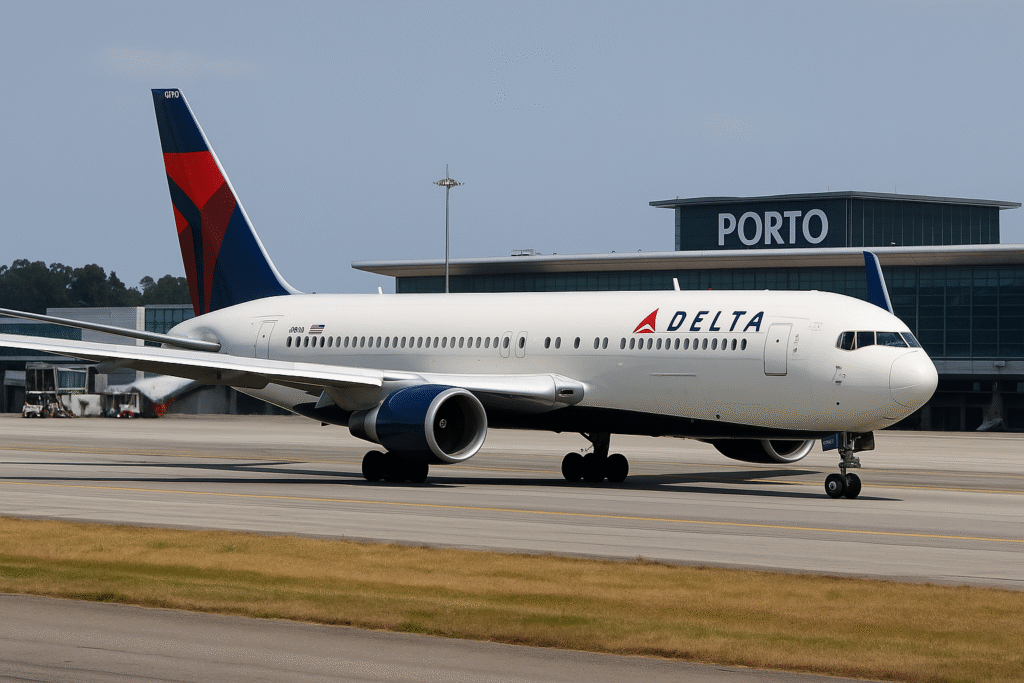
Delta Air Lines has reported strong financial results for its September quarter as elevated demand for premium travel and a rebound in corporate bookings propel revenue upward. The airline also announced a landmark new route that promises to reshape U.S.-Portugal links.
Delta posted operating revenue of about USD 16.7 billion in the quarter, achieving net income of USD 1.7 billion and a pre-tax margin near 10.7 percent. This marks a significant milestone in the airline’s recovery and growth phase.
The standout force behind Delta’s performance is premium travel demand. Passengers are increasingly opting for Delta’s higher-end cabin offerings, boosting average ticket yields. Premium cabin revenue rose sharply, even as main cabin sales softened. In fact, Delta expects premium airfare revenue to overtake economy ticket sales by 2026, signaling a strategic turning point in its business model.
Alongside premium demand, corporate bookings have staged a strong comeback. Sales to business travelers climbed around 8 percent year-over-year, reflecting renewed confidence in corporate travel budgets. Surveys suggest nearly 90 percent of companies expect their travel volume to remain steady or rise. This recovery in corporate demand has reinforced Delta’s high-margin revenue mix.
Delta also fine-tuned its capacity strategy. By reducing seat counts on certain domestic routes, the airline has been able to improve unit revenue. This selective capacity pullback helps avoid price dilution while meeting demand in more lucrative segments.
Delta’s outlook remains optimistic heading into 2026. The airline plans further adjustments in cabin configurations and network plans to lean into the growth in premium segments. As global travel patterns shift, Delta aims to stay ahead by aligning its offerings with passenger preferences.
New nonstop route boosts tourism ties
In a bold move for tourism and connectivity, Delta will launch daily nonstop service between New York’s JFK and Porto, Portugal (OPO) starting May 21, 2026. This marks Delta’s first-ever route to northern Portugal and complements its existing U.S.–Lisbon service.
The seasonal service (running through October) will operate aboard Boeing 767-300 aircraft. Passengers across cabin classes will enjoy premium options including Delta One with lie-flat suites, Premium Select, Comfort+, and standard economy. These enhanced onboard offerings match Delta’s broader push to lean into premium travel.
Porto itself is a destination of growing interest. Nestled along the Douro River, it combines scenic waterfronts, historic architecture, and vibrant cultural life. It’s also globally known for its port wine and nearby Douro Valley vineyards. For U.S. travelers, the new direct link reduces travel friction and opens fresh tourism possibilities.
Local officials see the route as a major boost for regional tourism. The direct link to New York strengthens Porto’s global connectivity and invites more visitors to explore northern Portugal beyond Lisbon.
Key highlights and strategic moves
- Domestic passenger revenue rose about 5 percent year-on-year, boosted by corporate and premium cabin demand.
- Corporate sales growth of 8 percent underscores the return of business travel.
- Delta maintained its reputation for punctuality, leading among U.S. carriers in on-time performance.
- During the quarter, Delta added 31 new aircraft (12 in the quarter) in its ongoing fleet renewal program.
- The airline retired six older aircraft in the quarter, accelerating fleet modernization.
- To support international expansion, Delta’s 2026 European plans include the new JFK-Porto route along with increased service to other regions.
Delta now faces a competitive landscape in which some rivals are scaling back or restructuring. That shift creates opportunities for the airline to capture slots, routes, and passenger share in key markets.
At the same time, Delta remains alert to external risks—particularly trade policies and international aircraft deals. Tariff pressures and geopolitical uncertainties could complicate fleet acquisitions or route expansion. However, Delta’s executives remain confident in pushing forward while preserving flexibility.
As the airline leans into premium travel and strengthens transatlantic connectivity, Delta appears well positioned to tap into evolving travel demand. With solid financial footing and clear strategic direction, the airline is primed to carry momentum into 2026 and beyond.
For more travel news like this, keep reading Global Travel Wire