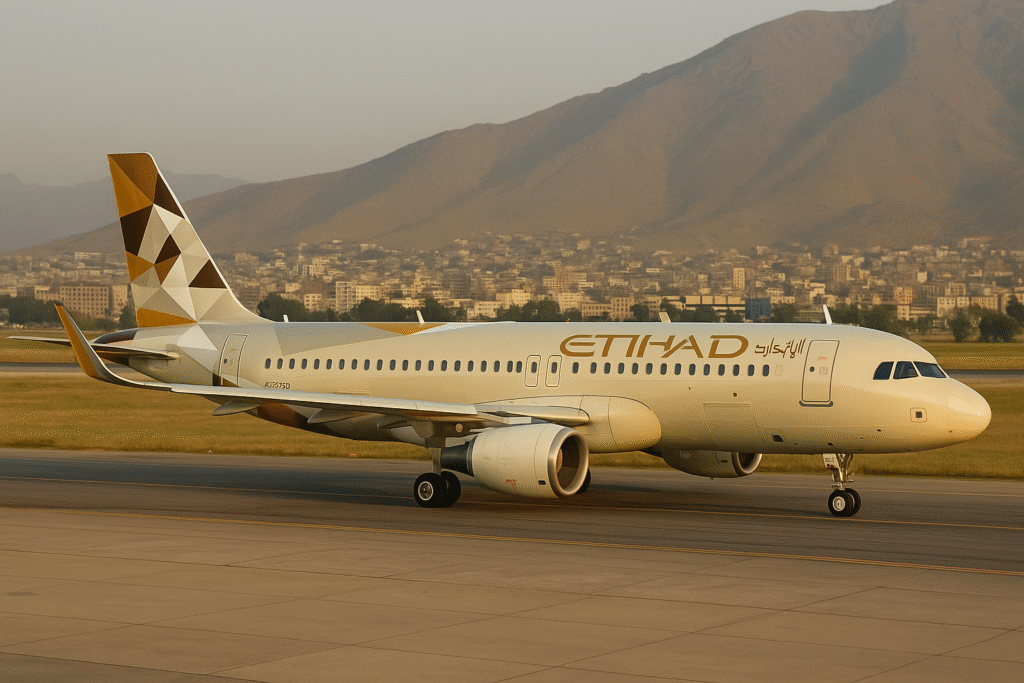
Beginning December 18, Etihad’s new route will fly between Abu Dhabi (AUH) and Kabul (KBL) on Tuesdays, Thursdays, and Saturdays aboard the airline’s Airbus A320, configured with 8 Business Class and 150 Economy seats. The outbound flight (EY310) departs Abu Dhabi at 14:45 and arrives in Kabul at 18:15 local time; return flight (EY311) leaves Kabul at 19:10, reaching Abu Dhabi at 22:10.
This route emerges as Etihad’s 31st new destination in 2025, reflecting its bold growth agenda. The launch is also timed to respond to rising demand for direct travel connections between Afghanistan and the Gulf.
Strengthening Tourism & Diaspora Connections
With a substantial Afghan diaspora in the UAE—estimated at around 300,000 people—this route offers a more direct and comfortable path for families, professionals, and visitors. The direct link reduces transit hassles and opens up easier access for cultural exchanges, family visits, and community engagement.
From the tourism perspective, Afghanistan—with its rich historical legacy and natural landscapes—could gradually welcome more visitors, especially those interested in heritage, culture, and offbeat destinations. Kabul, as one of the world’s oldest continuously inhabited cities, has deep historical significance, and this new connectivity can encourage travel firms to develop curated itineraries in Afghanistan’s major cities and regions.
Moreover, Etihad’s global network means travelers departing from Kabul will have seamless onward connections through Abu Dhabi to destinations across the Gulf, Europe, Australia, and North America. In this way, Kabul becomes more integrated into the international travel web.
Economic & Trade Impacts
The Abu Dhabi–Kabul service is poised to strengthen business and trade flows. Afghan entrepreneurs and enterprises can now tap into the UAE’s role as a regional trading hub more efficiently. The route helps to link Afghanistan to global supply chains via the UAE, facilitating faster movement of goods and personnel.
From the UAE’s perspective, enhancing economic engagement with Afghanistan aligns with its efforts to position Abu Dhabi as a key gateway to broader regional markets. The connection may also attract investment-led ventures in logistics, tourism, and infrastructure across both nations. It is aligned with Etihad’s ambition to drive connectivity between high-potential markets in South Asia and the Gulf.
Regional & Diplomatic Significance
Beyond economics, the new route carries diplomatic and symbolic weight. The UAE has over recent years deepened relations with Afghanistan’s ruling authorities, and resuming or increasing air services is one visible manifestation of that evolving connection.
For Afghanistan’s diaspora and global communities, the direct link helps to reinforce social and cultural bonds. It also signals to regional neighbors and international partners that Afghanistan, despite its geopolitical complexities, remains part of viable transport and connectivity plans in the wider region.
Etihad’s Growth Trajectory & Strategic Network
Etihad’s expansion to Kabul is not isolated. This year, the airline has revealed a flurry of new routes, reinforcing its “Journey 2030” strategy which aims to grow passenger volumes and global footprint. The airline has recorded passenger growth exceeding 80% since 2022 and is gearing up to serve 38 million passengers annually by 2030.
By adding Kabul, Etihad deepens its presence in South Asia and strengthens Abu Dhabi’s role as a transit hub for markets in Central & South Asia. It also complements recent expansions into Africa and other emerging regions.
Challenges & Considerations
While the route presents many opportunities, there are challenges. Afghanistan’s security environment is still volatile, and aviation operations require robust risk mitigation, local infrastructure support, and alignment with regulatory conditions. Tour operators and travelers will need to monitor security, border conditions, and travel advisories carefully.
Moreover, aviation overflight and airspace management have been delicate issues in the region. Airlines flying over or to Afghanistan must navigate overflight fees, airspace permissions, and complex regional coordination. These technical and regulatory procedures may influence operational stability and costs in the early phase of the route’s launch.
What It Means for Travelers & Stakeholders
- For travellers: A more direct, efficient connection between Abu Dhabi and Kabul opens up new options for leisure, business, or family travel. It removes the need for multi-stop transits, and supports access to onward networks from Abu Dhabi.
- For trade and industry: Businesses based in both countries gain faster and more reliable links for cargo, investment travel, and professional exchanges.
- For tourism: This route gives Afghanistan a chance to gradually re-emerge on regional tourism maps, allowing heritage cities like Kabul, Herat, Mazar-i-Sharif, and Bamiyan to become reachable by more international visitors.
- For diplomacy: It underscores the UAE’s role as a connectivity hub and reinforces growing UAE–Afghanistan bilateral ties, socially, economically and politically.
Looking Forward
When the Abu Dhabi–Kabul route launches, it could mark the beginning of broader aviation revival in Afghanistan. If successful, Etihad and other carriers may consider scaling frequency or adding Afghanistan-based connections to other GCC hubs.
In a world where connectivity is a bridge to development, Etihad’s new service has the potential to reshape how Afghanistan engages with the Gulf and the world. By linking Kabul into its network, the airline reaffirms that air travel remains a powerful driver of tourism, trade, and human connection across challenging landscapes.
For more travel news like this, keep reading Global Travel Wire