
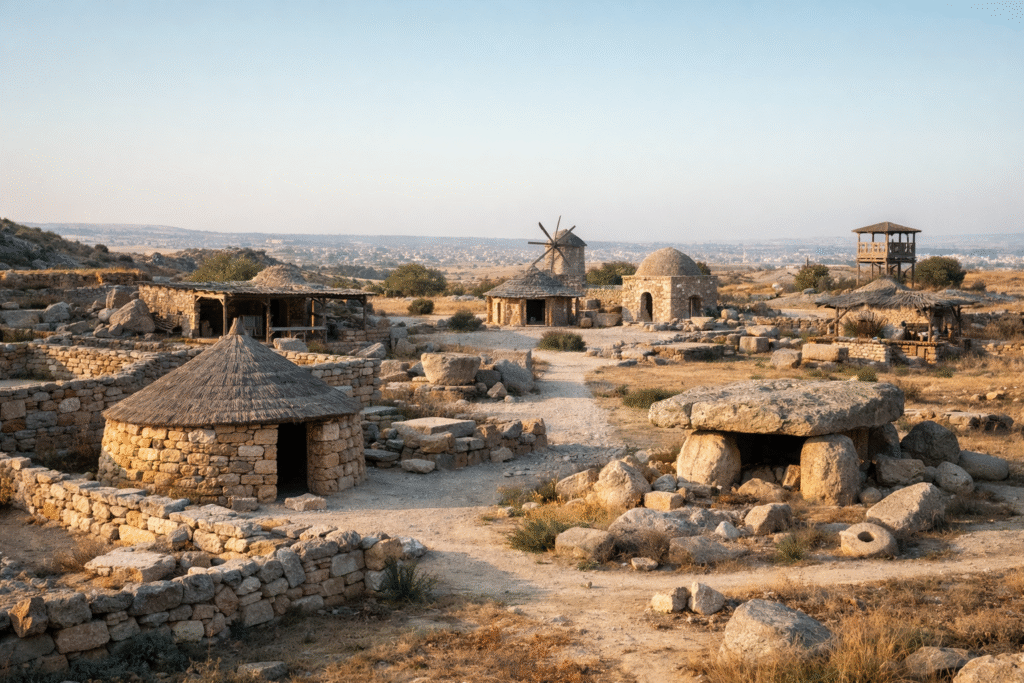
Just a short drive from Azerbaijan’s modern capital, a very different world opens up—one shaped not by skyscrapers or spectacle, but by stone, wind, and human persistence. Gala Archaeological Reserve stands as one of the country’s most meaningful cultural landscapes, offering travelers a chance to walk through layers of life that predate cities, borders, and written history.
Rather than presenting the past as something sealed behind museum walls, Gala invites visitors to experience it directly under open skies. This is not a single monument or excavation, but a living archaeological environment where thousands of years of human activity remain visible in their original relationship with the land.
A Landscape That Explains Human Settlement
Located in the village of Gala on the Absheron Peninsula, the reserve sits within a region shaped by arid conditions, steady winds, and limited natural resources. These environmental factors explain why early communities developed practical lifestyles centered on survival, adaptation, and cooperation.
What makes the location especially compelling is that it remains a lived landscape. Surrounding villages still follow rhythms tied to land and climate, creating a quiet continuity between ancient settlement patterns and present-day rural life. This coexistence adds depth to the visitor experience, turning history into something observed rather than staged.
An Open-Air Record of Human Adaptation
Gala Archaeological Reserve differs from conventional heritage sites by bringing together remains from multiple periods in one coherent space. Visitors encounter prehistoric shelters, burial mounds, ancient stone tools, rock carvings, and later domestic structures without artificial separation between eras.
This layered presentation reveals how life evolved gradually over millennia. Instead of dramatic ruins associated with power or conquest, Gala focuses on ordinary existence—how people built homes, stored food, tended animals, and organized daily routines in response to a demanding environment.
Traces of Prehistoric Life
Some of the oldest elements in the reserve date back several thousand years. Evidence of early pastoral communities can be seen in simple tools, primitive dwellings, and spatial layouts designed for mobility and resilience. These traces may appear modest, but they carry powerful meaning.
For travelers interested in deep history, the absence of monumental architecture becomes a strength. The site emphasizes continuity over collapse, showing how human presence endured rather than disappeared.
Architecture Built for Survival
As societies evolved, more permanent stone structures appeared across the landscape. Homes, enclosures, and storage areas were constructed with thick walls and compact forms to withstand harsh weather and conserve resources.
These buildings tell a story not of wealth or hierarchy, but of practicality. They demonstrate how architecture served daily needs, reinforcing the idea that most of human history has been shaped by ordinary people responding creatively to their surroundings.
Ethnography and Living Memory
Beyond archaeology, Gala also incorporates ethnographic elements that bridge the ancient past with more recent cultural traditions. Preserved tools, household items, and craft demonstrations reflect rural practices that survived into modern times.
This blending of material history and cultural memory makes the reserve especially valuable for visitors interested in identity and heritage. It shows how ancient knowledge continues to influence lifestyles, skills, and values today.
A Site Designed for Slow Exploration
Gala Archaeological Reserve encourages visitors to move at a human pace. There are no rigid routes or forced narratives. Open paths, unobstructed views, and minimal barriers allow travelers to wander freely and form their own connections between structures, terrain, and space.
This approach supports intuitive discovery rather than passive consumption. Visitors are invited to notice how homes relate to wind direction, how burial sites align with landscape features, and how movement shaped settlement design.
Sound, Space, and Atmosphere
One of Gala’s most striking qualities is its quiet. The dominant sounds are wind, footsteps, and distant village life—an acoustic environment likely similar to what early inhabitants experienced. This sensory openness adds emotional authenticity to the visit.
For travel writers and cultural tourists alike, atmosphere becomes as important as information.
A Destination for Responsible Cultural Tourism
Because the reserve exists as an open archaeological landscape, preservation depends heavily on visitor awareness. Respecting pathways, avoiding disturbance of stones, and treating the site as shared heritage are essential practices.
Rather than heavy restriction, Gala relies on education and responsibility, aligning naturally with principles of sustainable and slow tourism.
Anchoring Azerbaijan’s Deeper Story
Azerbaijan is often introduced through medieval cities, fire temples, or striking modern architecture. Gala Archaeological Reserve quietly reminds visitors that the country’s story begins much earlier—with communities learning to live in balance with land and climate.
It grounds national identity not in grandeur, but in endurance.
History Without Walls
Gala Archaeological Reserve does not separate past from present. It allows them to coexist in the open air, under the same sky.
For travelers willing to slow down, it offers more than historical knowledge—it offers perspective. A reminder that before cities and empires, there were people shaping life carefully around land. In Gala, that beginning remains visible, waiting to be walked rather than explained.
For more travel news like this, keep reading Global Travel Wire