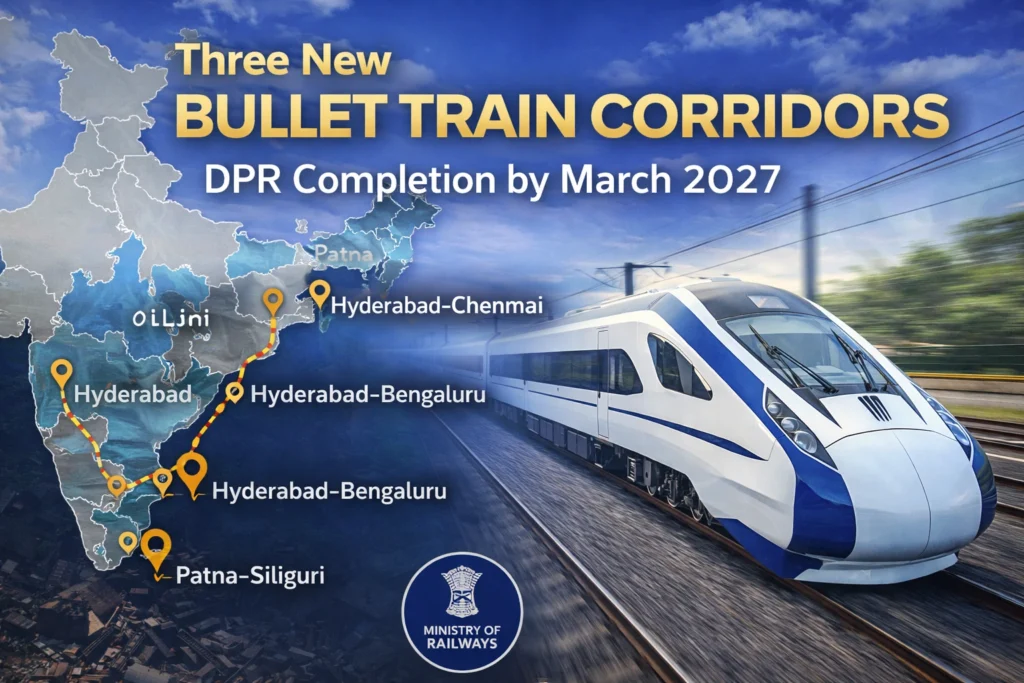
Ministry of Railways has set a target to complete detailed project reports (DPRs) for three new high-speed rail corridors by March 2027. The move marks a significant step in expanding India’s bullet train network.
Officials confirmed that DPR preparation will take place between September 2026 and March 2027. These reports will define timelines, costs, and implementation strategies.
As a result, the projects are moving closer to execution, subject to final approvals.
Three Key Routes Identified
The proposed corridors include Hyderabad–Chennai, Hyderabad–Bengaluru, and Patna–Siliguri routes. These corridors aim to improve connectivity across major economic and travel hubs.
The Hyderabad–Chennai and Hyderabad–Bengaluru routes will strengthen southern India’s transport network. Meanwhile, the Patna–Siliguri corridor will enhance connectivity in eastern India.
Importantly, the Patna–Siliguri section forms part of the larger Varanasi–Siliguri high-speed rail project.
Strategic Importance for Tourism and Travel
These corridors are expected to transform travel patterns across India. High-speed rail reduces travel time significantly compared to conventional trains.
For example, journeys between major cities could be completed in a fraction of current durations. This makes rail travel more attractive for both business and leisure travelers.
Moreover, improved connectivity can boost tourism in emerging destinations. Cities along these routes may see increased visitor arrivals.
Budget Support and Policy Alignment
The Varanasi–Siliguri corridor was highlighted in the Union Budget 2026–27. Nirmala Sitharaman emphasized infrastructure development as a key priority.
This policy support strengthens the case for high-speed rail expansion. It also aligns with India’s broader goals of modernizing transport infrastructure.
Furthermore, the government aims to enhance regional connectivity and economic integration through such projects.
Role of National High-Speed Rail Corporation
The National High-Speed Rail Corporation Limited has been tasked with accelerating work on these corridors.
The agency is responsible for planning, design, and execution of high-speed rail projects in India.
By assigning this role, the Railway Board aims to streamline project development. This ensures faster progress and better coordination.
Indigenous Bullet Train Development Gains Momentum
Alongside corridor planning, India is developing its first indigenous bullet train. The B28 trainset is being designed and manufactured by BEML.
The train is expected to have a design speed of 280 km/h and an operational speed of 250 km/h.
Authorities aim to complete the prototype by March 2027. This timeline aligns with the DPR completion for new corridors.
Passenger Comfort and Modern Features
The B28 bullet train will include modern passenger सुविधाएँ. Fully air-conditioned coaches will ensure comfort during high-speed travel.
Seats will be reclining and rotatable, offering flexibility for passengers. Additionally, accessibility features will support travelers with reduced mobility.
These सुविधाएँ aim to match global standards in high-speed rail travel.
Consequently, passengers can expect a premium travel experience.
Economic and Industry Impact
The expansion of high-speed rail will have wide-ranging economic benefits. Infrastructure projects generate employment and attract investment.
Moreover, faster connectivity supports business travel and regional development. Cities along the corridors may experience increased economic activity.
For the tourism sector, improved accessibility can drive growth. Destinations that were previously less connected may gain popularity.
Challenges and Next Steps
While the projects show strong potential, several challenges remain. These include land acquisition, funding, and environmental clearances.
However, completing DPRs is a crucial first step. It provides a clear roadmap for project execution.
Once approved, construction can begin according to the timelines outlined in the reports.
A Transformative Vision for India’s Rail Network
India’s push for bullet train corridors reflects a long-term vision for modern transport. High-speed rail can redefine intercity travel across the country.
By combining advanced technology with strategic planning, the government aims to create a world-class rail network.
Ultimately, these projects will enhance connectivity, improve travel experiences, and support economic growth.
As India moves closer to this goal, high-speed rail is set to become a key pillar of the nation’s transportation future.
For more travel news like this, keep reading Global Travel Wire