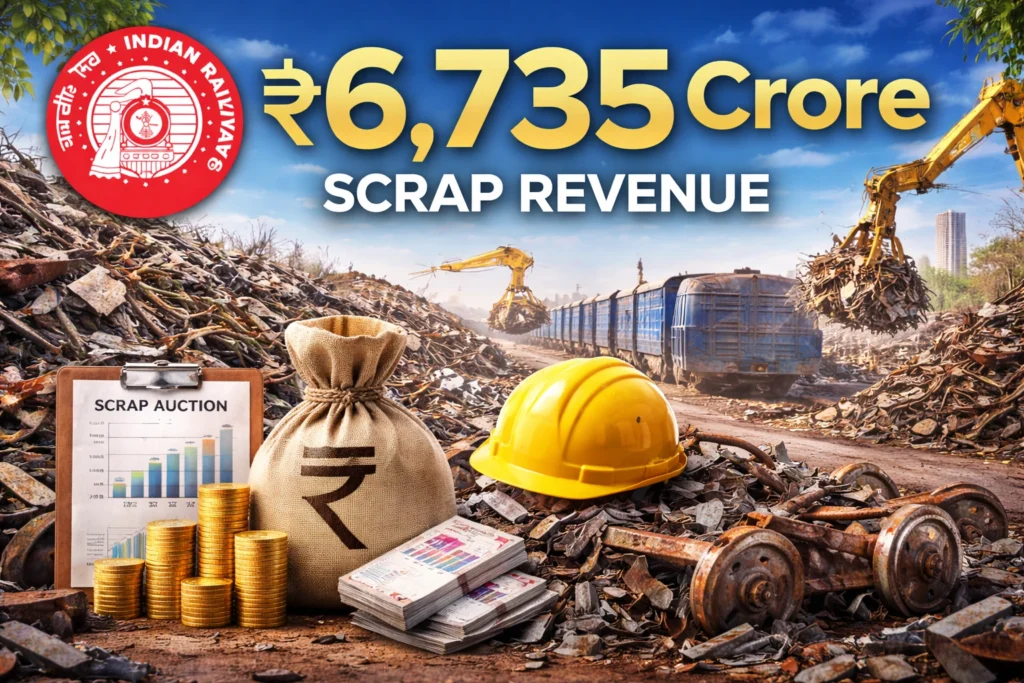
Indian Railways has reported a record ₹6,735 crore in scrap revenue for the financial year 2025–26. The performance exceeds the annual target of ₹6,000 crore by more than 12 percent.
Officials confirmed that total scrap sales reached ₹6,735.52 crore by March 30. This achievement reflects a strong push toward improving operational efficiency and generating non-fare revenue.
Moreover, the final month of the financial year saw a sharp acceleration in auctions. This helped the railways comfortably surpass its target.
Digital Auctions Drive Transparent Growth
Indian Railways conducted over 5,000 e-auctions during the year. Specifically, 5,053 auctions were completed across multiple zones.
These digital platforms improved transparency and price discovery. As a result, the railways achieved higher returns on scrap disposal.
Additionally, online auctions reduced manual processes and increased participation. This ensured competitive bidding and better value realization.
Consequently, digital transformation played a key role in this record performance.
Top-Performing Railway Zones Lead the Surge
Several railway zones delivered strong results. South Central Railway emerged as a top contributor, generating ₹641.92 crore.
Similarly, Western Railway recorded ₹639.96 crore, exceeding its target by over 36 percent. This marked the highest growth among major zones.
Eastern Railway also performed well, achieving ₹595.57 crore. Meanwhile, Northern Railway generated ₹589.62 crore.
Other zones, including Southern Railway and Central Railway, contributed significantly to overall revenue.
East Coast Railway Shows Strong Performance
East Coast Railway, headquartered in Bhubaneswar, also delivered notable results.
The zone generated ₹290.22 crore in scrap revenue, exceeding its target of ₹260 crore. This represents an increase of over 11 percent.
As a result, East Coast Railway ranked among the top-performing zones nationwide.
Cleanliness and Efficiency Initiatives Drive Results
The record revenue is closely linked to national initiatives such as “Swachhata Hi Seva” and “Mission Zero Scrap.”
These programmes focus on clearing obsolete materials from railway premises. They also aim to improve workplace safety and operational efficiency.
Railway divisions removed redundant assets from workshops, yards, and loco sheds. This included large volumes of scrap materials.
Therefore, the initiative not only generated revenue but also improved overall infrastructure conditions.
Large-Scale Disposal of Obsolete Assets
Indian Railways disposed of various types of scrap during the year. These included condemned rails, permanent way materials, and ferrous scrap.
In addition, authorities auctioned decommissioned rolling stock. This included electric and diesel locomotives, coaches, and wagons.
Such large-scale disposal helped free up valuable space. It also improved asset utilization across the network.
Consequently, the railways achieved both financial and operational benefits.
Production Units Contribute to Growth
Railway production units also played a key role in the achievement. Facilities such as coach factories and workshops reported strong gains.
They disposed of obsolete inventory and manufacturing scrap. This contributed significantly to overall revenue.
Moreover, these units improved efficiency by clearing unused materials. This allowed better use of resources and space.
Challenges in Certain Zones
While most zones exceeded their targets, some faced challenges. South Western Railway fell short of its target.
The zone generated ₹154.96 crore against a target of ₹175 crore. This resulted in a negative variation of over 11 percent.
However, overall performance remained strong due to contributions from other zones.
Impact on Rail Infrastructure and Travel
The increase in scrap revenue has broader implications for the rail sector. Higher non-fare earnings support infrastructure development and modernization.
Improved cleanliness and asset management also enhance passenger experience. Travelers benefit from better-maintained stations and coaches.
Furthermore, efficient resource utilization supports long-term sustainability goals.
Outlook for FY27 and Beyond
Officials expect the momentum to continue in the next financial year. With only a small number of auctions pending, the pipeline remains strong.
Indian Railways plans to further expand digital auction systems. This will enhance transparency and efficiency.
Additionally, continued focus on cleanliness and asset optimization will drive future growth.
A Step Toward Financial and Operational Excellence
The record scrap revenue highlights Indian Railways’ commitment to financial prudence. It also demonstrates the importance of non-fare revenue streams.
By combining digital innovation with operational reforms, the railways have achieved significant progress.
Ultimately, the initiative reflects a broader vision of a cleaner, more efficient, and financially sustainable railway system in India.
For more travel news like this, keep reading Global Travel Wire