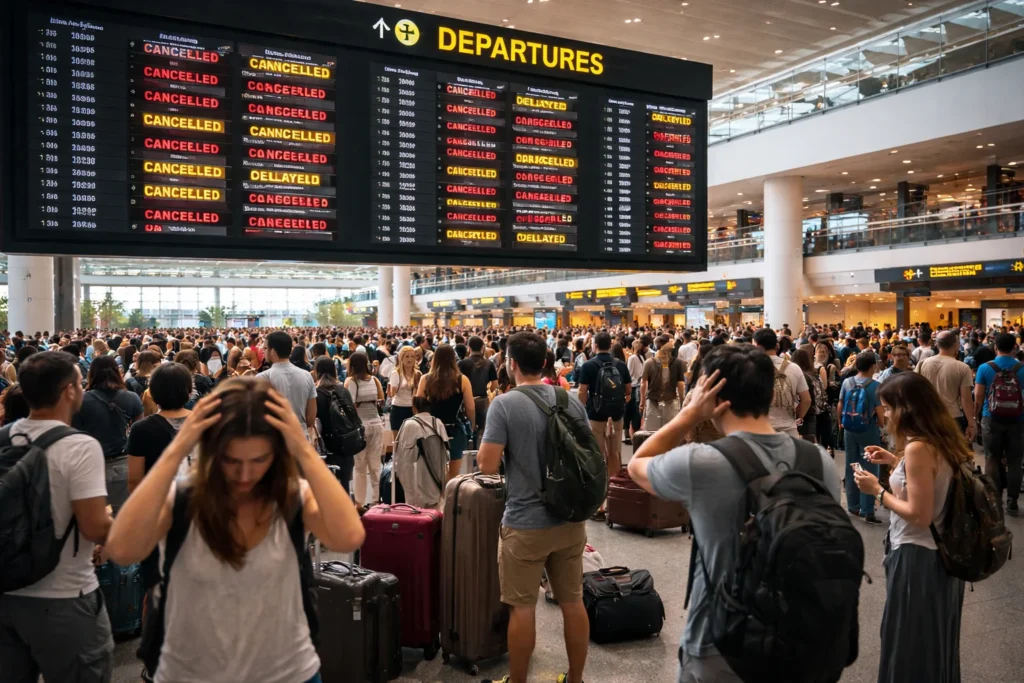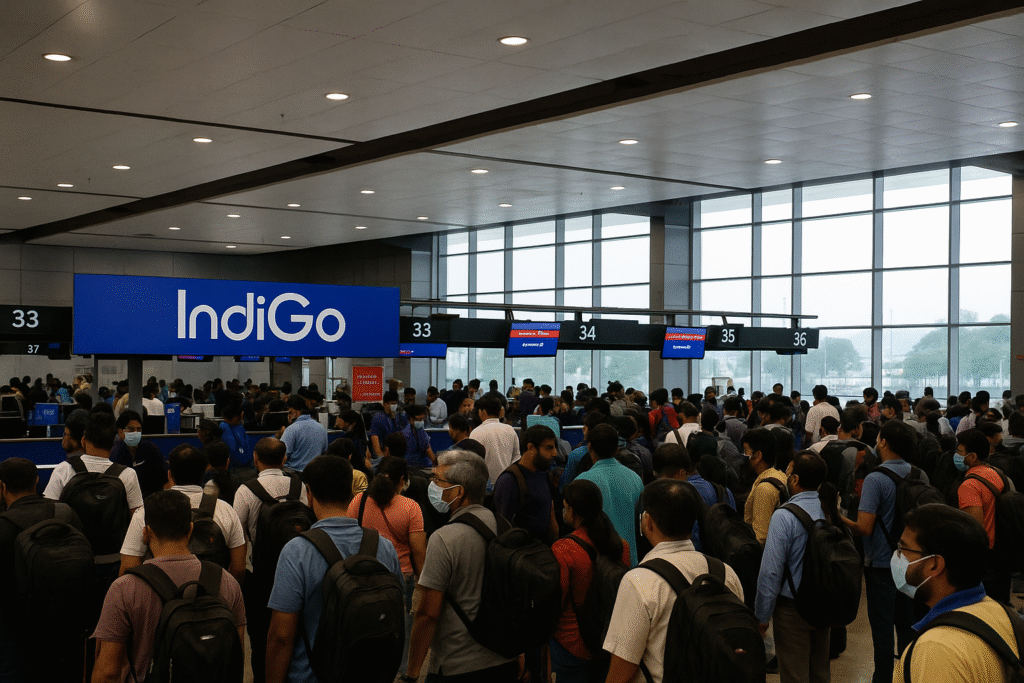
India’s aviation sector is once again in the spotlight as IndiGo’s widespread operational breakdown leaves thousands of travelers stranded. The crisis comes at the peak of the holiday and wedding season, a time when air travel demand surges and tourism revenue spikes. The sudden cancellations and delays have exposed the vulnerability of a market that depends heavily on a single dominant carrier.
Travel Chaos Highlights India’s Reliance on One Airline
IndiGo controls more than 65% of India’s domestic market, giving it an influence unmatched by airlines in most major countries. This scale helped the airline expand into smaller cities and connect new tourism hubs. For years, IndiGo was praised for reliability, affordability, and disciplined operations.
But the recent disruption has changed the tone. Overcrowded airports, grounded planes, and long queues have become common scenes. Some airports struggled to function due to limited parking bays. Pune airport even halted operations briefly when all bays were taken up by grounded IndiGo aircraft.
For travelers, the impact has been severe. Holiday trips were cancelled. Wedding guests were stranded. Tourism operators reported rising losses as itineraries collapsed. The breakdown proved how risky it is for a country to depend on one airline for most of its connectivity.
A Sector Built on Fragile Foundations
India’s airline industry has faced years of turmoil. Many carriers collapsed under financial stress. Kingfisher shut down in 2012. Jet Airways folded in 2019. SpiceJet has faced repeated cash crunches. Go First suspended flights in 2023. Each failure reduced competition and left a gap that IndiGo quickly filled.
IndiGo’s rise brought stability for a while. It offered safe, on-time, and low-fare travel. Millions of new passengers flew for the first time. Tourism in Tier 2 and Tier 3 cities grew faster as air connectivity improved.
But the dominance also created a bottleneck. When IndiGo falters, the entire system feels the shock. Other airlines do not have enough aircraft to pick up the slack. Travelers are left with few alternatives, and prices surge when demand spikes.
Government Faces Pressure to Act
Political leaders and aviation experts are calling for urgent intervention. Many argue that India’s aviation model has unintentionally encouraged a near-monopoly. They warn that depending on one carrier puts both travelers and the tourism economy at risk.
India needs multiple strong airlines to ensure resilience. Countries with larger aviation markets spread their capacity more evenly. In China, the top three carriers combined do not hold the majority of domestic seats. In the United States, several major carriers compete on most routes, preventing overdependence on a single player.
To restore balance, India must rethink its policies.
Air India’s Revival Still a Work in Progress
The Tata Group’s takeover of Air India raised hopes of meaningful competition. The airline’s merger with Vistara aims to build a full-service giant capable of challenging IndiGo. But progress remains slow. Legacy systems, high operating costs, and restructuring hurdles continue to limit Air India’s ability to absorb market share.
Until Air India regains efficiency, India lacks a strong second pillar in its aviation landscape. This weakens the tourism sector, which depends on reliable, affordable flights to grow.
Policy Barriers Restrict Competition
One major barrier to new entrants is the Substantial Ownership and Effective Control (SOEC) policy. It requires Indian airlines to be Indian-owned and controlled. This discourages foreign carriers from investing in India or launching local operations.
Industry specialists believe opening the market to international investment could boost competition. Many countries allow foreign airlines to operate domestic services through local subsidiaries. This increases fleet capacity, reduces fares, and helps stabilize tourism and business travel.
Allowing more players would improve service quality and reduce the pressure on IndiGo. It would also support India’s goal of becoming a major global aviation hub.
Tourism Impact and the Road Ahead
India’s tourism industry relies heavily on smooth air travel. From Himalayan adventure towns to coastal getaways, many destinations need better connectivity. When airlines struggle, tourism slows. Hotel occupancy drops. Tour operators face cancellations. Local economies suffer.
A more competitive airline market would protect these sectors from sudden shocks. It would also support the government’s vision of increasing domestic tourism and boosting international arrivals.
As India updates its aviation strategy, policymakers must balance industry stability with open competition. Encouraging new carriers, easing investment norms, and supporting airport expansion will help distribute capacity more evenly.
Conclusion: A Turning Point for Indian Aviation
IndiGo’s operational crisis is more than a temporary setback. It is a wake-up call. India must build a diversified aviation ecosystem where multiple airlines thrive. Only then can the travel and tourism industry grow without fear of sudden disruption.
A resilient aviation sector will make India stronger, more connected, and better prepared for the next phase of tourism expansion.
For more travel news like this, keep reading Global Travel Wire