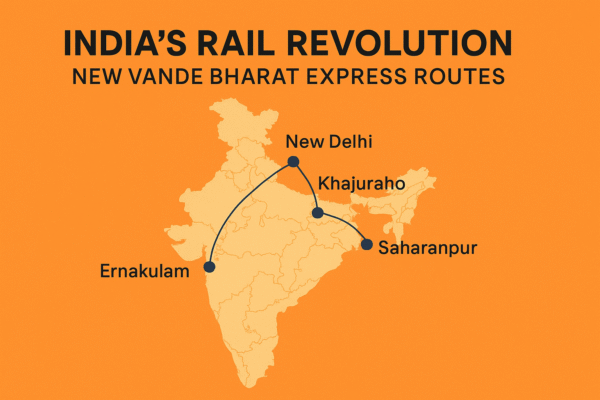
India’s railway map is set for another transformative leap as new high-speed train services under the flagship Vande Bharat Express brand are announced, connecting major cities and cultural destinations across the country. The latest routes will link Ernakulam in Kerala, New Delhi, Khajuraho in Madhya Pradesh, and Saharanpur in Uttar Pradesh, marking a pivotal step in travel-ease, tourism promotion and regional economic uplift.
The Indian Railways’ decision to bring these routes online is part of a broader push to modernize the rail network, shorten journey times, enhance passenger comfort and strengthen inter-state mobility. These new services will not only open up new corridors for business and daily commuting, but equally vital for tourism, enabling visitors to reach historical, cultural or scenic locations more quickly and comfortably.
One of the significant new links joins the vibrant city of Ernakulam in Kerala with other parts of India. Kerala’s peaceful backwaters, tropical landscapes and cultural richness make it a high-demand destination for both domestic and international travellers. Enhanced rail connectivity — faster, modern and direct — means that visitors can incorporate Ernakulam into a broader multi-city itinerary with ease. For example, arriving by Vande Bharat in Ernakulam and then proceeding to other regional spots becomes far simpler.
Another pivotal route focuses on northern India: improved train services linking the national capital, New Delhi, with Saharanpur in Uttar Pradesh and with the heritage town of Khajuraho in Madhya Pradesh. Khajuraho is world‐renowned for its UNESCO-listed temple complex and attracts tourists seeking culture, history and architecture. With faster rail travel, Khajuraho becomes more accessible from major gateways, thereby offering promising prospects for regional tourism growth.
Saharanpur, situated at the northern edge of Uttar Pradesh, gains particular significance because it lies in a corridor that connects Delhi with northern states and beyond. With upgraded Vande Bharat services stopping there or passing through, Saharanpur’s accessibility improves markedly — enabling easier travel for tourists heading toward hill destinations, wildlife zones or cultural circuits that start in the region.
Passengers travelling on Vande Bharat trains enjoy a number of modern amenities. These trains feature automatic doors, sealed gangways between coaches, bio-vacuum toilets, onboard Wi-Fi, comfortable air-conditioned seats and a design speed of up to 160 km/h. With such improvements, travel time reduction is substantial compared with older conventional express trains. The ripple effect for tourism is clear: more efficient travel means more possible itinerary flexibility, fewer travel fatigue constraints and more time at destination.
Moreover, the new services are expected to yield strong economic benefits. Faster connectivity fosters business travel, regional commerce, and the movement of talent. For tourism, the improved rail links mean that hotels, resorts, local tour operators and restaurants in connected destinations can expect higher visitor flows. The accessibility boost is particularly potent for remote or less-served destinations, unlocking potential for new tourism products such as weekend getaways, heritage circuits or rail-based packages that combine multiple cities in a single journey.
From a practical standpoint, tours combining Delhi, Khajuraho and Saharanpur become realistic, and similarly for south-to-south-west or east-to-south circuits via Ernakulam. Visitors can now plan multi-leg journeys with confidence, knowing the rail leg is modern and efficient.
That said, the deployment of these new services also brings challenges which the railway sector and tourism industry must address. Infrastructure upgrades are needed on the track and signalling front to sustain high-speed operations. Reliable scheduling, maintenance of coaches, and passenger comfort management all become critical. For tourism providers in newly connected regions, there must be readiness to handle increased visitor numbers — lodging capacity, local transport, guided tours, and after-hours amenities all matter.
For travellers planning to make the most of these new Vande Bharat routes, some key tips:
- Book early: given the popularity of premium trains and the novelty of new routes, seats can fill quickly.
- Choose route combinations: For example, arrive via Delhi, take the Vande Bharat to Khajuraho, then onward to Saharanpur or further north — taking advantage of the speed and comfort.
- Use the time savings: With shorter travel times, you might convert a full day excursion into a weekend trip or combine two destinations in one visit.
- Gear for local connection: Rail gets you to the major station faster — but local logistics (airport transfers, bus/taxi to remote sites) must be factored in.
- Embrace sustainable travel: Modern trains consume less energy per passenger kilometre compared to flights or long road journeys. By choosing high-speed rail you contribute to greener tourism.
Looking ahead, the induction of these new Vande Bharat routes signals a broader trend across India: improved rail connectivity is increasingly seen as a backbone for regional growth and tourism expansion. By linking major cities with heritage towns, nature-rich landscapes and cultural hubs, the rail network underpins the creation of “rail-accessible tourism circuits”.
For travellers from within India and those from overseas who include India in their itinerary, the message is that multi-destination rail travel is now far more viable, comfortable and efficient. The days when one city meant one long train journey or overnight bus are drawing to a close. Instead, premium semi-high-speed rail like Vande Bharat enables you to traverse states while resting, enjoying upgraded comfort and arriving ready to explore.
To summarise: these newly announced Vande Bharat Express routes connecting Ernakulam, New Delhi, Khajuraho and Saharanpur herald a new chapter in India’s rail travel story. They bring speed, comfort and accessibility to destinations that matter for tourism, business and culture alike. For travellers and tourism stakeholders alike, the opportunities are real: shorter travel times, improved connectivity, more flexible itineraries and the ability to build exciting multi-city journeys around the modern train network. As India moves further into the era of high-speed rail-enabled tourism, these developments are worth watching — and hopping aboard.
For more travel news like this, keep reading Global Travel Wire