








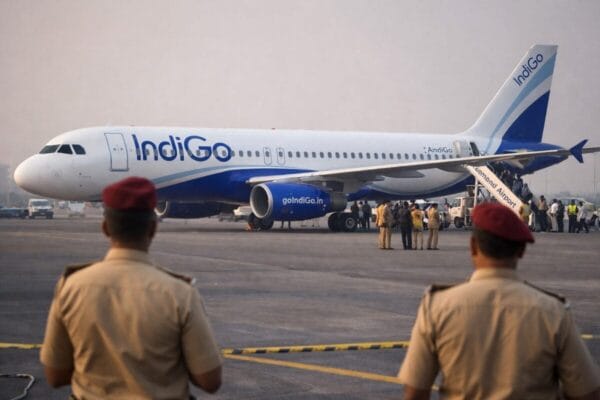
A serious aviation security incident unfolded when an international flight operated by IndiGo was forced to divert to Sardar Vallabhbhai Patel International Airport following a hijack and bomb threat discovered onboard. The swift diversion, evacuation of passengers, and comprehensive aircraft inspection once again brought global attention to the evolving security challenges faced by the airline industry.
The flight was operating from Kuwait to Delhi with 180 passengers and crew members onboard when a handwritten note was discovered inside the cabin. Written on a tissue paper, the message claimed that an explosive device had been planted on the aircraft. Recognizing the seriousness of the threat, the flight crew immediately alerted air traffic control and activated established emergency protocols.
Rapid Decision-Making Ensures Passenger Safety
In consultation with aviation authorities, the decision was made to divert the aircraft away from its original destination and land at Ahmedabad, one of India’s major international airports equipped to handle security emergencies. The aircraft touched down safely in the early morning hours and was immediately isolated on the tarmac as a precautionary measure.
Emergency response teams, including airport security, local police, bomb disposal units, and sniffer dog squads, were deployed within minutes of landing. Passengers were calmly evacuated from the aircraft and escorted to secure areas of the airport while authorities began a detailed inspection of the plane.
The rapid response highlighted the effectiveness of coordination between the airline, airport officials, and security agencies. Industry experts note that timely decision-making during such incidents is critical to minimizing risk and ensuring passenger confidence.
Thorough Aircraft and Luggage Checks Conducted
Following evacuation, security teams conducted a systematic search of the aircraft, including the cabin, cargo hold, and technical compartments. Passenger luggage was also screened as part of standard operating procedures. Preliminary inspections did not reveal any explosive material or suspicious objects, suggesting the threat may have been a hoax.
Despite the absence of immediate danger, authorities followed all mandatory protocols before allowing any further movement of the aircraft. Such caution reflects the zero-tolerance approach adopted across the aviation sector, where even unverified threats are treated with the utmost seriousness.
Passengers were kept informed throughout the process, and arrangements were made to resume the journey once final clearance was granted. While the diversion caused inconvenience, many travelers acknowledged that safety considerations outweighed delays.
A Growing Pattern of Security Threats
This incident is not isolated. In recent weeks, multiple flights across India have faced similar threats, placing airline security systems under increasing pressure. IndiGo itself has experienced several such situations, including diversions and emergency landings prompted by bomb threats and false claims made by passengers.
In one recent case, an IndiGo flight traveling from Delhi to Bagdogra was diverted mid-journey after a security alert during boarding. In another instance, flights on international routes were grounded or rerouted following threatening messages received by the airline. While most of these threats later proved to be hoaxes, each required full-scale emergency responses.
These recurring events underline a troubling trend affecting the global aviation industry, where hoax threats consume significant resources and disrupt operations while still posing serious safety concerns.
Aviation Security Under Increasing Strain
With global air travel steadily increasing, aviation security agencies face the challenge of balancing efficiency with heightened vigilance. Airlines operate under strict regulatory frameworks that mandate immediate action in response to any perceived threat, regardless of credibility.
Modern aviation security relies on a combination of advanced technology, intelligence sharing, and rigorous training. Explosive detection systems, behavioral analysis, and real-time communication between agencies form the backbone of these efforts. Flight crews undergo regular training to handle emergency scenarios, including bomb threats and unlawful interference.
Industry observers note that while technology continues to improve, human judgment and preparedness remain critical. The calm and professional handling of the IndiGo diversion is being cited as an example of effective crisis management.
Impact on Passengers and Airline Operations
For passengers, experiencing a diversion due to a security threat can be unsettling. Anxiety, uncertainty, and delays are common reactions, even when the situation is resolved safely. Airlines increasingly recognize the importance of clear communication during such incidents to reassure travelers and maintain trust.
From an operational perspective, security threats carry significant costs. Diversions, ground delays, aircraft inspections, and crew rescheduling disrupt flight networks and place financial strain on airlines. However, industry leaders emphasize that these costs are secondary to the fundamental priority of passenger safety.
Looking Ahead: Strengthening Air Travel Security
The Ahmedabad diversion serves as a reminder that aviation security is an ongoing process rather than a fixed system. As threat tactics evolve, airlines and authorities must continuously adapt their procedures, invest in training, and enhance detection capabilities.
There are growing calls for stricter penalties for hoax threats, which not only endanger lives but also divert critical security resources. At the same time, public awareness campaigns are seen as essential to discourage irresponsible behavior that can have far-reaching consequences.
For IndiGo, India’s largest airline by market share, the incident underscores the importance of preparedness in an increasingly complex operating environment. The successful handling of the situation reinforced the airline’s commitment to safety and demonstrated the effectiveness of coordinated emergency response.
As air travel demand continues to rise, ensuring passenger confidence will remain central to the industry’s recovery and growth. Incidents like this, while disruptive, also highlight the resilience of aviation security systems designed to protect lives above all else.
For more travel news like this, keep reading Global Travel Wire