
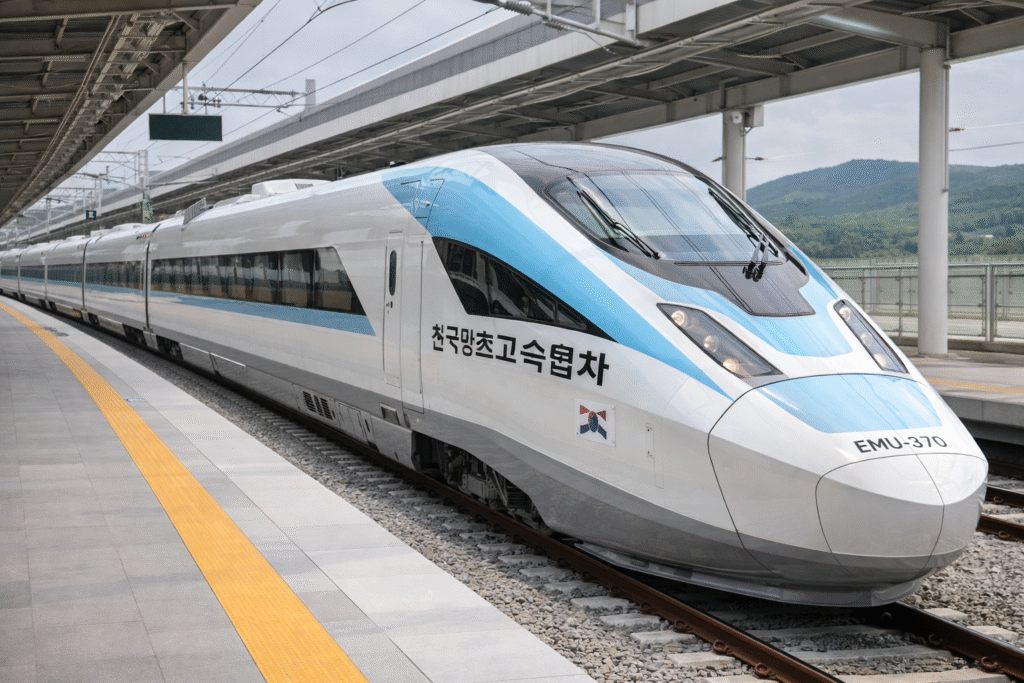
South Korea has taken a decisive step toward redefining the future of rail travel with the unveiling of its next-generation high-speed train, the EMU-370. Designed to operate at speeds of up to 370 km/h, the new train represents a major technological leap and reinforces the country’s ambition to remain at the forefront of global rail innovation. Combining advanced engineering, passenger comfort and environmental efficiency, the EMU-370 is set to transform how people travel between major cities while strengthening Korea’s position in the international rail market.
The development of the EMU-370 marks the successful completion of a four-year national research and development programme led by the Korea Railroad Research Institute. The initiative brought together public and private sector expertise, including rolling stock manufacturer Hyundai Rotem, to address the complex technical challenges associated with ultra-high-speed rail. With substantial investment from government and industry partners, the project reflects Korea’s long-term commitment to modern, efficient and sustainable transportation infrastructure.
A Major Leap Beyond Existing High-Speed Rail
The EMU-370 builds upon the technological foundation of Korea’s existing high-speed fleet, particularly the KTX-Cheongryong (EMU-320), which currently operates at speeds of up to 320 km/h. While the earlier generation was engineered to perform reliably below the 350 km/h threshold, the new EMU-370 has been designed specifically to exceed that barrier safely and efficiently.
Achieving such speeds required overcoming challenges related to aerodynamic drag, vibration control, noise reduction and energy consumption. Engineers focused on refining every aspect of the train’s design, from its streamlined nose to its underfloor equipment and roof structures. The result is a train with significantly reduced air resistance, allowing it to maintain higher speeds while using energy more efficiently.
Powerful Performance Meets Passenger Comfort
At the heart of the EMU-370 is a newly developed high-efficiency traction motor delivering 560 kW of power. This represents a substantial increase compared to previous models and enables the train to achieve rapid acceleration and stable performance at ultra-high speeds. Each eight-car train set is equipped with multiple motors distributed across the cars, ensuring balanced power delivery and enhanced reliability.
Beyond raw speed, passenger comfort has been a central focus of the design. Advanced suspension systems reduce lateral vibrations by approximately one-third, providing a smoother ride even at maximum operating speeds. Interior noise levels have also been lowered through the use of sound-insulating composite materials and structural refinements, creating a quieter and more relaxing travel environment.
The EMU-370’s airtight doors, developed entirely with domestic technology, further enhance passenger comfort by stabilising cabin pressure when travelling at high speeds or passing through tunnels. This achievement also highlights the growing maturity of Korea’s rail manufacturing ecosystem.
Setting New Standards in Rail Technology
One of the most significant outcomes of the EMU-370 project is the establishment of technical standards for trains capable of operating at speeds approaching 400 km/h. By developing and validating these standards domestically, Korea has positioned itself ahead of many other regions that are still in the process of defining benchmarks for ultra-high-speed rail.
According to the Ministry of Land, Infrastructure and Transport, production of the first EMU-370 train sets is expected to begin in the latter half of the decade, followed by extensive testing on designated high-speed rail sections. Commercial operations are anticipated in the early 2030s, subject to successful trials and safety certification.
Transforming Domestic Travel and Global Competitiveness
Once operational, the EMU-370 is expected to significantly reduce travel times between Korea’s major urban centres. Faster rail journeys will strengthen rail’s competitiveness against domestic air travel, offering passengers a reliable, city-centre-to-city-centre alternative with lower environmental impact.
High-speed rail is already a cornerstone of Korea’s national transportation strategy, supporting regional development, reducing congestion and contributing to carbon reduction goals. The introduction of the EMU-370 aligns with broader policy objectives aimed at promoting sustainable mobility and reducing dependence on fossil-fuel-intensive transport modes.
Beyond domestic benefits, the EMU-370 is poised to enhance Korea’s standing in the global rail export market. As countries around the world invest in modernising rail networks to meet climate targets and growing travel demand, interest in proven high-speed rail technology continues to rise. Korea’s ability to offer next-generation trains backed by advanced standards and operational experience strengthens its appeal as a global rail technology partner.
Looking Toward the Future of Ultra-High-Speed Rail
The EMU-370 is not the final destination in Korea’s rail innovation journey. Government planners and research institutions are already exploring technologies capable of supporting speeds of up to 400 km/h, pushing the boundaries of what is currently achievable in conventional rail systems.
These efforts reflect a long-term vision in which high-speed rail plays a central role in sustainable economic growth, regional connectivity and international competitiveness. By continuously investing in research, testing and industrial collaboration, Korea aims to remain a leader in shaping the future of rail travel.
A Defining Moment for Global Rail Travel
The unveiling of the EMU-370 represents more than a technological milestone; it signals a shift toward faster, cleaner and more passenger-focused rail systems. As the train moves toward production and testing, it offers a glimpse into the next chapter of high-speed rail, where cutting-edge engineering meets environmental responsibility.
For Korea, the EMU-370 stands as a symbol of innovation and ambition, demonstrating how advanced rail technology can redefine national mobility while contributing to global progress in sustainable transportation.
For more travel news like this, keep reading Global Travel Wire