
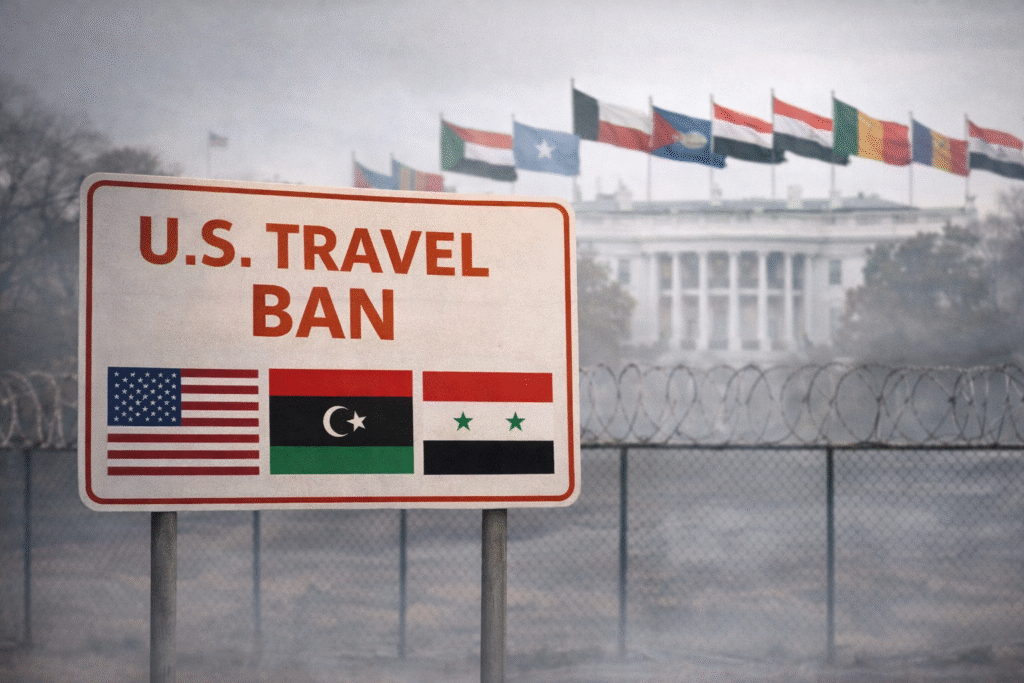
The United States has significantly expanded its travel restrictions, adding Libya to a growing list of countries facing a full U.S. travel ban amid heightened national security concerns and persistent gaps in identity verification and vetting systems. The move places Libya alongside nations such as Sudan, Somalia, Yemen, Chad, Haiti, Laos, Burkina Faso, Syria, Mali, and others, marking one of the most extensive travel restriction updates in recent years.
The decision reflects Washington’s broader strategy to strengthen border security and ensure that travelers entering the country can be reliably vetted through internationally recognized security and information-sharing standards. While the policy is rooted in security objectives, it carries major implications for global tourism, aviation, education exchanges, and international mobility.
Why the U.S. Expanded the Travel Ban
U.S. authorities have stated that the affected countries exhibit significant deficiencies in identity documentation systems, passport security, and the ability to share reliable threat-related data. These shortcomings, according to officials, limit the U.S. government’s capacity to properly screen travelers before entry.
Libya’s inclusion follows years of political instability, fragmented governance, and inconsistent border controls, factors that complicate international cooperation on security screening. Similar concerns were cited for other countries facing full bans, many of which are affected by conflict, fragile institutions, or limited administrative capacity.
The expanded policy distinguishes between full entry bans and partial restrictions, depending on the assessed level of risk and cooperation.
Countries Facing a Full U.S. Travel Ban
Nationals from countries under the full ban are prohibited from entering the United States across nearly all visa categories. This includes tourist visas, business travel, student visas, and most temporary work permits. Libya now joins a list that includes Afghanistan, Somalia, Sudan, Yemen, Syria, Haiti, Chad, Burkina Faso, Laos, Mali, Niger, South Sudan, Iran, and others.
For travelers from these countries, the ban effectively halts leisure tourism to the United States and sharply limits opportunities for academic exchange, professional travel, and family visits. Only narrow exemptions may apply in exceptional humanitarian or diplomatic cases.
Partial Restrictions Add New Layers of Complexity
In addition to full bans, several countries are subject to partial travel restrictions. Nationals from these states may still be eligible for certain visas, but with tighter scrutiny, reduced visa validity, longer processing times, and increased inspection upon arrival.
Countries under partial restrictions include parts of Africa, the Caribbean, and Latin America. Travelers from these regions may face uncertainty when planning trips, as approvals can vary depending on individual circumstances and security assessments.
While these measures stop short of a total ban, they introduce significant friction into travel planning and have already begun to affect booking patterns and traveler confidence.
Impact on Global Tourism and Aviation
The expanded U.S. travel ban is expected to reshape international travel flows, particularly affecting tourism markets in Africa, the Middle East, and parts of Southeast Asia. Airlines serving routes between restricted countries and the United States may see reduced demand, route suspensions, or the need to redirect capacity to alternative destinations.
Tour operators and travel agencies that specialize in U.S.-bound travel are also likely to experience a downturn from affected markets. Group tours, educational travel programs, and cultural exchanges are among the segments most impacted, as visa uncertainty discourages advance planning.
Conversely, destinations outside the United States may see increased interest from travelers who would otherwise have visited American cities. This redistribution of tourism spending could benefit Europe, Asia, and parts of the Middle East that maintain more accessible entry policies.
Broader Economic and Educational Consequences
Beyond tourism, the ban has implications for universities, research institutions, and multinational businesses that rely on international mobility. Students from fully banned countries are unable to pursue education in the U.S., while those from partially restricted nations may face delays that affect enrollment cycles.
Businesses may encounter challenges moving staff, attending conferences, or developing partnerships involving nationals from restricted countries. Over time, these barriers could influence where companies choose to invest, host events, or establish regional hubs.
Industry Response and Traveler Adaptation
The travel industry is already adapting by increasing advisory services, offering alternative destination planning, and helping travelers navigate changing visa landscapes. Airlines and booking platforms are updating systems to reflect eligibility changes, while tourism boards are monitoring shifts in traveler demand.
Travel experts advise travelers from affected countries to seek early guidance, verify eligibility before booking, and consider destinations with clearer entry requirements. Flexibility and contingency planning have become essential in the current global travel environment.
Looking Ahead
The expansion of the U.S. travel ban underscores how national security considerations continue to shape international mobility. While authorities emphasize that the policy is not aimed at specific populations but at systemic risks, its effects are deeply felt across tourism, education, and global connectivity.
As geopolitical dynamics evolve, the list of restricted countries may continue to change, keeping travelers and the tourism industry in a state of adjustment. For now, Libya’s addition signals a more cautious and restrictive era for travel to the United States, with long-term implications for global tourism patterns and international exchange.
For more travel news like this, keep reading Global Travel Wire