The Lufthansa Group has announced strict new rules for power banks on flights across its entire network. The policy covers Lufthansa, SWISS, Austrian Airlines, Brussels Airlines, Eurowings, and ITA Airways. The rule took effect on 15 January 2026 and now shapes how passengers pack and power electronic devices during travel. Lithium-ion battery safety sits at the heart of the change. The new regulations align with guidance from international aviation authorities that warn about fire risks linked to battery failures.
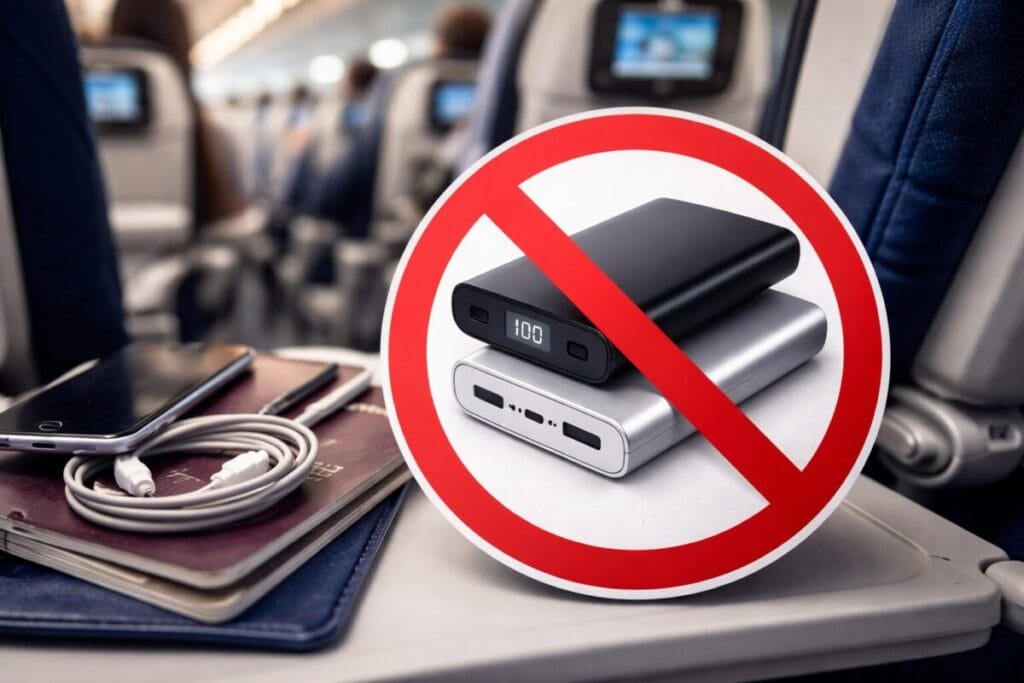
The Lufthansa Group now limits each passenger to two power banks. Travelers must pack them in carry-on bags or keep them on their person. Passengers cannot charge or use power banks during flights. Travelers must place the power banks under the seat or in the seat pocket. The rule bans the storage of power banks in checked baggage or overhead bins due to fire safety concerns.
What the New Power Bank Restrictions Mean for Flyers
Passengers can bring power banks of up to 100 watt-hours without any airline approval. Passengers with power banks between 100 and 160 watt-hours must request airline approval before travel. The policy includes a single exception for passengers who rely on power banks to operate essential medical devices. The policy defines clear limits to help safety teams identify and manage battery risk during flight operations.
Lithium-ion batteries power modern devices such as phones, tablets, cameras, e-cigarettes, and laptops. Power banks pose a higher risk because they store spare energy and often lack external casing protections found in certified devices. Safety teams prefer quick access to spare batteries so they can intervene in the rare event of overheating or smoke. Cabin crews train extensively to handle such incidents.
Why Regulators and Airlines Tightened Battery Rules
Aviation regulators across Europe, North America, and Asia have highlighted serious concerns regarding lithium battery failures in aircraft cabins. Authorities note that even small batteries can ignite if they suffer short circuits or impact damage. Cabin fires threaten passenger safety due to intense smoke and limited extinguishing options.
Manufacturers ship more lithium-powered devices every year. Air travel now sees a record number of electronics on board, especially during long-haul flights. Airlines and regulators concluded that uncontrolled charging of spare batteries increases risk. A single burning battery can affect multiple passengers and disrupt emergency procedures. Lufthansa Group therefore tightened its policy to lower the likelihood of thermal runaway events.
Impact on Travel Device Usage and Passenger Planning
The new rule directly impacts travelers who rely on portable chargers during long flights. Power banks have become essential tools for tourists, business travelers, students, and families. Many passengers stream entertainment, complete work, or use connectivity tools during flight. Frequent flyers also rely on power banks during layovers in airports where outlets remain limited.
Passengers now must adjust device usage and charging habits before boarding. Travelers should fully charge phones, tablets, and laptops in advance. Travelers can also use approved in-seat power outlets if available. Seat power availability varies across aircraft types and cabin classes. Expect uncertainty on older aircraft because airlines continue to upgrade fleets at different speeds.
Benefits for Travelers Through Improved Safety Measures
The Lufthansa Group highlights safety as the key benefit. By removing in-flight charging and restricting the storage of power banks, the group reduces inflight battery hazards. Passengers gain peace of mind knowing that airlines enforce stricter standards on spare batteries. The harmonisation of rules across all group airlines also reduces confusion, especially for connecting itineraries involving multiple flags.
Tourism analysts expect other carriers to adopt similar rules. Aviation regulators have signaled that lithium battery guidance will continue to evolve. Travelers will likely encounter similar rules throughout Europe and possibly beyond.
Downsides and Inconvenience for Digital Travel Lifestyles
The restrictions introduce new inconveniences for travelers. Passengers who work during flights may struggle if their devices lose charge before landing. Families rely on tablets to entertain children during long-haul journeys. Travelers who use accessibility devices also require additional planning. Passengers who misunderstand the watt-hour rules may risk confiscation at airport security checkpoints.
High-capacity power banks also introduce new bureaucracy. Passengers must check watt-hour ratings before packing. Some brands do not list watt-hour information clearly, which complicates compliance. Business travelers with heavy device loads face the greatest inconvenience. These travelers often carry laptops, phones, wireless headsets, tablets, and secondary devices for presentations or remote work.
What Travelers Should Do Before Boarding Lufthansa Flights
Travel experts recommend several steps to avoid disruptions:
• Check your power bank capacity before packing
• Charge devices fully before arriving at the airport
• Request approval for power banks between 100 and 160 Wh
• Carry power banks in a bag kept under the seat
• Avoid checking in any spare batteries
• Confirm seat power availability for long-haul flights
These steps help passengers maintain productivity and comfort without violating new safety standards.
Safety Versus Convenience: A New Tension in Air Travel
The power bank policy reveals a broader tension in modern aviation: rising safety standards versus growing digital dependence. Travelers demand more device time during long-haul journeys. Airlines must protect passengers while meeting evolving digital expectations. The Lufthansa Group prioritises safety in this case, even when it inconveniences tech-heavy travelers.
Air travel continues to modernise through new hardware, improved training, and upgraded aircraft. Lithium battery rules serve as another evolution in safety protocol. Travelers who adapt early will navigate this transition smoothly.
For more travel news like this, keep reading Global Travel Wire