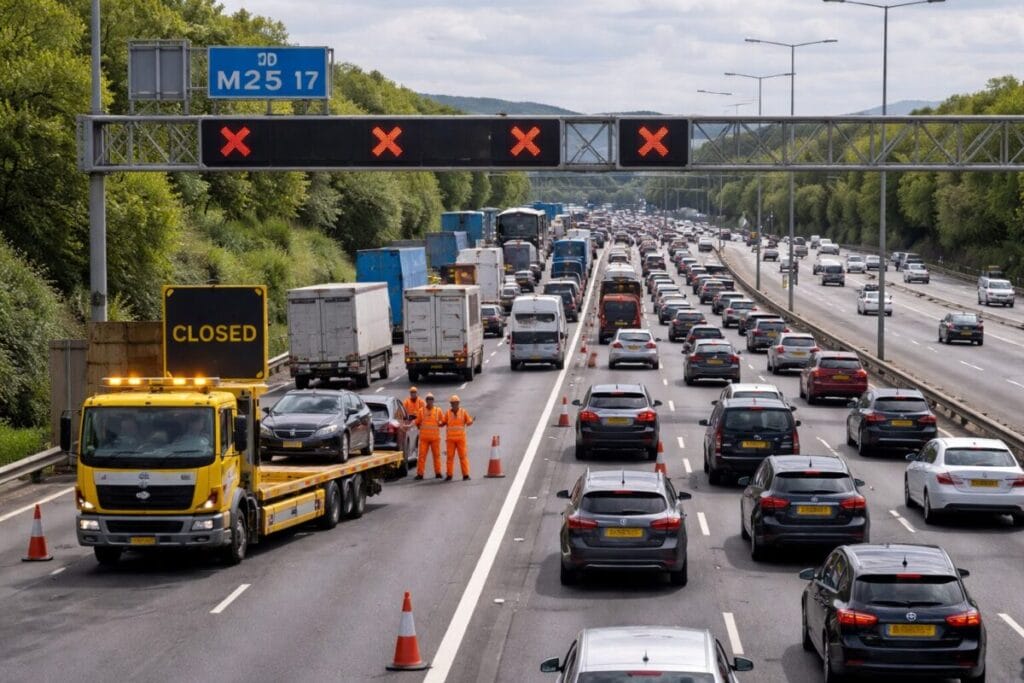
A vehicle breakdown caused significant travel disruption on the M25 motorway, one of the United Kingdom’s busiest transport corridors. Authorities closed multiple lanes on the anticlockwise carriageway between Junction 17 (Rickmansworth) and Junction 16, which connects to the M40. The incident triggered heavy congestion during the morning rush hour.
Drivers experienced delays of up to 50 minutes. The disruption affected daily commuters, airport transfers, and tourism-related travel around Greater London. Traffic moved slowly across several miles as congestion built quickly during peak travel hours.
Lane Closures Implemented for Safety
Traffic management teams closed two lanes to ensure safe handling of the broken-down vehicle. Safety crews arrived early in the morning to manage the situation and prevent secondary accidents. Lane restrictions remained in place while recovery operations continued.
Officials warned drivers about long queues and urged caution. Reduced road capacity led to bottlenecks, especially as traffic volumes increased during the morning commute.
Quick intervention helped maintain safety, but the closures significantly slowed vehicle movement across this busy stretch of motorway.
Why the M25 Matters to UK Travel and Tourism
The M25 motorway forms a critical ring road around Greater London. It connects major routes such as the M1, M3, M4, and M40. This network supports business travel, tourism mobility, and freight transportation across England.
Tourists traveling between London attractions, nearby countryside destinations, and major airports rely heavily on this road. Heathrow Airport access routes also connect to the M25, making disruptions particularly impactful for international travellers.
When incidents occur on this motorway, the ripple effects extend beyond local commuters. Travel plans for visitors, tour operators, and logistics services often face sudden changes.
Congestion Impacts Commuters and Airport Transfers
Thursday morning’s delays affected thousands of drivers heading toward central London and nearby counties. Airport taxis, shuttle services, and long-distance coaches encountered slower travel times. Freight vehicles transporting goods toward ports and distribution centers also faced extended journeys.
Tourism businesses operating transfers or guided tours experienced scheduling challenges. Delays during peak hours often cause cascading effects throughout the day, affecting arrival times and onward connections.
For visitors unfamiliar with UK roads, sudden congestion can create confusion. Traffic alerts help travelers adjust routes and manage expectations.
Location Challenges Increase Traffic Pressure
The affected section near Junctions 17 and 16 lies on the western edge of Greater London. This area already experiences heavy traffic due to commuter flows and long-distance travel. Even minor incidents can quickly escalate into large delays.
Roadworks and ongoing maintenance projects across parts of the M25 add further pressure. Drivers frequently encounter speed restrictions, lane changes, and temporary closures. These factors increase vulnerability to congestion when unexpected breakdowns occur.
Authorities rely on digital signage and traffic monitoring systems to guide motorists and manage traffic flow during incidents.
Real-Time Monitoring and Incident Management
Traffic officers continuously monitor the motorway network using cameras, sensors, and reporting systems. When incidents happen, teams deploy quickly to control traffic and support recovery operations.
Electronic signs display reduced speed limits or lane closure information. These measures aim to keep road users safe while helping traffic continue moving, even under restricted conditions.
Coordinated responses between traffic officers, emergency services, and recovery crews remain essential for restoring normal flow as fast as possible.
Safety Remains the Top Priority
Lane closures often frustrate drivers, but authorities stress that safety takes priority. Working near live traffic poses risks for recovery teams and other road users. Closing lanes creates safer working conditions and reduces the chance of further collisions.
Drivers are encouraged to maintain safe distances, follow temporary speed limits, and stay alert when passing incident zones. Responsible driving helps prevent additional disruptions.
Peak Travel Times Increase Risk of Delays
The M25 sees extremely high traffic volumes during weekday mornings and evenings. Peak hours leave little room for error. Any incident, even a single vehicle breakdown, can trigger significant congestion.
Historical data shows that the motorway frequently experiences delays caused by accidents, mechanical failures, or planned engineering work. Regular users often build extra time into their journeys due to unpredictable traffic patterns.
For tourists planning day trips or airport transfers, early departures can reduce stress during busy periods.
Historical Context: Why the M25 Faces Constant Pressure
Completed in stages during the late twentieth century, the M25 remains one of Europe’s busiest orbital motorways. Growing population numbers, rising tourism, and increased freight demand continue to place pressure on this road.
Despite ongoing improvements and smart motorway technologies, congestion remains a persistent challenge. Authorities continue to invest in monitoring systems and infrastructure upgrades to improve traffic flow and safety.
Travel Advice for Motorists and Visitors
Transport officials recommend checking live traffic updates before starting any journey, especially during peak travel periods. Drivers should allow extra travel time and consider alternative routes when possible.
Tourists visiting London by car may benefit from using public transport options during heavy traffic periods. Planning ahead can reduce delays and make travel more predictable.
When Normal Traffic Flow Will Return
Recovery teams aim to clear incidents quickly and reopen closed lanes as soon as conditions allow. Even after lanes reopen, residual congestion may continue for some time as traffic disperses.
Authorities continue to monitor the situation closely. Normal traffic conditions are expected to return gradually once the obstruction is removed and traffic volumes stabilize.
For more travel news like this, keep reading Global Travel Wire