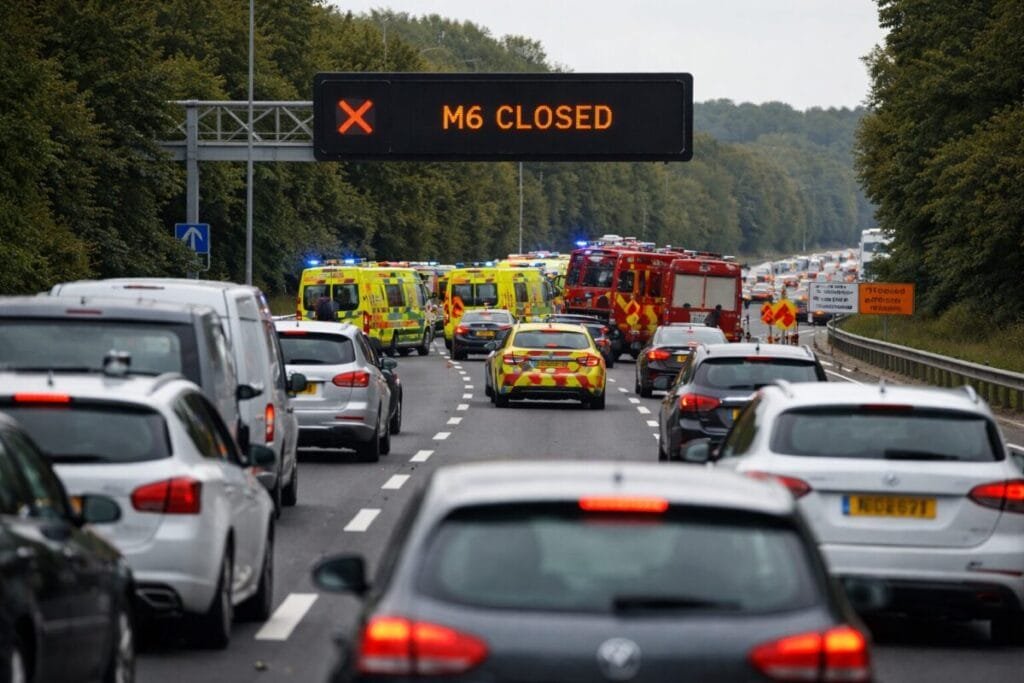
A serious incident on the M6 brought a sharp halt to traffic movement in Greater Manchester and triggered hours of travel disruption across the region. The motorway closed between junction 26 at the M58 Orrell Interchange and junction 23 at the East Lancashire Road. The closure followed a fatal emergency earlier in the morning that led to a rapid response from police, paramedics, and traffic officers.
The situation developed shortly before 8 a.m. when emergency services were called to reports concerning the welfare of a woman on the motorway. She was pronounced dead at the scene. Police confirmed that the investigation continues, but early updates indicated no suspicious circumstances. Formal identification will follow in due course.
Massive Delays and Standstill Traffic
The closure sent congestion rippling through the wider motorway network. Drivers approaching the shut section faced heavy queues that stretched for miles. Northbound delays climbed beyond 45 minutes, while southbound traffic slowed by nearly 20 minutes as vehicles funneled into smaller routes.
Around four miles of northbound traffic queued behind the closure point. On the opposite carriageway, three miles of slow-moving traffic formed due to lane restrictions, onlookers, and diverted vehicles. The gridlock spilled into local roads, increasing strain on communities already dealing with peak morning travel.
In Ashton-in-Makerfield, authorities also closed Downall Green Road due to its proximity to the incident. The move aimed to support emergency operations and reduce the risk of secondary collisions.
Diversions for Drivers and Impact on Travel Plans
National Highways introduced a diversion route involving the M58, the A570 Rainford Bypass, and the A580 East Lancashire Road. These roads provide alternative access to the North West corridor and are commonly used for major contingency planning. Despite the diversion, journey times surged as vehicles redirected through unfamiliar routes and traffic signals.
With the closure expected to continue into the afternoon and possibly longer, officials urged travelers to rethink their journeys. Commuters, haulage operators, and leisure travelers faced delays that disrupted schedules. Delivery operators adjusted logistics routes and reported missed slots at distribution centers across the region.
Tourism and hospitality sectors also felt ripple effects. Local attractions reported a rise in late arrivals, and some day-trip plans shifted or were canceled. Congested road conditions can influence tourism flow, especially near bank holidays or peak visitor seasons, as noted by past road disruption reports from UK transport agencies.
Emergency Services Maintain Investigation and Public Safety
Greater Manchester Police led the investigation and worked through the morning alongside National Highways and local council officers. Traffic officers assisted with barrier placement, lane control, and public communication. Services stressed the importance of driver cooperation to ensure safety for personnel working on the live motorway environment.
Police reiterated that driver patience plays a crucial role during fatal road incidents. Investigations involving loss of life must meet strict forensic standards. This can extend closure duration, yet helps ensure accuracy, safety, and legal compliance.
Motorist Safety and Preparedness Remain Key
The incident renewed discussion on motorway safety planning. Authorities encouraged motorists to check travel updates before setting off and to carry essentials such as water, charged mobile devices, and medication during longer routes. Tailbacks sometimes leave drivers stranded for extended periods with limited service access.
During such closures, emergency welfare units may support vulnerable travelers when gridlock lasts beyond several hours. UK motorway operators have expanded safety campaigns in recent years, promoting breakdown lanes, red X compliance, and smart motorway awareness. These efforts aim to reduce secondary accidents, which can compound congestion and endanger responders.
Longer-Term Resilience and Network Pressure
The M6 is one of the busiest road arteries in the United Kingdom and forms a vital link between the Midlands, Cheshire, Lancashire, and Scotland. Any prolonged closure influences freight movement, commuter mobility, and regional tourism logistics. The motorway carries millions of journeys annually, including holiday traffic bound for coastal areas, national parks, and major cities.
Incidents like this highlight the dependence on the UK motorway grid and the importance of contingency planning for both travelers and authorities. Transport planners continue working on strategies that balance safety, traffic flow, and emergency response capabilities.
Conclusion: Return to Normal Expected After Full Clearance
Authorities worked through the day to restore normal traffic operations. Police confirmed that they would reopen the motorway only after all safety requirements and investigation procedures were completed. Drivers were advised to avoid the area, follow diversion signs, and remain alert to sudden speed changes.
Travelers headed across Greater Manchester should continue building extra time into their journeys until full reopening. The priority remains public safety and the respectful handling of the morning’s tragic circumstances.
For more travel news like this, keep reading Global Travel Wire