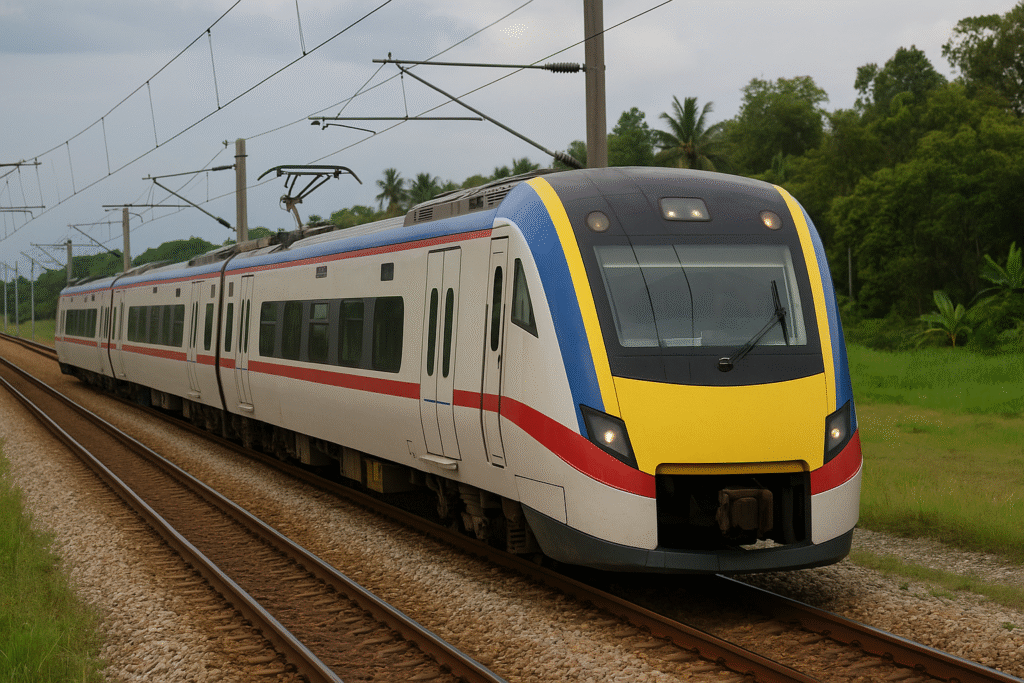
Malaysia assumes a central role in the unfolding story of Southeast Asia’s rail transformation. As the only land bridge between Thailand and Singapore, the country serves as the key connector in the ambitious Singapore‑Kunming Rail Link (SKRL). The project envisions a 7,000-kilometre corridor linking China through Southeast Asia to Singapore. Malaysia’s involvement opens major opportunities in trade, logistics and tourism across the region.
Strategic Position in ASEAN Connectivity
Transport analysts underscore Malaysia’s importance in the SKRL. The country’s existing rail network and its position between Thailand and Singapore make it irreplaceable for the corridor’s success. Key nodes like Johor, the Klang Valley region and the East Coast Rail Link (ECRL) take centre stage in the planning for this corridor. Malaysia’s domestic infrastructure upgrades will serve as the foundation for the broader regional rail link.
Johor stands out for its proximity to Singapore and its role in cross-border integration. The Klang Valley, already a transport hub, links to Malaysia’s west coast and onwards into Southeast Asia. The ECRL, cutting across the east of the peninsula, provides the critical east-west axis that bolsters Malaysia’s leverage in the SKRL plan. Through these three anchors Malaysia rises as the central player in connecting the region’s multiple destinations.
Overcoming Integration Challenges
Despite Malaysia’s promising positioning, the SKRL initiative encounters several practical challenges in rail integration. One major hurdle lies in customs, immigration and quarantine (CIQ) processes at the Malaysia–Singapore border, particularly at Johor Bahru. Unless border facilities streamline operations, time savings on the rail link may vanish into bureaucratic bottlenecks.
Another issue stems from rail-system compatibility. Malaysia’s main passenger network runs on metre-gauge tracks, while standard-gauge systems dominate new regional corridors. Ensuring smooth transitions or establishing transfer nodes will matter for seamless service. Malaysia advances key projects such as the Gemas–Johor Bahru electrified double-track line to ready the infrastructure for future connectivity.
Finally, rail-readiness concerns remain. The domestic upgrades must align with broader ASEAN-rail timelines. Without parallel progress in neighbouring systems, Malaysia risks becoming the link that’s ready while others lag behind. Those delays could push the full vision beyond the 2030 horizon many hope for.
ECRL: A Cornerstone for Rail Expansion
Malaysia’s ECRL project stands as a major internal investment in the country’s rail future and a strategic piece for the SKRL. With routes linking Kelantan, Terengganu and Pahang to Selangor and the west coast, the ECRL forms a vital trade corridor. The government targets December 2027 for completion of much of the 665-kilometre stretch.
Expanded further, the ECRL may extend north toward Thailand and south toward Seremban and Melaka. These extensions would feed into the SKRL network, enabling freight and passengers to traverse Malaysia and beyond with greater speed and efficiency. The ECRL thus aligns domestic transport goals with regional connectivity ambitions in one cohesive strategy.
Transforming Regional Trade and Tourism
The Singapore-Kunming Rail Link promises to reshape regional trade in profound ways—and Malaysia stands to gain significantly. By facilitating smoother cargo flows and linking major economic centres, the project helps reduce logistics costs and expand market access across ASEAN. Malaysia’s position at the heart of that corridor means new investment in logistics hubs and special economic zones along the rail line.
Tourism also stands to benefit. With efficient rail links in place, visitors may choose a scenic train journey over long highway drives, exploring Malaysia’s landscapes and culture en route to neighbouring countries. Rail access can stimulate travel between key cities and tourist destinations, boosting local economies and promoting regional integration in tourism.
Furthermore, Malaysia’s shift toward electrified rail and freight transport supports sustainability goals. Reducing reliance on road freight helps lower traffic congestion and carbon emissions, aligning with Malaysia’s national climate ambitions and reinforcing its role as a transport leader.
Malaysia’s Future Role in a Wider Rail Network
Looking ahead, Malaysia has an opportunity to become a hub within Southeast Asia’s evolving rail landscape. Discussions around cross-border projects such as the Johor Bahru–Singapore Rapid Transit System and proposed high-speed links to Kuala Lumpur underline Malaysia’s expanding rail footprint. As these projects mature, Malaysia may become the pivot between mainland ASEAN and Singapore, and by extension, China’s rail-network ambitions.
By 2030, Malaysia could transform into a model of regional rail integration: connecting cities, enabling cross-border commerce, and offering alternative transport modes for both freight and passengers. Its domestic and regional rail upgrades stand out as proof of its commitment to this vision.
Conclusion
Malaysia’s strategic role in the SKRL and its parallel investments in rail infrastructure place it at the forefront of ASEAN connectivity and regional trade. The challenges are real, but the opportunities are enormous. If Malaysia continues to build and align its rail network, it will emerge not merely as a participant but as a driving force in Southeast Asia’s transport future. Rail travel may soon become as common as highway journeys in the region, and Malaysia will lead the way.
For more travel news like this, keep reading Global Travel Wire