
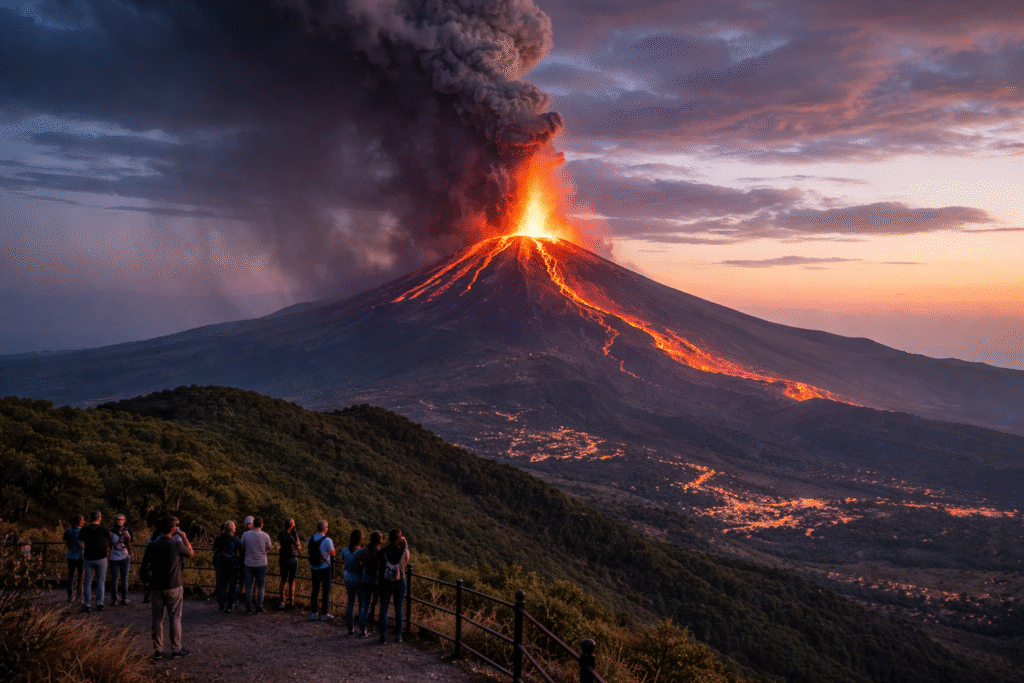
Mount Etna has erupted again and is reshaping the tourist season in Sicily. The latest activity, which began in late December 2025, has created glowing lava flows and ash emissions near the summit. Local authorities moved swiftly to tighten safety rules to protect residents and travelers. The eruption has also disrupted guided tours and sightseeing excursions, surprising visitors who expected a routine holiday on Europe’s most famous volcano.
Understanding Etna’s Volcanic Behavior
Mount Etna is known as the most active volcano in Europe. Its frequent eruptions have been documented for thousands of years. Geologists consider it one of the world’s most important natural laboratories due to its constant changes and reliable instrument monitoring. Italian scientific agencies report that the current eruption remains active, although lava fronts have slowed as they cool along the slopes.
Volcanologists explain that these cycles are normal for Etna. The volcano often shifts between explosive activity, ash plumes, and slow-moving basaltic lava. These conditions attract research teams, drone surveys, and seismic monitoring instruments.
Authorities Enforce Stricter Tourist Rules
To protect visitors, officials in Catania and surrounding municipalities have issued new safety protocols. Public access near the lava flow is now restricted. Visits after dusk are banned, and guided groups are capped at ten people. An exclusion zone has been drawn around the active lava areas, and patrol teams monitor compliance.
Officials stress that even if lava appears slow and predictable, the terrain can change without warning. Gases, vents, and collapses pose hazards to untrained hikers who often underestimate volcanic conditions. The new measures prioritize life safety and scientific access over tourism convenience.
Tour Guides Push Back Against Restrictions
The sudden policy shift upset many local tour guides who rely on volcano tourism for income. Etna tours are a signature adventure experience in Sicily, and the eruption season is usually their busiest period.
Groups of certified mountain guides staged demonstrations in early January to voice concern about the economic fallout. Many argue that guided excursions historically operated safely when professionals controlled the routes and protected visitors from hazards. They claim the new rules limit their ability to work and ignore their specialized training and on-site knowledge.
Officials acknowledged the frustrations but underscored the responsibility to safeguard tourists. The authorities maintain that the new rules are temporary and will be reviewed as volcanic conditions evolve.
Travel Disruption for Visitors
The eruption has disrupted many travel plans. Tourists who traveled from across Italy and abroad to see nighttime lava flows found tours canceled or postponed. While the ban on sunset tours disappointed many sightseers, officials argue that reduced visibility increases risk and complicates emergency response.
Nearby towns such as Taormina, Nicolosi, and Catania have seen fluctuating visitor numbers. However, no evacuations have been ordered for residential areas, and the broader region remains open for travel. Tour operators are shifting to panoramic drives, coastal viewpoints, and winery routes to help tourists enjoy the landscape without entering the exclusion zone.
Local airports continue to monitor ash plumes. Although no closures have been announced during the current phase, past eruptions have affected flight schedules and required temporary rerouting.
Economic Impact on Sicily’s Travel Sector
Volcano tourism is a major contributor to Sicily’s economy. Mount Etna National Park draws hikers, photographers, students, and adventure travelers throughout the year. Restaurants, hotels, rental car services, vineyards, and souvenir vendors benefit from the activity season.
Travel analysts expect the temporary restrictions to reduce revenue in the short term. However, they also note that dramatic volcanic landscapes tend to stimulate long-term interest. Past eruptions have sparked global attention and increased future bookings once conditions stabilize.
A Scientific and Cultural Icon
Mount Etna is more than a geological feature. It holds UNESCO World Heritage status for its scientific value and cultural significance. The volcano has shaped regional myths, agriculture, and settlement patterns for millennia. Its fertile slopes support orchards, vineyards, and farms that benefit from mineral-rich volcanic soil.
Scientists from across Europe continue to collect data from seismic networks, satellite tracking, and field measurements. These studies improve understanding of lava dynamics and help refine early warning systems for both Sicily and global volcano monitoring programs.
Travel Advice for Future Visitors
Travel experts recommend that visitors monitor official updates before planning hikes or lava-viewing excursions. Licensed guides remain the safest option for experiencing volcanic environments. They understand the terrain, emergency procedures, and current restrictions.
Travelers who prefer panoramic views can safely admire the volcano from coastal roads, observation terraces, and nearby urban centers. Many tour companies now offer alternative itineraries focused on food, culture, and history, allowing travelers to enjoy the region without entering restricted zones.
Balancing Adventure and Safety
Mount Etna’s newest eruption showcases nature’s power and the fragile balance between adventure tourism and public safety. Sicily continues to welcome travelers, but it asks them to respect evolving rules and stay informed. With caution and flexibility, visitors can still experience the dramatic beauty of one of the world’s most captivating volcanoes.
For more travel news like this, keep reading Global Travel Wire