
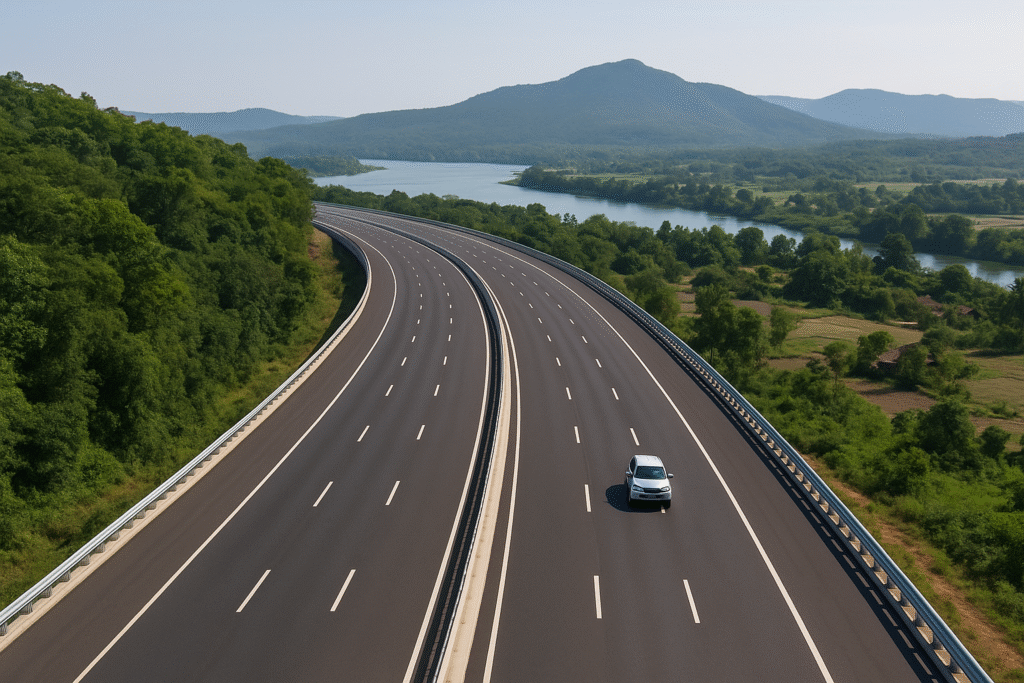
In a landmark step for coastal connectivity, the much-awaited Konkan Expressway — stretching from Panvel (Navi Mumbai) to Sindhudurg — is edging toward completion, poised to slash the Mumbai to Goa driving time from the current 12–13 hours to roughly six. This transformational infrastructure project is expected not only to reframe travel patterns but to unlock a fresh chapter in Konkan tourism and regional development.
Final Stretches Underway, Full Operation Expected Soon
The 466-kilometre six-lane, access-controlled expressway is nearing its finish line. Of the ten constituent segments, many are already near completion: parts in Sindhudurg are reportedly 99% done, Ratnagiri sections are in the 90–98% range, and Raigad’s stretches are advancing steadily. Earlier delays caused by land acquisition disputes and environmental approvals have largely been resolved, paving the way for contractors to accelerate remaining work.
Authorities now anticipate the expressway will be fully operational by March 2026. Once open, it will redefine the Mumbai-Goa road experience — offering safer travel, consistent speeds, and fewer interruptions.
Smart Tolling for Uninterrupted Movement
One of the most revolutionary features of the Konkan Expressway is its use of satellite-based tolling coupled with Automatic Number Plate Recognition (ANPR). Under this system, vehicles will no longer be required to stop at physical toll booths. Instead, toll charges will be deducted automatically, streamlining traffic flow and minimizing congestion. This technology-forward approach positions the expressway as a potential benchmark for future national highways.
A Scenic Route with Deep Cultural Access
The expressway snakes through Raigad, Ratnagiri, and Sindhudurg districts, touching 232 villages across 17 talukas. Along with speed, the route promises a visual treat — passing hillocks, river valleys, coastal vistas, and traditional villages. Interchanges will link the expressway to destinations like Alibaug, Ganpatipule, Ratnagiri, and Tarkarli, enabling tourists to dip into local culture, cuisine, and heritage without complicated detours.
Travel time projections suggest that while Sindhudurg may be reached from Mumbai in about six hours, reaching deeper parts of Goa would still necessitate additional travel — putting the total Mumbai to Goa journey closer to eight hours once fully functional.
Tourism and Economic Impact Along Konkan
Reduced drive time and seamless travel are expected to energize tourism across the Konkan coast. Hotels, homestays, guesthouses, restaurants, and allied services in coastal towns are likely to see a surge in visitors. Spontaneous weekend getaways and multi-point coastal circuits may become the norm for domestic travelers.
Beyond tourism, the expressway’s ripple effects include:
- Boost to local commerce: Enhanced access can raise footfall to village markets, coastal fisheries, and rural enterprises.
- Employment generation: Construction, logistics, hospitality, and service sectors are poised to gain.
- Logistics and trade gains: Faster movement of goods between Maharashtra and Goa will improve supply chains and reduce costs.
- Eco-travel shift: With a viable road alternative, some short-haul flights may be replaced by scenic drives — supporting more environmentally conscious travel.
Challenges and Ongoing Progress
Despite its nearing completion, the Konkan Expressway project has contended with hurdles. Delays in land acquisition, environmental clearances, and difficult terrain forcing bridges and tunnels have pushed timelines. The original target of December 2023 was missed, and deadlines have been revised multiple times. In some stretches of the existing Mumbai–Goa corridor (NH-66), roadwork is still ongoing — in Raigad and Ratnagiri districts, certain sections are reported to be 73–86% complete, leading to traffic disruption. Festival seasons have intensified pressure, prompting authorities to prioritize repairs and temporary relief measures.
Still, with work advancing around the clock and key bottlenecks addressed, stakeholders remain hopeful that the expressway will transform coastal connectivity by early 2026.
Shaping the Future of Coastal Travel
Once fully functional, the Konkan Expressway is expected to shift travel behaviour along India’s west coast. A journey that once consumed half a day may soon be done in mere hours, enabling fluid planning for weekend escapes, coastal explorations, or multi-day road trips. International visitors too may opt for road-based itineraries across Maharashtra and Goa, effortlessly linking beaches, forts, temples, and villages.
In tandem, regional administrations are likely to ramp up destination promotion for lesser-known coastal stretches — positioning Konkan not just as an en route corridor but a viable tourism belt in its own right.
Conclusion
The pending launch of the Konkan Expressway promises more than faster travel. It signals a new era of coastal tourism, regional upliftment, and infrastructure-driven growth. By linking Mumbai and Goa in just six hours, the expressway is set to rewire how travellers experience the Konkan — turning it from a destination en route to a destination in itself.
For more travel news like this, keep reading Global Travel Wire