








North Korea has reopened its borders with China in 2026 after a long closure. This move marks a major shift in regional travel and diplomacy. Authorities restored both rail and air routes between the two countries.
Officials confirmed that the first passenger train departed from Beijing on March 12, 2026. This event signals a new phase of cooperation between the two nations. As a result, travel, trade, and diplomatic exchanges will likely increase.
The reopening also reflects growing confidence in regional stability. Moreover, it creates new opportunities for tourism and business travel in Northeast Asia.
Pyongyang–Beijing Train Returns With Regular Services
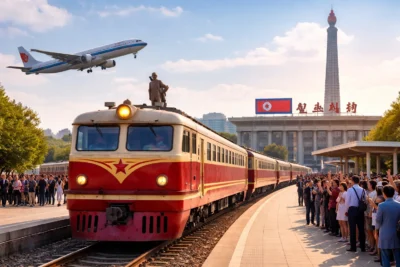
The famous Pyongyang–Beijing train service has resumed operations. It now runs four times a week, offering a consistent travel option. The journey takes around 20 hours and passes through key Chinese cities.
Passengers travel through industrial regions before reaching the North Korean border. At the same time, the Dandong–Pyongyang route now operates daily. This route provides a faster and more frequent connection.
Train services follow strict protocols to ensure safety and control. Only a limited number of carriages serve international passengers. Therefore, the experience remains exclusive and highly regulated.
Soft-sleeper tickets cost around 1,450 CNY, reflecting premium travel conditions. Despite restrictions, demand continues to grow steadily. Travelers show strong interest in this rare cross-border journey.
Flights Resume Between Beijing and Pyongyang
Air travel between China and North Korea has also resumed. Air China restarted its Beijing to Pyongyang route on March 30, 2026. The airline now operates a weekly service using a Boeing 737 aircraft.
This flight reduces travel time to under two hours. As a result, it offers a faster option than rail transport. Business travelers and diplomats benefit greatly from this convenience.
Meanwhile, Air Koryo continues to expand its flight network. The presence of both airlines ensures balanced aviation cooperation. This arrangement supports long-term bilateral relations.
Experts believe that increased flight frequency signals rising trust between the two nations. Consequently, air connectivity will likely improve further in the coming months.
Strategic Importance of the Reopening
The reopening carries strong diplomatic and economic significance. Regular transport links help strengthen communication and cooperation. They also support people-to-people exchanges between both countries.
China remains North Korea’s key economic partner. Therefore, restored routes reinforce this long-standing relationship. The rail corridor alone handles a large share of bilateral trade.
With passenger travel now allowed, officials can manage joint projects more efficiently. Business delegations can move more easily across borders. This change supports industrial and infrastructure development.
At the same time, North Korea seeks to increase foreign currency inflow. Improved connectivity plays a crucial role in achieving this goal. However, authorities continue to manage risks carefully.
Tourism Plans Gain Momentum in North Korea
North Korea has started preparing for a tourism revival. Chinese visitors have historically dominated inbound tourism. In fact, they once made up nearly 90 percent of all arrivals.
To attract visitors again, the country has accelerated major development projects. Cities like Sinuiju and coastal areas like Wonsan are undergoing rapid transformation. New hotels, restaurants, and entertainment venues are under construction.
These projects aim to meet the expectations of modern travelers. Authorities focus on comfort, convenience, and curated experiences. As a result, tourism infrastructure continues to improve steadily.
Interest in visiting North Korea has already increased. Online searches for train tickets and flights have surged. This trend suggests strong demand once restrictions ease further.
Travel Restrictions Still Limit Tourist Entry
Despite reopening, strict travel controls remain in place. Currently, only business, official, and press travelers can enter the country. Tourist visas have not yet fully resumed.
Visitors must complete health checks and provide official invitations. Authorities enforce detailed travel guidelines for all entrants. Additionally, guides accompany travelers throughout their stay.
These measures ensure tight supervision and controlled movement. While they limit flexibility, they maintain security and compliance.
However, experts expect gradual easing of restrictions later in 2026. Once that happens, tourism could grow rapidly. The reopening has already laid the foundation for future expansion.
A New Era for Northeast Asian Travel
The 2026 reopening marks a turning point for regional travel. North Korea and China have restored key transport links after years of isolation. This move strengthens economic ties and opens new tourism possibilities.
Although restrictions still apply, momentum continues to build. Infrastructure upgrades and rising interest point toward a tourism revival. In the coming months, travelers may gain more access to this unique destination.
For now, the world watches closely as North Korea steps back onto the global travel map.
For more travel news like this, keep reading Global Travel Wire