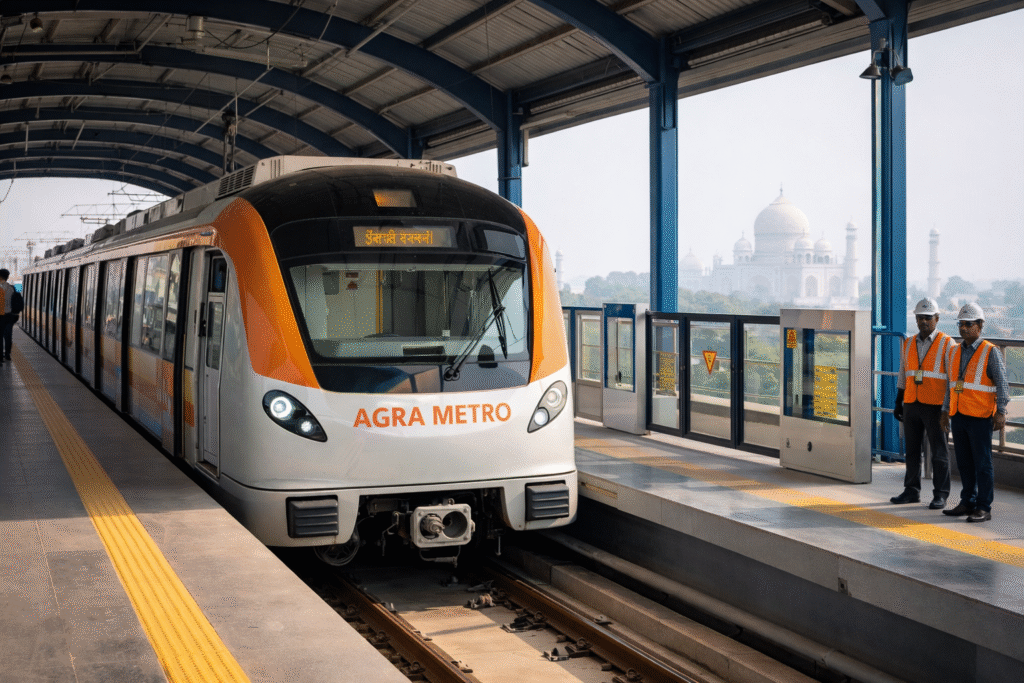
Agra has taken a significant step toward transforming its urban transport landscape with the successful completion of a six-kilometre trial run on the Agra Metro. The trial, conducted between Mankameshwar and the Inter-State Bus Terminal (ISBT), marks a critical milestone in the city’s journey toward a fully operational metro system. This progress not only strengthens daily commuting options for residents but also enhances Agra’s appeal as a well-connected tourism destination.
The smooth execution of the trial run confirms that track laying and essential technical systems on this stretch have been completed and are functioning as planned. With this achievement, the project is now ready to move into extended testing phases, which are essential to ensure safety, reliability, and operational efficiency before full-scale passenger services are introduced.
A Key Corridor Moves Closer to Readiness
The six-kilometre section between Mankameshwar and ISBT is an important link within Agra’s growing metro network. The trial was carried out on the up-line, demonstrating the readiness of signalling systems, power supply, rolling stock, and operational coordination. Such trials are a crucial part of metro development, as they allow engineers and operators to test systems under real conditions and fine-tune performance.
With track work on this section now complete, longer and more frequent trial runs will follow. These tests will simulate regular operations, helping authorities assess travel times, station coordination, emergency preparedness, and overall system resilience. Each successful phase brings Agra closer to a seamless metro service that can support the city’s expanding population and visitor numbers.
Strengthening Daily Commuting and Visitor Access
Once fully operational, the Agra Metro is expected to significantly ease pressure on the city’s roads, which often experience congestion due to mixed traffic and high tourist inflows. For residents, the metro promises faster, more predictable travel across key parts of the city. For visitors, it offers a convenient and modern way to move between transport hubs, residential zones, and major attractions.
Agra welcomes millions of domestic and international tourists each year, many of whom rely on road transport to navigate the city. Improved metro connectivity will help distribute visitor movement more evenly, reduce travel times, and contribute to a smoother overall tourism experience. Easy access between bus terminals, railway stations, and central areas is particularly important for a heritage city with high footfall.
Leadership and Vision Behind the Project
The Agra Metro Rail Project is being implemented by Uttar Pradesh Metro Rail Corporation Limited, which is responsible for planning, construction, and operations. The organisation oversees multiple metro systems across the state and plays a central role in Uttar Pradesh’s broader urban transport strategy.
The vision guiding the project focuses on safety, sustainability, and efficiency. Metro systems are designed to reduce carbon emissions by shifting commuters away from private vehicles and diesel-powered transport. In cities like Agra, where environmental protection is a priority due to its cultural heritage, cleaner mass transit options are especially valuable.
Corridor Design and Network Expansion
The Agra Metro network has been planned with two main corridors, covering a total length of nearly 30 kilometres. Corridor One connects Taj East Gate to Sikandara, combining underground and elevated sections to serve both historic and residential zones. Corridor Two links Agra Cantt to Kalindi Vihar, primarily through elevated stations designed for efficient passenger flow.
A major milestone was reached earlier when services were inaugurated on the priority stretch between Taj East Gate and Mankameshwar. This initial operation provided valuable insights into passenger behaviour, operational logistics, and system performance. The completion of the up-line track between ISBT and Mankameshwar builds on this foundation, bringing the network closer to full connectivity.
Supporting Sustainable Urban Growth
Beyond convenience, the Agra Metro is expected to play a vital role in shaping the city’s long-term development. Reliable mass transit encourages more compact urban growth, reduces dependence on private vehicles, and supports cleaner air quality. For a city balancing modern needs with heritage conservation, these benefits are particularly significant.
The metro system is also expected to improve accessibility for students, workers, and small businesses by connecting residential areas with employment and education hubs. Over time, improved mobility can contribute to economic activity, job creation, and enhanced quality of life across the city.
What Comes Next for Agra Metro
With the successful trial run completed, the focus now shifts to extended testing, system validation, and phased commissioning of additional sections. These steps are necessary to ensure that the metro operates smoothly under daily passenger loads and meets safety standards before wider public use.
As each segment becomes operational, Agra will move closer to having a comprehensive, modern metro system comparable to those in other major Indian cities. The progress achieved so far reflects consistent planning and execution, reinforcing confidence in the project’s timeline and outcomes.
A Transformative Step for the City
The completion of the six-kilometre trial run between Mankameshwar and ISBT is more than a technical achievement; it represents a turning point in Agra’s urban journey. By bringing efficient, sustainable, and reliable public transport closer to reality, the Agra Metro is set to redefine how residents and visitors experience the city.
As testing continues and new sections come online, the metro will increasingly become a backbone of daily life and tourism movement in Agra. The project stands as a symbol of the city’s commitment to modern infrastructure while preserving its historic identity, paving the way for a more connected and sustainable future.
For more travel news like this, keep reading Global Travel Wire