
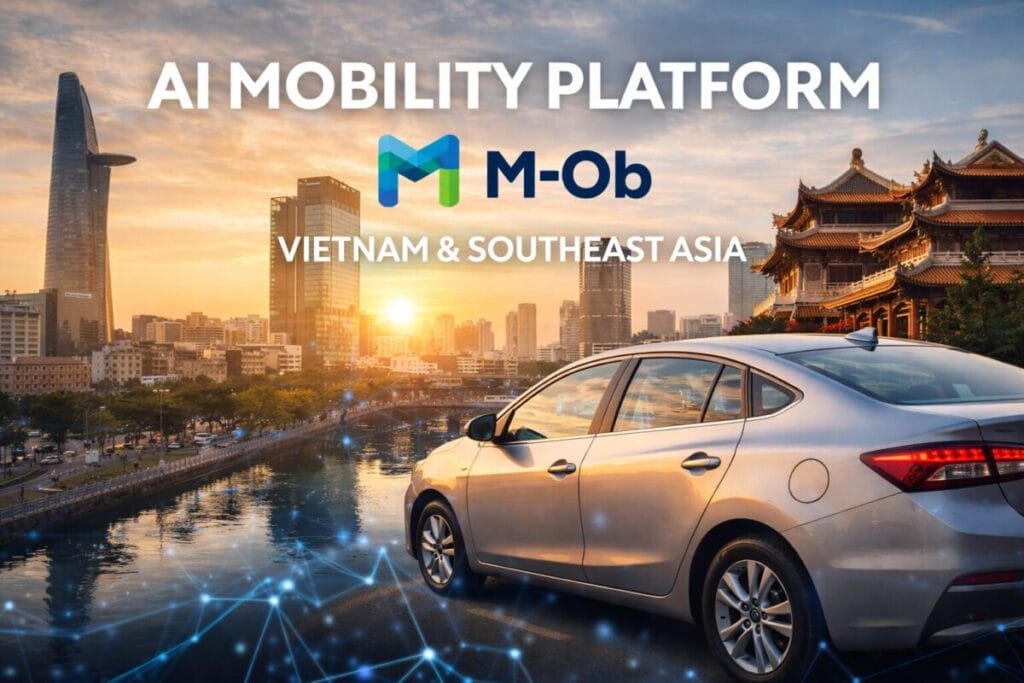
A new wave of innovation is reshaping how travelers move across Southeast Asia, with Vietnam emerging as a key testing ground. M-Ob, a travel technology startup originating from South Korea, is preparing to introduce an artificial intelligence–powered Global Distribution System for car rentals that could fundamentally change how ground transportation is booked and managed across the region.
As global travel rebounds and business mobility accelerates, the lack of a unified system for ground transportation has become increasingly evident. Flights and hotels operate through long-established global distribution networks, yet car rentals and local mobility services remain fragmented, especially in fast-growing tourism markets. M-Ob’s platform is designed to close this gap by digitally connecting car rental providers into a single intelligent ecosystem.
A Breakthrough for Ground Transportation
At the heart of M-Ob’s vision is the world’s first AI-driven global mobility platform dedicated to car rental services. By applying artificial intelligence to supplier connectivity, pricing, availability, and communication, the system aims to deliver the same efficiency and transparency travelers expect when booking flights or accommodation.
According to Ron, who leads the company’s Vietnam operations, transportation has long been the missing link in the digital travel journey. While travelers can easily compare flights and hotels in seconds, arranging reliable ground transport often requires navigating local platforms, language barriers, and inconsistent service standards. M-Ob’s technology seeks to unify these fragmented systems under one AI-powered interface.
Why Vietnam and Southeast Asia Matter
Vietnam and the broader Southeast Asia region represent some of the world’s fastest-growing travel markets. Rising inbound tourism, expanding business travel, and increasing domestic mobility have placed new pressure on transportation infrastructure. While demand is surging, digital integration within ground transport has struggled to keep pace.
By launching first in Vietnam, M-Ob is targeting a market where rapid tourism growth intersects with strong government support for digital transformation. The country’s expanding airports, industrial zones, and business hubs have made efficient local transportation a priority for both travelers and policymakers.
Solving Real Business Travel Pain Points
Business travelers in Southeast Asia often face tight schedules, unfamiliar road networks, and limited access to standardized rental services. M-Ob’s AI-powered system is designed to simplify these challenges by allowing travelers to reserve vehicles from verified local suppliers through a single platform.
For international executives and regional professionals, the platform offers predictability and flexibility—two factors critical for productivity. By automating supplier matching and optimizing availability in real time, the system reduces delays and improves reliability, particularly for multi-city or cross-border trips.
Supporting Smarter and More Sustainable Travel
Beyond convenience, M-Ob positions its technology as a tool for sustainable tourism development. A unified digital transportation system allows for better fleet utilization, reduced idle vehicles, and smarter route planning, all of which contribute to lower emissions and improved efficiency.
As Southeast Asia balances tourism growth with environmental responsibility, AI-enabled mobility solutions are increasingly viewed as part of the solution. Improved data visibility also helps local authorities and tourism planners better understand travel patterns, supporting infrastructure development that aligns with sustainability goals.
A First-Mover Advantage in a Fragmented Market
While the region’s transportation sector still faces challenges such as uneven digital adoption and varying regulatory environments, M-Ob views these obstacles as opportunities. The absence of a dominant global system for car rentals gives the company a chance to define industry standards rather than adapt to existing ones.
By focusing on AI-driven mobility commerce, M-Ob aims to become a foundational platform for ground transportation, much like global distribution systems did for air travel decades ago. Its strategy includes expanding supplier networks, integrating with travel management companies, and supporting both business and leisure travel segments.
Government Support and Long-Term Vision
Backed by strong support from South Korea’s innovation ecosystem, M-Ob is positioning itself for regional expansion beyond Vietnam. The company’s roadmap includes scaling across Southeast Asia before entering other high-growth travel markets.
Its long-term ambition is to lead the next generation of mobility commerce, where travelers can seamlessly book flights, accommodation, and ground transport within a single intelligent ecosystem.
Redefining the Future of Travel Mobility
As travel becomes increasingly digital, ground transportation is finally catching up with the rest of the tourism ecosystem. M-Ob’s AI-powered Global Distribution System represents a significant step toward closing one of the industry’s most persistent gaps.
For destinations across Southeast Asia, improved mobility means better visitor experiences, stronger business connectivity, and more sustainable tourism growth. For travelers, it promises a future where transportation is no longer a logistical challenge but an integrated part of a smooth, efficient journey.
With its launch in Vietnam, M-Ob is not just introducing new technology—it is redefining how travel mobility works in one of the world’s most dynamic tourism regions.
For more travel news like this, keep reading Global Travel Wire