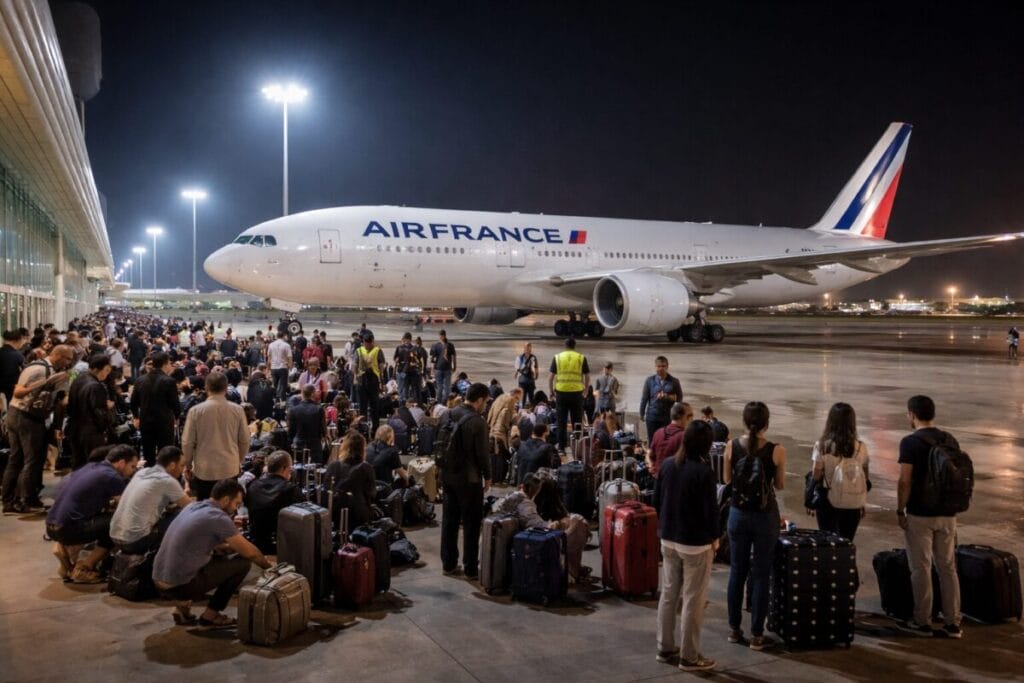
More than 250 passengers onboard an Air France flight from Bengaluru to Paris continue to wait in Ashgabat after the aircraft diverts for an emergency landing. What starts as a routine long-haul journey becomes a two-day travel ordeal with limited information and strict border controls shaping the experience.
Flight AF191 takes off nearly a day late from Bengaluru after a technical delay. The aircraft finally departs close to midnight, with passengers expecting an overnight flight to Charles de Gaulle Airport. However, four hours into the flight, the crew reports an engine fault as the plane crosses Turkmenistan airspace. The pilots divert to Ashgabat Airport for safety, initiating an unplanned stop in Central Asia.
The aircraft taxis to a remote bay under bright floodlights. Passengers disembark and enter the terminal without a clear timeline for departure. The wait begins.
Strict Entry Rules Add Complexity for Travelers
Turkmenistan has some of the strictest border and visa policies in the region. The country requires advance-approved visas supported by an official invitation letter. Transit visitors also need screening and documentation. Fees apply for both visa processing and health checks.
Upon arrival, passengers undergo mandatory COVID-19 testing. Credit cards are not accepted for health-screening payments, creating added stress for travelers unfamiliar with local norms. With no transit visas issued on the spot, travelers cannot exit the airport or explore the city. The terminal becomes the waiting room.
While Ashgabat is known for its marble architecture, monumental plazas, and planned boulevards, few foreign tourists gain spontaneous access due to the controlled tourism model. This makes the diversion even more restrictive for stranded passengers.
Replacement Aircraft Expected After Long Delay
Air France prepares to dispatch a replacement aircraft from Paris. However, flying a spare long-haul jet to Central Asia takes time. Crew duty regulations also require rest periods upon arrival. This pushes the expected departure for stranded passengers to the following afternoon.
By the time travelers prepare to reboard for Paris, more than 33 hours pass since the diversion. Many business travelers face missed meetings and rebooked schedules. Holidaymakers lose valuable trip time and may face hotel and tour re-arrangements upon arrival in Europe.
Communication Becomes a Key Passenger Frustration
Throughout the delay, passengers express frustration over limited communication. Airport staff coordinate movement within the terminal, but details about onward travel remain unclear for many hours. Airline support channels face delays as customer service teams handle rebooking and updates for family members waiting in Paris.
Travel anxiety rises as travelers navigate unfamiliar health screening rules, currency limitations, and visa barriers. For some, this becomes their first exposure to Central Asia’s controlled border infrastructure.
Impact on Tourism and Global Travel Patterns
This incident highlights the unpredictable nature of international travel. Global airline networks increasingly cross remote and politically controlled regions. Emergency diversions in countries with tight entry protocols complicate logistics for both carriers and passengers.
Business travelers on tight schedules may experience lost productivity. Tourists on fixed packages may lose sightseeing days or reservations. Flight insurance and delay compensation policies vary, adding another layer of complexity for passengers trying to recover expenses.
Central Asian airports handle emergency and technical diversions with professionalism, but limited tourism infrastructure and strict border rules can restrict mobility for foreign visitors. This stands in contrast to more open transit hubs where stranded passengers can leave terminals for hotels, tours, or meals.
What Passengers Can Expect Going Forward
Air France confirms the replacement aircraft is on its way and passengers will continue their journey as soon as crew regulations allow. Paris Charles de Gaulle Airport prepares to manage missed onward connections once travelers land in France. Some travelers may require overnight stays due to reduced evening flight schedules at European hubs.
Meanwhile, relatives tracking the situation express relief at the safe landing, despite the extended timeline. Safety remains the airline’s primary focus throughout the incident.
Travel Preparedness in an Era of Unpredictability
Travel experts note that long-haul passengers benefit from staying informed about transit visa requirements, alternative routing options, and airline duty regulations. Although events like engine failures are rare, airlines undergo regular mechanical inspections and adhere to strict international aviation protocols.
Carriers flying through Central Asia follow established safety corridors due to geopolitical constraints in neighboring regions. While diversions are uncommon, airports like Ashgabat remain critical emergency landing sites for wide-body aircraft.
Conclusion: A Challenging Detour for International Passengers
What begins as a standard overnight flight from India to France becomes a marathon stopover in an unexpected destination. Stranded for more than 33 hours, Air France passengers discover firsthand how border controls, technical aviation requirements, and communication gaps affect modern travel.
The situation serves as a reminder that even in an era of advanced aviation, travel remains vulnerable to unexpected disruptions. Passengers continue to wait calmly for their final departure, hoping their long journey soon returns to schedule.
For more travel news like this, keep reading Global Travel Wire