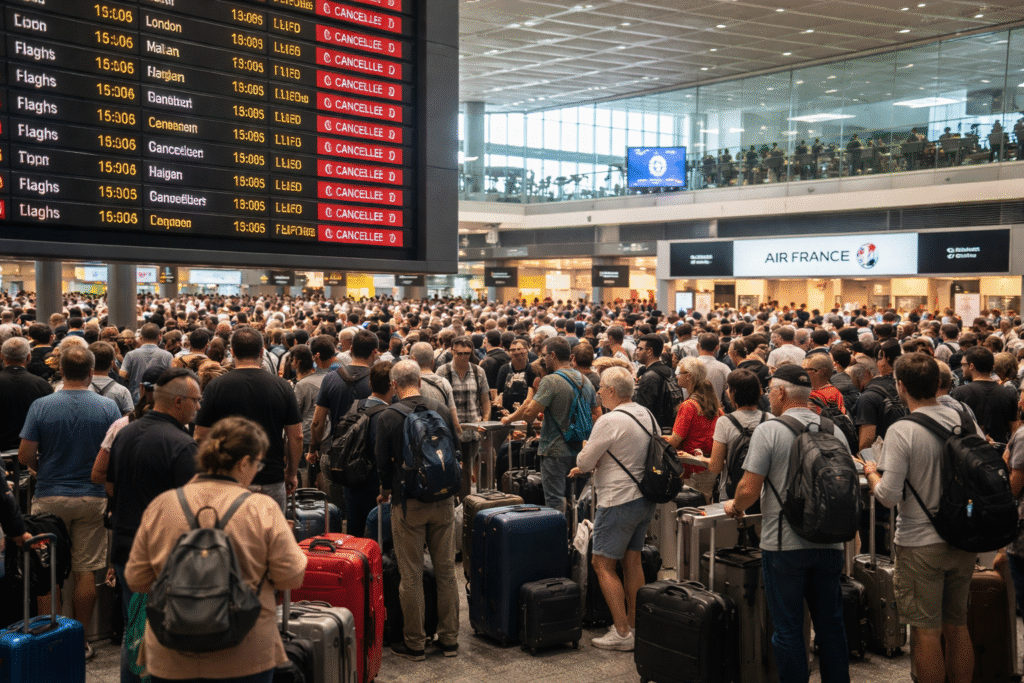
Air travel across Europe experienced heavy turbulence as Air France cancelled 167 flights and delayed nearly 380 others. Thousands of travelers found themselves stranded in major airports as the airline struggled to stabilize operations. The disruption affected both short-haul and long-haul routes, forcing passengers to navigate rebooking issues, missed connections, and overnight stays.
Crowded terminals, anxious tourists, and long waiting lines became common scenes in cities such as Stockholm, Milan, Geneva, Lisbon, and London. French hubs saw some of the most severe congestion, including Paris-Charles de Gaulle and Paris-Orly. The situation highlighted how operational challenges within one major carrier can create widespread ripple effects across the global travel system.
Tourism and Business Impact Across Key Destinations
The operational breakdown hit Europe’s tourism sector during a high-demand travel period. Popular holiday destinations such as Italy, Portugal, Switzerland, and Spain reported stuck tourists and delayed arrivals. Business travelers faced missed meetings and shifting itineraries, especially on routes connecting Paris with London, Amsterdam, Milan, and Barcelona.
Flights linking France to the United States, Canada, and the Middle East also experienced major delays. Travelers heading to New York, Miami, San Francisco, and Toronto reported extended wait times and unexpected re-routing. Connections on important trade routes to Dubai, Nairobi, and Beirut also experienced disruptions.
For tourism operators, the situation added financial stress. Hotels near major airports filled rapidly as stranded passengers sought last-minute accommodation. Transportation companies saw increased demand, while tour operators adjusted schedules for late arrivals.
European Airports Under Pressure
European airports struggled to absorb the passenger overflow. London and Stockholm saw long lines at customer service counters. Geneva and Milan faced packed boarding areas as airlines attempted to reorganize departure schedules. Lisbon and Barcelona received redirected travelers as part of contingency planning among partner carriers.
In France, airports experienced the heaviest congestion due to the volume of domestic and international connections. Paris-Charles de Gaulle handled stranded long-haul travelers overnight, while Paris-Orly dealt mostly with short and medium-haul rebookings. Airports in Toulouse, Nice, Marseille, Bordeaux, and Lyon also experienced delays due to network gridlock.
Airport authorities across Europe deployed additional staffing to help manage the disruptions, especially at passport control, baggage desks, and transportation hubs.
What Triggered the Disruptions
While airlines regularly deal with scheduling breakdowns, the scale of this event attracted attention. Air France cited operational challenges linked to aircraft rotations, technical checks, and crew scheduling complications. European aviation regulators have noted that growing seasonal demand has put pressure on carriers and airport service providers in recent quarters.
Transport analysts noted that airlines operating expansive networks are vulnerable to cascading delays. A missed rotation in Paris can affect aircraft availability hours later in other cities such as Amsterdam or Florence. When multiple routes experience delays, entire networks slow down in a domino effect.
Impact on Long-Haul Tourism and Global Travel
Long-haul travelers felt the disruption deeply. Delays on routes between Europe and North America affected tourism flows into major US destinations. Travel agencies reported an increase in itinerary changes among leisure travelers bound for Florida, California, and New England.
Middle Eastern tourism connectivity also slowed. Dubai and Beirut route delays created scheduling conflicts for passengers connecting onward to Asia and Africa. In Africa, Nairobi and Lome experienced late arrivals that pushed ground services into extended operating hours. Business travelers on these routes relied on rapid rescheduling as companies anticipated new meeting timelines.
Passenger Response and Airlines’ Recovery Efforts
Passengers expressed frustration about long waits and lack of clarity while trying to rebook flights. Rebooking queues in Paris stretched for hours, and customer service desks in London and Geneva reported intense pressure throughout the day.
Air France deployed additional staff to manage customer support and launched recovery flights to reduce backlog. The airline prioritized stranded long-haul travelers and families with young children. However, full normalization remained a challenge due to limited aircraft availability and scheduling constraints.
Travel advisors recommended that passengers traveling within Europe monitor airport departure boards frequently and allow additional time for connections.
European Travel Resilience Amid Disruption
Despite the setbacks, European tourism remains resilient. Government tourism boards in France, Italy, Portugal, and Spain emphasized that airports remain fully operational and that visitors continue to enjoy cultural, culinary, and sightseeing experiences across major cities and coastal destinations. Summer and autumn tourism demand continues to show strength, especially in Mediterranean regions.
Airlines across Europe have coordinated operational strategies to reduce future disruption. Industry experts highlight investment in fleet upgrades, staffing support, and digital communication tools as key to improving passenger experience.
Outlook for Travelers
Travelers can expect gradual normalization as Air France works through its backlog. However, analysts warn that seasonal demand spikes and tight aviation staffing could create periodic disruptions across the European network. Passengers planning multi-leg trips are encouraged to select longer layovers and monitor travel advisories before departure.
As the airline industry modernizes its infrastructure and adapts to rising global demand, travelers may continue to see occasional turbulence. Europe remains one of the most interconnected aviation regions in the world, making swift recovery vital for both tourism and business travel.
For more travel news like this, keep reading Global Travel Wire