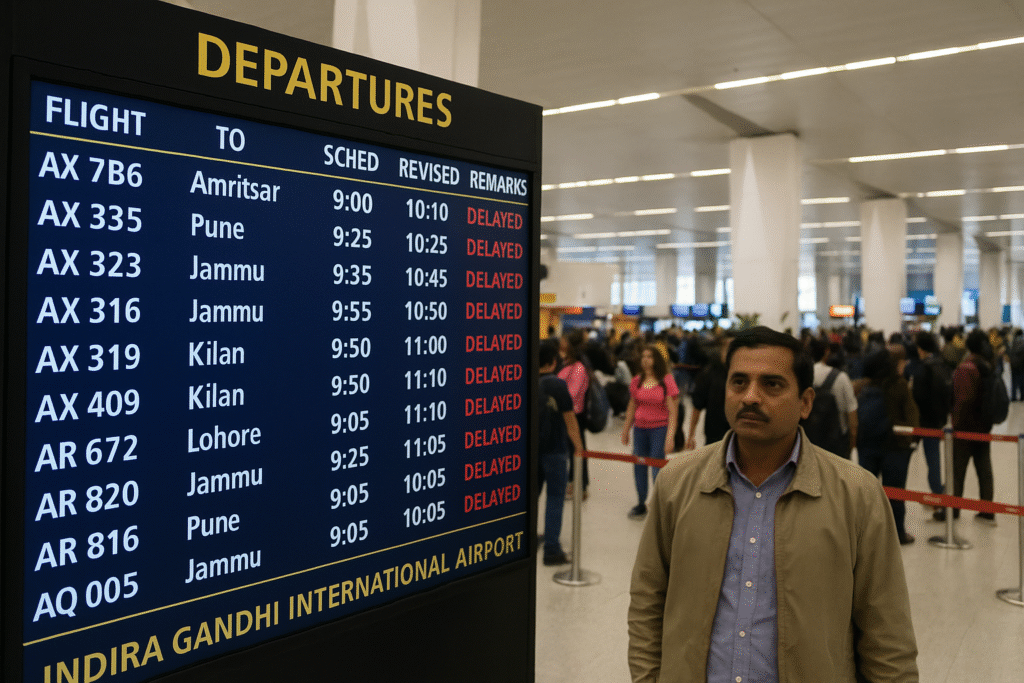
Travel chaos erupted at Indira Gandhi International Airport (IGIA) in Delhi after a serious software problem in its air-traffic control (ATC) system caused delays for more than 100 flights. The issue began late Thursday and intensified through Friday morning, affecting departures, arrivals and flights overflying Delhi airspace.
What Went Wrong With the ATC System
The disruption traces back to a failure in the Automatic Message Switching System (AMSS), a vital software that routes flight-plan data to ATC controllers. With AMSS malfunctioning, controllers had to handle flight-plan processing manually, slowing operations significantly. IGIA normally handles about 1,500 flights a day, but with the automated system down, every step took much longer.
Ripple Effects Across India’s Aviation Network
While the glitch originated at IGIA, its impact widened quickly. Aircraft scheduled to depart from Delhi were grounded, incoming flights were stacked up, and crews hit duty-time limits. The resulting backlog spread delays to other northern airports. Airlines such as IndiGo, Air India and SpiceJet reported extended delays of 45 to 60 minutes or more for many services.
Airlines and Airport Issued Passengers Advisories
In response to the disruption, IGIA’s operator and major airlines issued advisories urging travellers to check flight status before heading to the airport. Ground staff and cabin crews remained on high alert, assisting stranded passengers and managing the backlog. The Airports Authority of India (AAI) confirmed it was working with technical teams to restore full functionality of the AMSS.
Impact on Tourists and Travel Plans
The timing is particularly challenging, given the high volume of tourist and leisure travel in India at this time of year. Visitors who planned departures or arrivals via Delhi face uncertainty and extended wait times. Missed connections, rescheduled flights and longer airport stays may affect tourism flow, hotel bookings and onward travel plans.
What Travellers Should Do Right Now
- Check your flight status via the airline’s website or app before leaving home.
- Communicate with your airline if you are travelling via IGIA – they have the latest updates.
- Build in extra time for check-in, security and boarding – delays are running through the day.
- Avoid last-minute airport runs if possible – peak times see the longest queues until the system backlog eases.
Looking Ahead: When Will Things Normalize?
Technical teams are on site working to restore the automated processing system. While no firm timeline has been issued, authorities expect improvements as the day progresses and the AMSS recovers. Until full speed returns, flights will face slower clearances, manual processing and potential knock-on delays.
Why This Matters for Aviation Infrastructure
The incident highlights how even the busiest modern airport hinges on a few key software systems. When one fails, the ripple effects can hit the entire network. For IGIA—India’s busiest airport—the reliance on automation is critical. The challenge is now to clear the backlog, restore confidence and prevent a similar disruption in future.
For more travel news like this, keep reading Global Travel Wire