Spain has been gripped by shock and mourning after a deadly high-speed train collision in the southern region of Andalusia left at least forty passengers dead and many more injured. Investigators have revealed a crucial clue: a broken rail joint found on the section of track where the derailment occurred. The discovery has ignited a storm of questions surrounding safety standards on one of Europe’s most advanced rail networks and has triggered urgent calls for new protections across Spain’s transportation system.
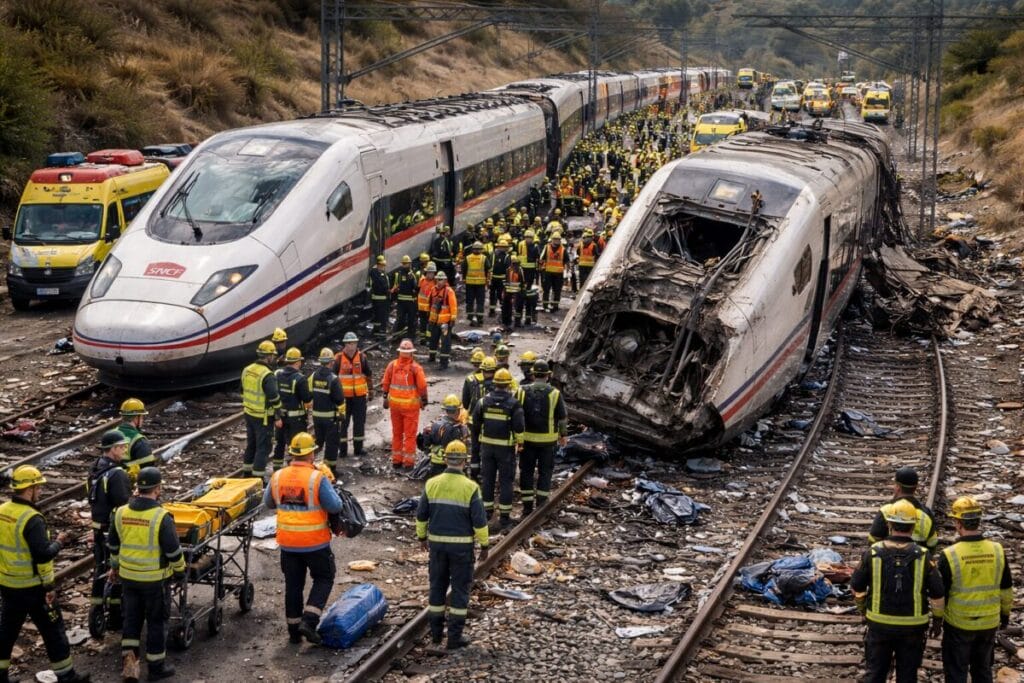
The crash happened near Adamuz, located in the province of Córdoba, a region well-known to both domestic and international tourists. Two high-speed trains, traveling in opposite directions, were involved in the tragedy. The first train derailed on a straight section of track—an area rail experts described as “low-risk”—before the second train collided directly with the wreckage. Scenes from the crash site showed emergency crews working through twisted metal and debris in a frantic rescue effort to locate survivors trapped inside carriages.
A Broken Rail Joint Becomes the Center of the Investigation
The battered rail joint—also called a fishplate—quickly became a central focus of the investigative team. Rail joints are engineered to connect lengths of track and withstand the immense pressure exerted by passing trains. Investigators now believe the joint suffered a sudden failure, potentially causing the initial derailment. A structural break could create a misalignment between track segments, something even the most advanced high-speed trains are not designed to absorb at full velocity.
The revelation that the failure occurred on a recently renovated stretch of track has intensified the urgency of the investigation. The line had undergone inspections and maintenance, and no immediate warnings had been raised. Officials described the event as “unusual and extraordinary,” noting that derailments on modern straight-line segments of high-speed track are exceedingly rare.
A Shock to a Nation That Relies on High-Speed Rail
Spain’s high-speed rail network, operated primarily by Renfe, has long been celebrated as one of Europe’s fastest and most reliable. It links major cities in a matter of hours, reducing reliance on domestic air travel and providing a vital service to both locals and tourists. Visitors from across Europe and beyond regularly use high-speed services to travel between Madrid, Seville, Barcelona, Valencia, Málaga, and other cultural or coastal destinations.
The deadly collision has shaken public confidence, particularly because the Spanish network has historically posted strong safety records. As Spain embraces a growing wave of inbound tourism, particularly in Andalusia’s cultural hubs like Córdoba and Seville, the rail system remains central to mobility. The tragic crash now threatens to cast a shadow over what has been one of Europe’s strongest rail success stories.
National Mourning and Emotional Aftermath
In response to the tragedy, Spain declared a national period of mourning. Flags were lowered, vigils were held in major cities, and messages of solidarity poured in from across Europe. The victims included Spanish nationals and foreign travelers, many of whom were moving between cities for work, tourism, or family visits. Emergency medical teams were deployed not only to hospitals but also to crisis centers tasked with supporting family members awaiting identification updates.
Government officials praised the rapid response of emergency workers, whose coordinated efforts prevented further loss of life. The crash site’s remote location and the scale of the wreck meant that rescue operations continued into the night, with helicopters, ambulances, and specialized rail teams working in tandem.
Tourism and Mobility Industry Faces Tough Questions
The crash also triggered a wider debate about Europe’s rail infrastructure as cross-border tourism continues to grow. High-speed rail has been heavily promoted as a sustainable travel alternative to short-haul flights, aligning with climate goals and increasing demand for eco-friendly transport options. Tourists traveling across Spain frequently rely on the network as a fast and scenic way to experience multiple cities in one trip.
With security and infrastructure now under scrutiny, travel planners, tourism boards, and operators will be watching developments closely. While experts emphasize that rail remains one of the safest modes of transportation in Europe, the incident highlights the complex engineering required to maintain high-speed corridors at scale.
Investigations, Audits and Possible Systemic Reforms
The Minister of Transport announced that the government would conduct an independent audit of the high-speed network, focusing on maintenance protocols, inspection intervals, and track renovation standards. Calls for more sophisticated monitoring technology—such as automated track surveillance, predictive analytics, and vibration sensors—are growing louder among safety specialists. Such innovations are already in use in other parts of Europe but have not been universally deployed across all high-speed corridors.
Industry observers believe the tragedy could accelerate safety reforms not only in Spain but throughout Europe, particularly as nations push to expand next-generation rail systems. Infrastructure officials expect upgraded inspection policies, more robust maintenance schedules, and renewed investment in smart rail diagnostics.
A Call for Recovery, Accountability and Future Safety
Although high-speed trains remain a pillar of modern European travel, the fatal collision underscores how even advanced rail systems must constantly evolve to ensure safety. The discovery of the broken rail joint has shifted the debate from speculation to engineering realities, and Spain’s transportation authorities have pledged transparency throughout the investigation.
As the nation continues to mourn, focus now turns to accountability, recovery and reform. Tourists, commuters and policymakers alike will be watching for answers and long-term solutions that can prevent a similar tragedy and reinforce Spain’s position as a leader in European rail travel.
For more travel news like this, keep reading Global Travel Wire